

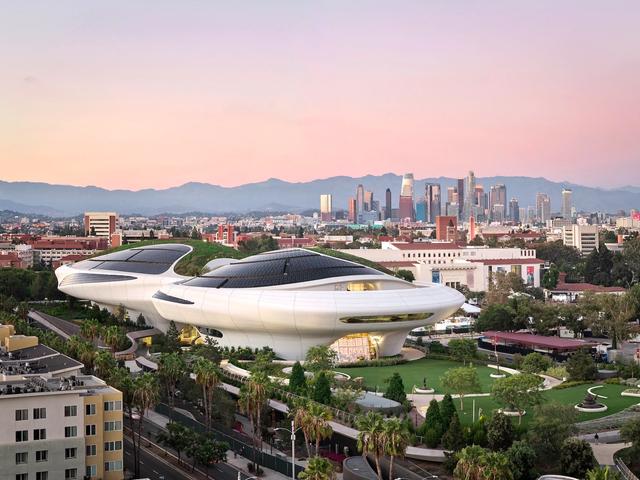
On the top floor of the new Lucas Museum of Narrative Art, which opened to the public last month, is a gallery some visitors might miss, partly because they have just explored the many galleries on the second floor below, and partly because they have to find just the right elevator to get there. This gallery is devoted to murals, not a typical category for an art museum but fitting for a city amply dotted with murals.
Perhaps more unexpected is the gallery’s prevalence of art that is overtly political in ways the rest of the museum largely skirts. Take the huge reproduction of Diego Rivera’s 1933 magnum opus for Rockefeller Center in New York to the right as you enter, very pro-worker and somewhat anti-capitalist—so much so that Nelson Rockefeller had it demolished and Rivera subsequently created a smaller version in Mexico City, on which this reproduction is based.
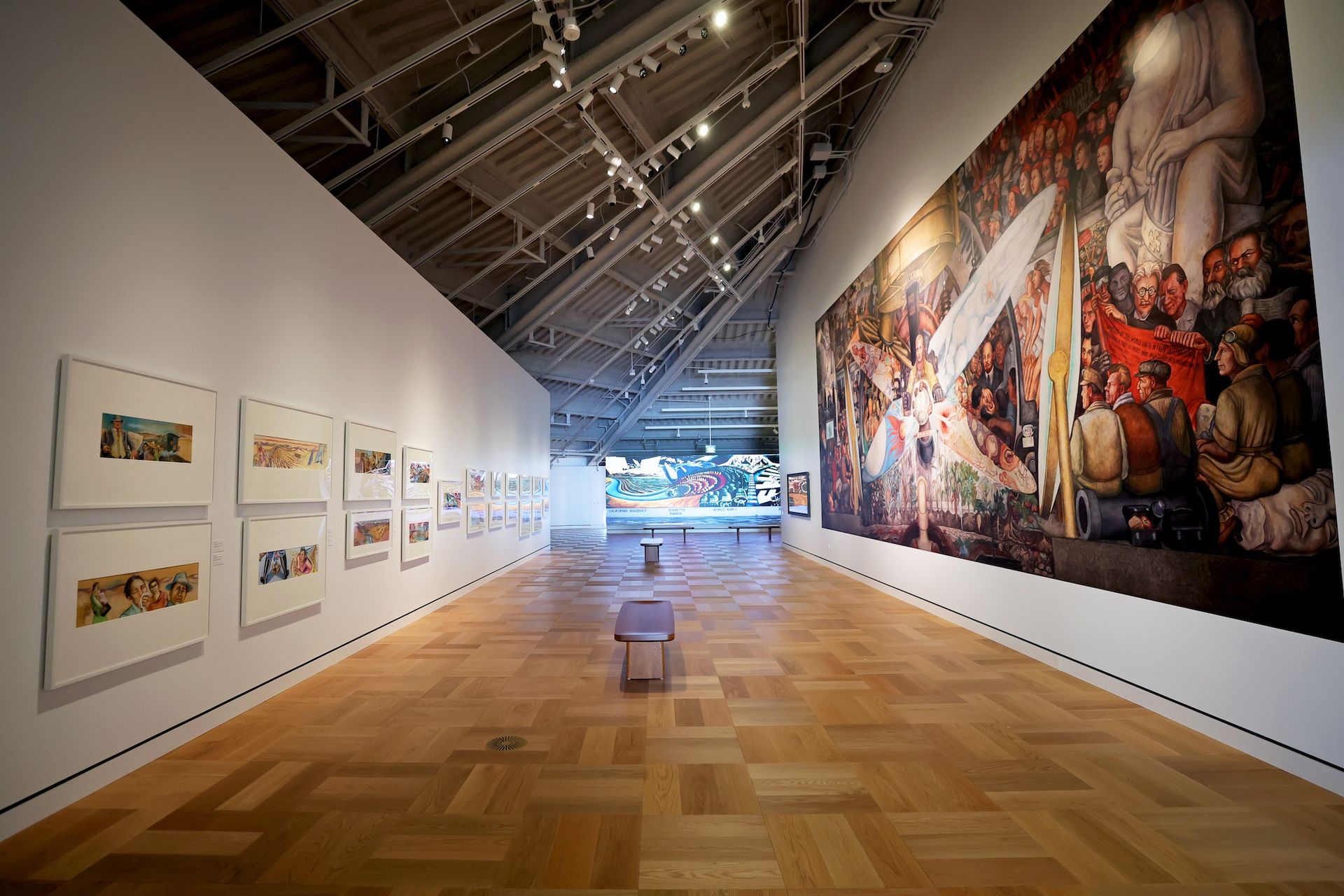
A view of the Lucas Museum of Narrative Art's murals gallery, with a reproduction of a Diego Rivera mural (right) and sketches for Judy Baca's The Great Wall of Los Angeles murals (left) Photo by Stefanie Keenan/Getty Images for Lucas Museum of Narrative Art
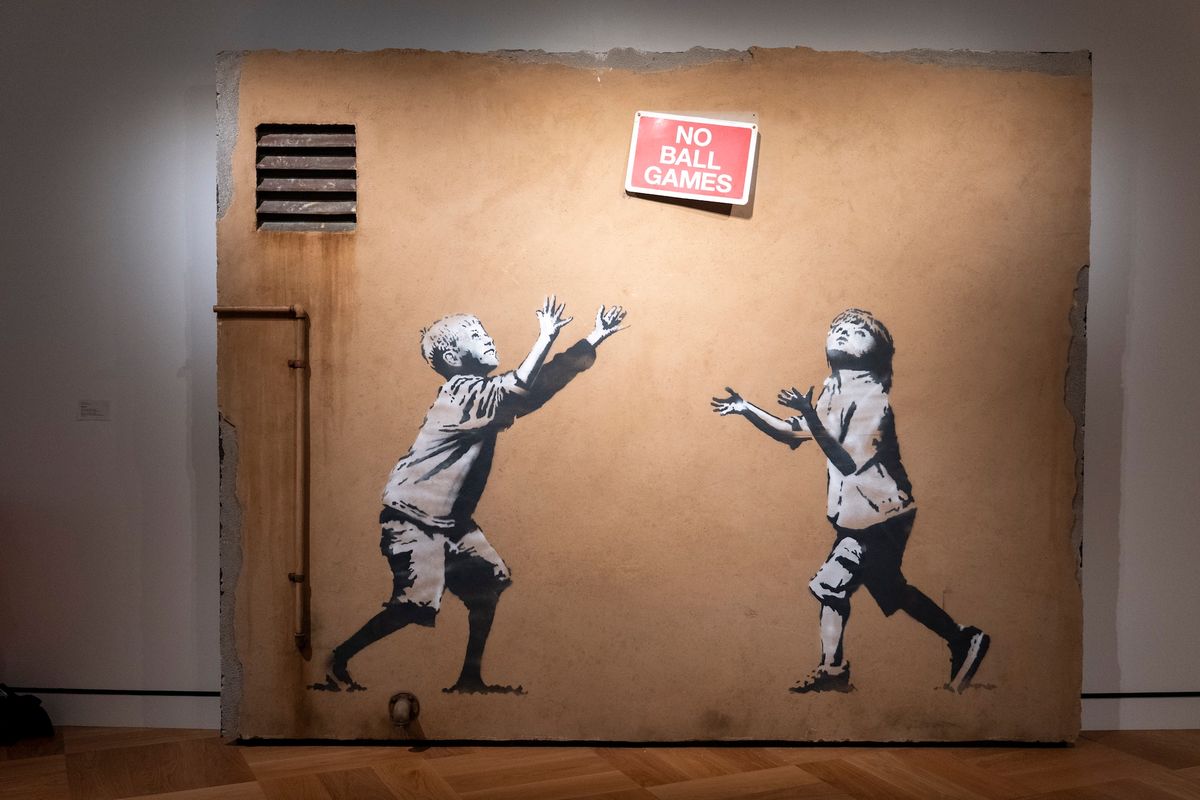
In the adjoining gallery are 12 works by the British street art prankster Banksy. The fact that these works—some reproduced in Banksy’s studio and two on loan—are in an institutional setting at all is unusual, as the anonymous artist has generally avoided museum shows. Information about his contributions to the museum was so closely guarded that most museum staff did not know what would fill these spaces until the media preview.
Though Banksy has long worked anonymously, speculation about his identity has been widespread for decades—earlier this year, an extensive Reuters investigation that identified him as Robin Gunningham, a conclusion reached by some previous investigations. In an interview with The Art Newspaper, the Lucas Museum’s chief executive Tracey Bates could not explain how Banksy’s works got to the institution.
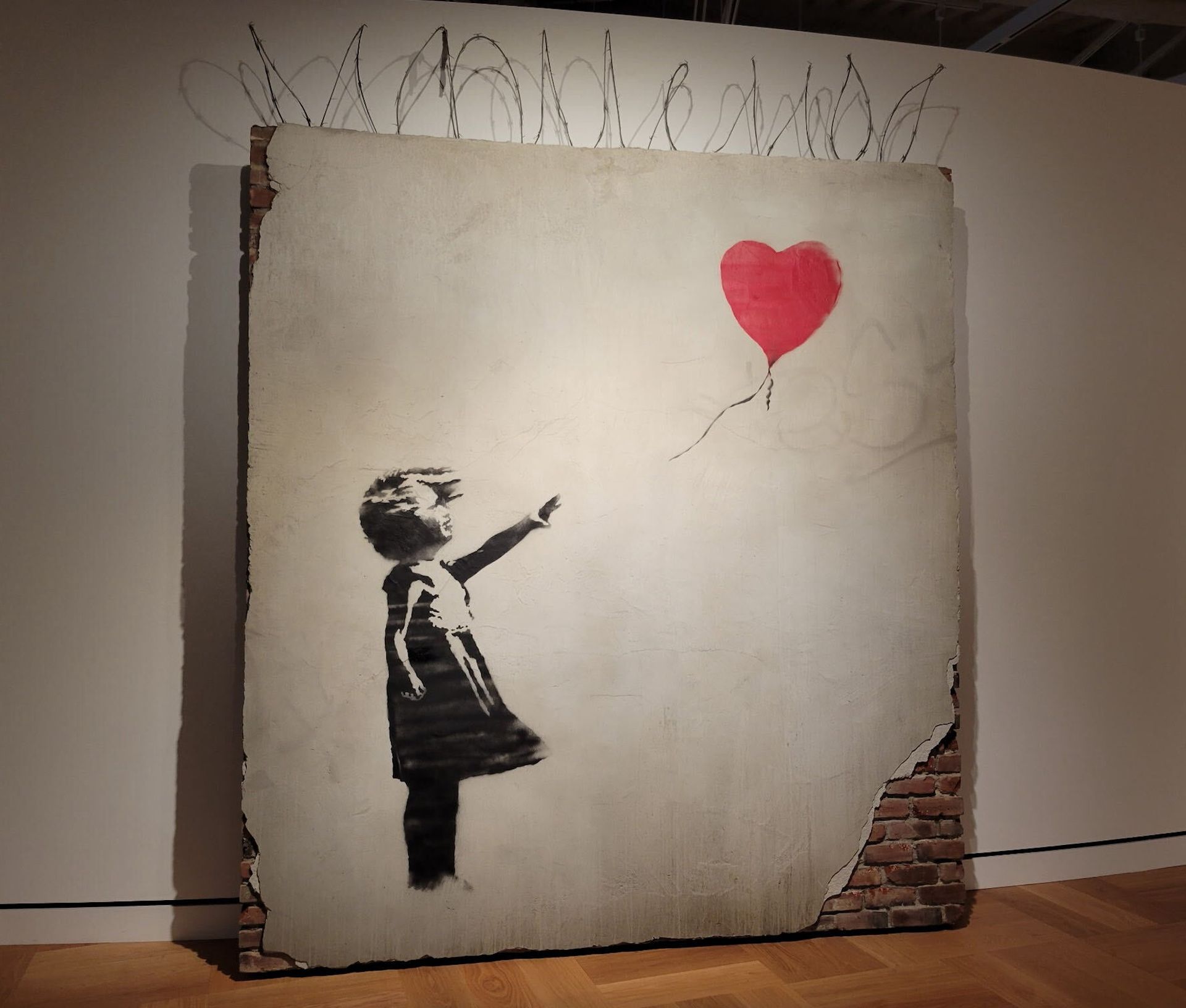
A mural featuring one of Banksy's most famous images, on the fifth floor of the Lucas Museum of Narrative Art Photo © Scarlet Cheng
“He’s an incredible living artist of our time, but an incredibly elusive artist,” she says. “I would say that George has always been a huge advocate for muralists all around the world, and he’s always been a big fan of Banksy. So it’s been a real meeting of minds with the two of them.” (A recent Wall Street Journal profile revealed that Banksy’s work played a central role in Lucas’s courtship of the executive Mellody Hobson, to whom he is now married and with whom he co-founded the museum.)
Banksy’s works at the Lucas Museum are accompanied by simple labels that provide little to no context, as is true throughout most of the institution. The most recognisable mural is Girl with Balloon, an image stencilled onto walls in different parts of London starting in 2002. It depicts a young girl with windblown hair as she reaches out to a red balloon that is floating away. It is painted on what looks like a thick chunk of wall, as if it had been jackhammered from its original urban location. Another that may be familiar is the maquette for the sculpture Flag Man, which appeared at Waterloo Place in London earlier this year—a suited man blithely marching forward, holding up a huge flag in one hand as its drapery blows back across his face.
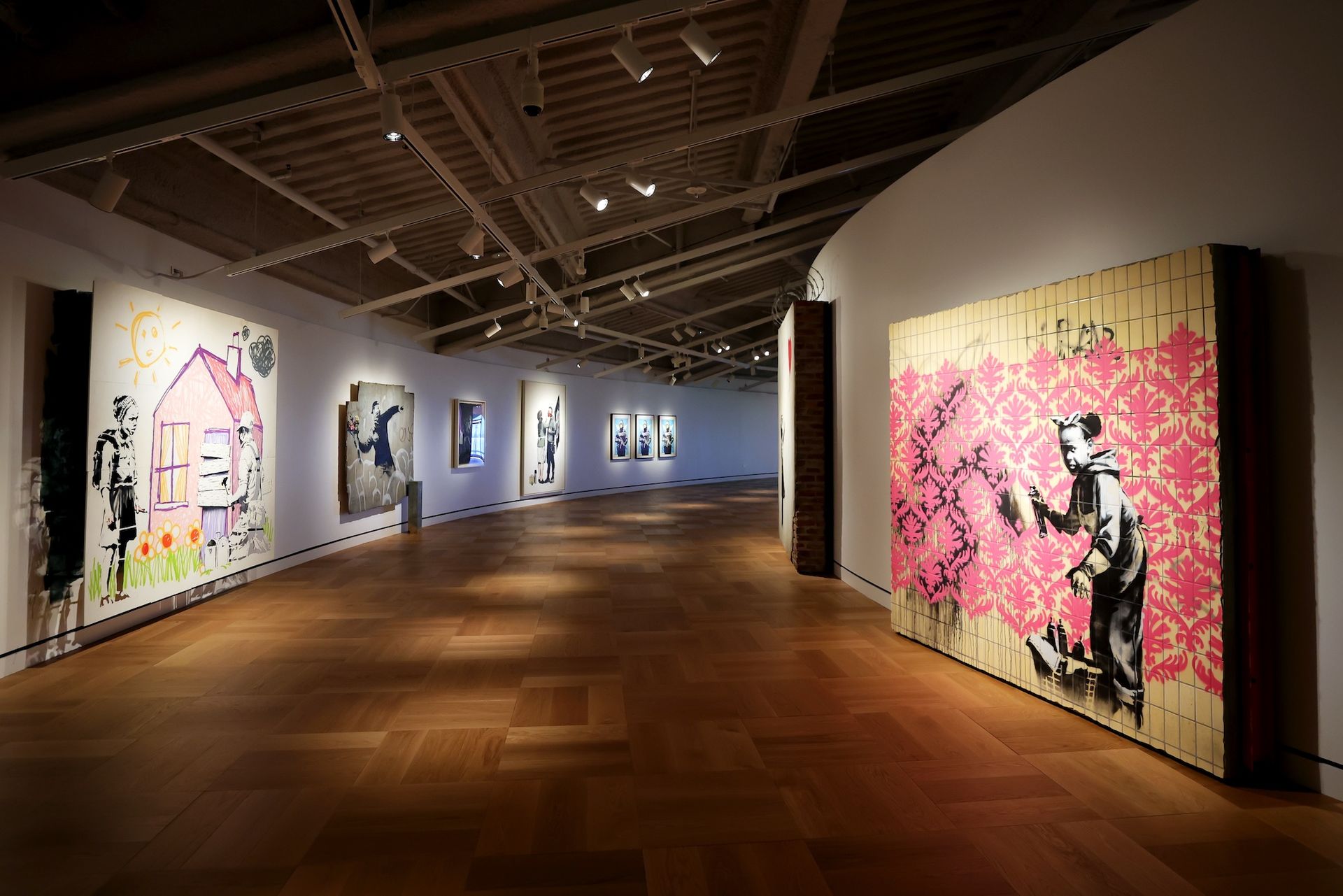
Several Banksy murals on the fifth floor of the Lucas Museum of Narrative Art Photo by Stefanie Keenan/Getty Images for Lucas Museum of Narrative Art
There is also a Banksy installation on the museum’s second floor, providing a bit of black humour. It features a pair of lion sculptures on pedestals, like those you might find flanking a Beaux-Arts building. Except on closer look, the one on the left is holding a whip in its jaw, and its muzzle is bloodied. The only other sign of the lion tamer is on the floor—a black top hat laying on its side. The wall label reads: Pair of ornamental garden Lions with added parts, 2026.
Wall-sized stories
The fifth-floor gallery, with its 25ft-high ceilings, is ideal for showing off murals, though there are also plenty of preparatory renderings and sketches on view. “We have a lot of mural studies in the collection,” says the museum’s senior curator, Ryan Linkof. Also on display are drawings and paintings by John Biggers, Dean Cornwell and Charles White.
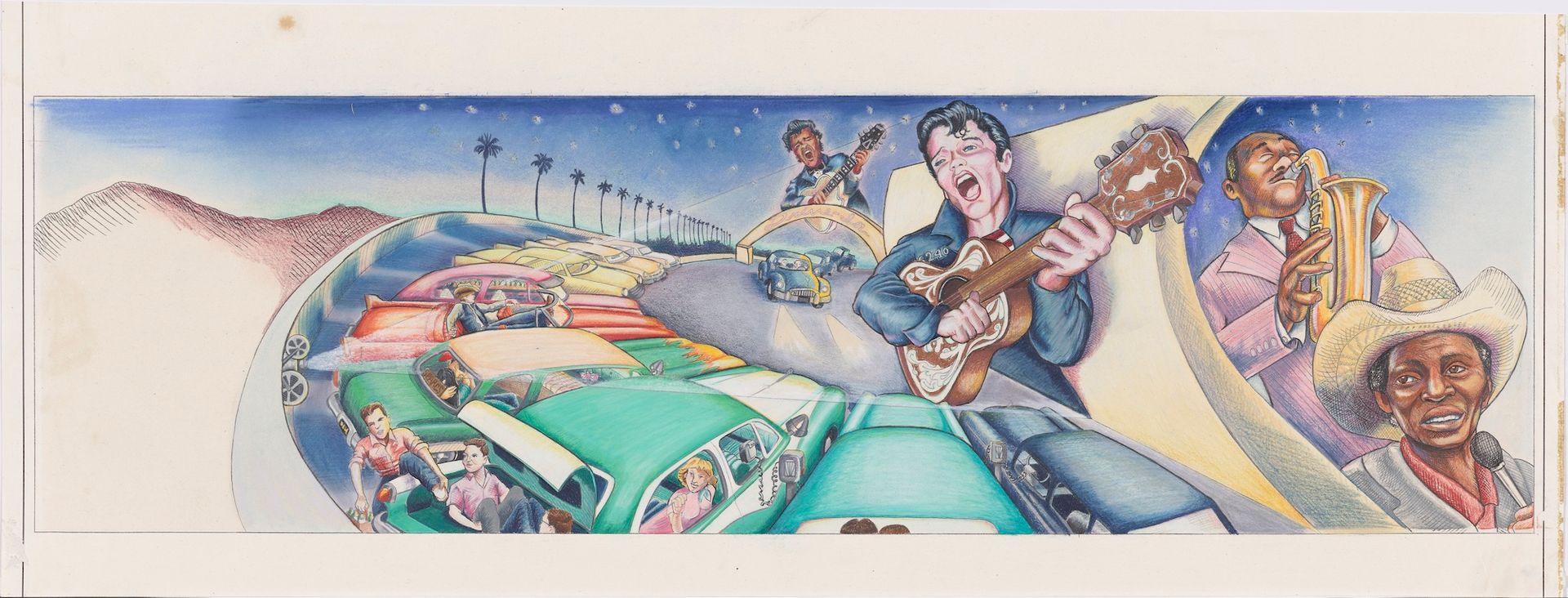
Judith F. Baca, final coloration for The Birth of Rock and Roll, from The Great Wall of Los Angeles 1950, mural in Los Angeles, California, 1983 Lucas Museum of Narrative Art, Los Angeles, 2018.34.6.5.20. © 1980 Judith F. Baca.
Facing the Rivera mural are colour preparatory drawings for the epic, The Great Wall of Los Angeles (1974-present), a people’s history of Los Angeles rendered on walls flanking the Tujunga Wash in the San Fernando Valley. Conceived by Judy Baca, the project was begun in 1974 and executed during the summers by students and community members. Baca “envisioned a long narrative of another history of California, one which included ethnic peoples, women and minorities who were so invisible in conventional textbook accounts”, the artist writes on the project’s website. (In 2021 the Mellon Foundation awarded a $5m grant to Baca and her team to extend the mural and the history from the 1960s to 2019—work that is due to be completed in 2028, in time for the summer Olympic Games.)
Murals were always going to figure prominently in the museum’s collection and galleries, Linkof says. “Illustration is important to us, both in terms of a professional category of people who are illustrators, but also this idea of illustrating stories,” he says. “Murals are fundamentally a form of illustration, and they often tell histories in a very specific way—social concerns expressed in really clear, didactic ways because they’re meant for broad public consumption.”