

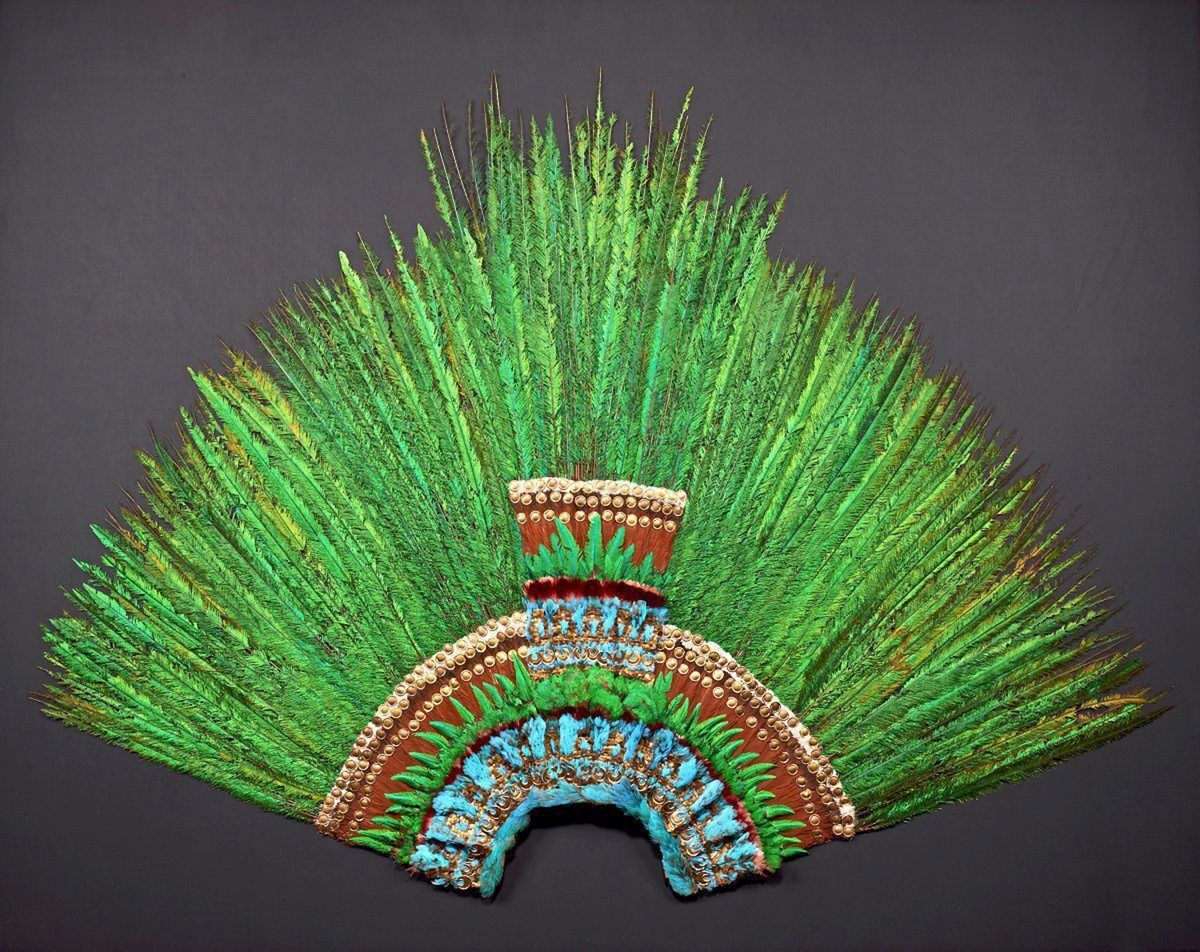
For decades, Mexico has unsuccessfully sought the return of Moctezuma’s 16th-century feather headdress, currently housed at the Weltmuseum in Vienna. Now an Austrian presidential hopeful, the economist Gunther Fehlinger-Jahn, has pledged to return the headdress to Mexico if he is elected in 2028. The contested Aztec object is back in the spotlight in what may be its first inclusion in an Austrian politician’s broader repatriation agenda.
“Austria and Mexico should negotiate a bilateral solution based on friendship rather than confrontation,” Fehlinger-Jahn, whose independent candidacy remains unconfirmed, tells The Art Newspaper. “The original penacho should ultimately belong to Mexico.”
The only known surviving example of its kind, the headdress shows the Indigenous mastery of featherwork. The heavily modified 1.3m-high, 1.75m-wide quetzalapanecayotl (Quetzal headdress) originally featured four zones of emerald-green, red, brown and blue feathers, along with gold ornaments.
How exactly the headdress arrived in Europe remains uncertain. One theory suggests that Moctezuma, the last Aztec ruler, gave it to the Spanish conquistador Hernán Cortés; it may have been included among objects that Cortés sent to Charles V. Yet experts largely agree that Moctezuma never wore it. “The headdress’s origin is uncertain, and its association with Moctezuma came much later,” the Mexican historian Federico Navarrete tells The Art Newspaper.
The headdress’s first documented European reference dates to 1596, in the inventory of Ambras Castle in Innsbruck, where it was described as “a Moorish hat” (a generic term describing exotic objects). Rediscovered in disrepair in the 19th century, it was identified as Indigenous Mexican and restored. In 1888, it went on view at Vienna’s Natural History Museum and later entered what is now the Weltmuseum, which holds numerous objects from former European colonies.
Restitution efforts began in the 1860s, when Mexico’s Habsburg emperor Maximilian requested its return. “The headdress was a symbol of power which Maximilian would embody, showing historic continuity,” says Miruna Achim, a researcher at Universidad Autónoma Metropolitana-Cuajimalpa in Mexico City.
Efforts continued from the 1980s. “The headdress is the most symbolic artifact that Mexico has been trying to repatriate for decades,” says Pierre Losson, the author of the book The Return of Cultural Heritage to Latin America (2022). He adds that, like the Benin Bronzes and the Parthenon Marbles, Moctezuma’s headdress keeps resurfacing in repatriation debates.
In 2020, Beatriz Gutiérrez Müller, the wife of then-Mexican president Andrés Manuel López Obrador, travelled to Austria to request the headdress’s loan for a 2021 exhibition marking 500 years since Tenochtitlán's fall. Mexico offered Habsburg-era objects in exchange, including Maximilian and Carlota's gilded carriage. Austria denied the request, causing diplomatic tensions.
Austria cites the headdress's fragility as the reason for rejecting its loan. A 2010-12 joint study between Mexico and Austria deemed it too fragile to transport, as vibrations could destroy it. Yet some experts dispute this assessment. Activists, including the Mexican dancer Xokonoschtletl Gómora, continue to advocate for the headdress’s return.
“If transport remains unsafe,” Fehlinger-Jahn says, “ownership could be transferred while experts establish a joint conservation and stewardship arrangement until it becomes possible.” But his overall approach has been very unusual.
“Governments are increasingly dealing with repatriation, but it is rare for someone to take this position in an election context,” Losson says. “Even if elected, an Austrian president cannot decide unilaterally on restitution.” In Austria, new legislation enabling the restitution of colonial-era objects remains pending.
The situation surrounding Moctezuma’s headdress reflects a larger global debate. “This pledge is part of a wider repatriation wave, in which the role of museums as custodians of universal art is being questioned,” Achim says. Staring with López Obrador’s administration, Mexico has prioritised returning pre-Hispanic heritage, which is closely tied to its national identity. In July, president Claudia Sheinbaum’s administration announced that it had recovered a total of 3,716 cultural objects.