

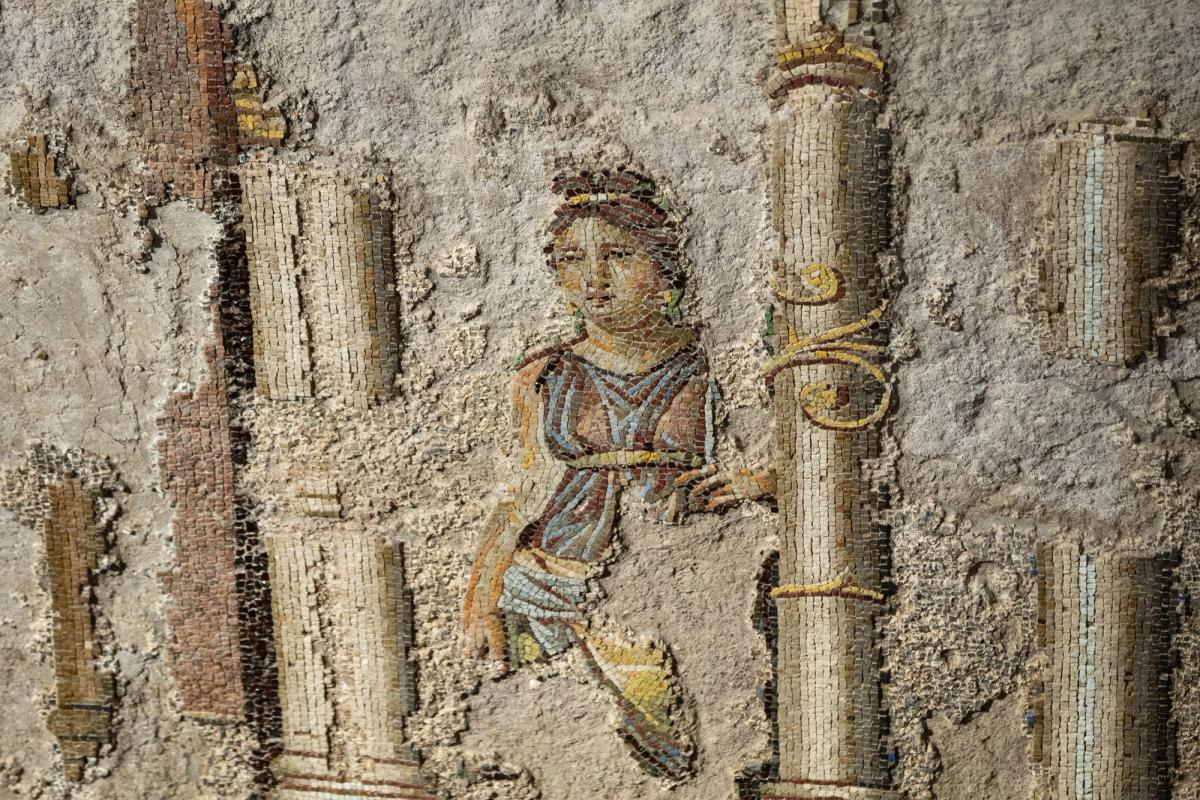
A vast mosaic uncovered in Rome, the largest ever discovered in the Roman world, has opened to the public for the first time. The mosaic and an accompanying fresco were discovered during excavations in the 1990s in an underground gallery beneath the Baths of Trajan, an expansive imperial leisure complex comprising libraries and bathing pools.
The works, known as the “Painted City” fresco and the “Muse and the Philosopher” mosaic, have opened to the public during weekends, initially for groups of 15. The first visitors saw the site last weekend (12 and 13 September); from 2 October, the viewings will run from Friday to Sunday. The opening times were confirmed by the mayor of Rome, Roberto Gualtieri, in an Instagram post.
According to CNN, archaeologist Francesco Pacetti said at the unveiling of the site earlier this month: “We estimate that it is the biggest wall mosaic ever found in the Roman World and we are still digging to find out where it stops.” The fresco and mosaic are thought to date from the first century.
The fresco features images of a walled port city, with defensive walls and towers, viewed from above. The mosaic, which is ten metres high and stretches along 16 metres of a wall beneath the Oppian Hill near the Colosseum, features figures and architectural structures over four different levels.
“It’s an extraordinary fresco, a real city seen from above, with its walls, towers and buildings depicted in perspective,” Gualtieri wrote on Instagram. “It’s even more incredible to think that it was done almost two thousand years ago, in the Neronian [54-68AD] or Flavia era [69-96AD], even before the Baths of Trajan [inaugurated 109AD].”
Gualtieri adds: “There is another masterpiece: the mosaic of the 'Muse and the Philosopher', that formed part of the decoration of a large hall overlooking the nymphaeum. On the walls, the mosaics depict a grand theatrical scene, featuring statues and real-life figures… Rome continues to surprise us. Every dig adds a piece to our city’s extraordinary history.”
An on-site museum focused on the Baths of Trajan opened earlier this month; the restoration of the new museum complex was carried out as part of the PNRR-Caput Mundi programme, a €500m project funded by the European Union.