

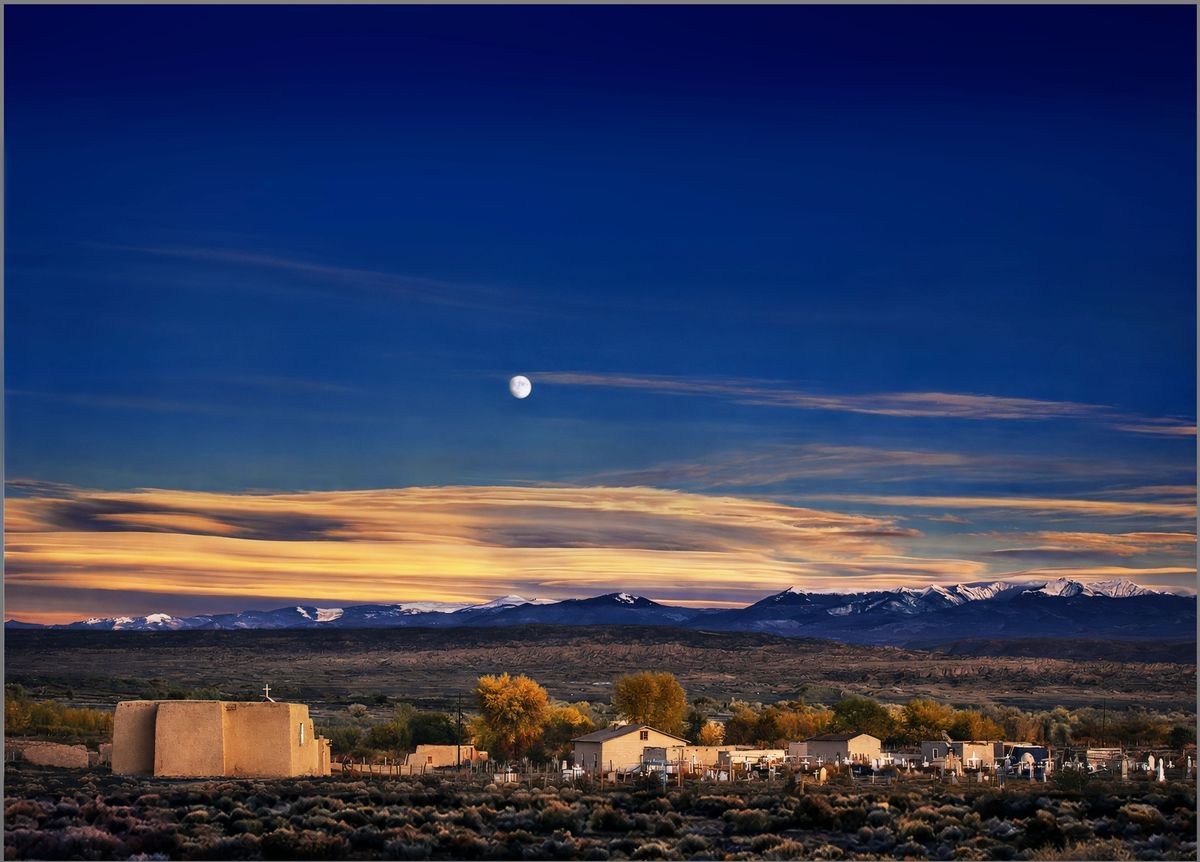

The Photography Show, the most respected photography fair in North America, is not usually the site of scandals. During the fair’s most recent edition in April, James Danziger, a participating gallerist, presented a “colourised” version of a well-known black-and-white image by Ansel Adams, Moonrise, Hernandez, New Mexico (1941), generated using artificial intelligence (AI). Adams continues to be a marquee artist for many collectors and the Ansel Adams Publishing Rights Trust manages his legacy. Editions of his images, including Moonrise, sell for prices that can reach into the six-figure range. At the Association of International Photography Art Dealers (Aipad) fair, Danziger was selling editions of his image for prices ranging from $6,000 to $10,000.
Artists, gallerists and Adams’s trust are up in arms about what has been so far framed as an egregious breach of conduct in the world of photography. Danziger, for his part, has argued that Moonrise is in the public domain and therefore he was within his rights to do with it as he wished. There is, however, some disagreement as to what his actual infraction is: the use of AI, the alteration of an iconic image, the sale of an appropriative work without the authorisation of the original artist’s representatives. The answer is not straightforward.
First, there has not been a wholesale rejection of AI in the photography market. Like several other artists, I have exhibited AI-generated photography at past editions of the Aipad fair. To reduce the uproar over Danziger’s version of Adams’s Moonrise to a debate about the technology’s use in photography today would be inaccurate.
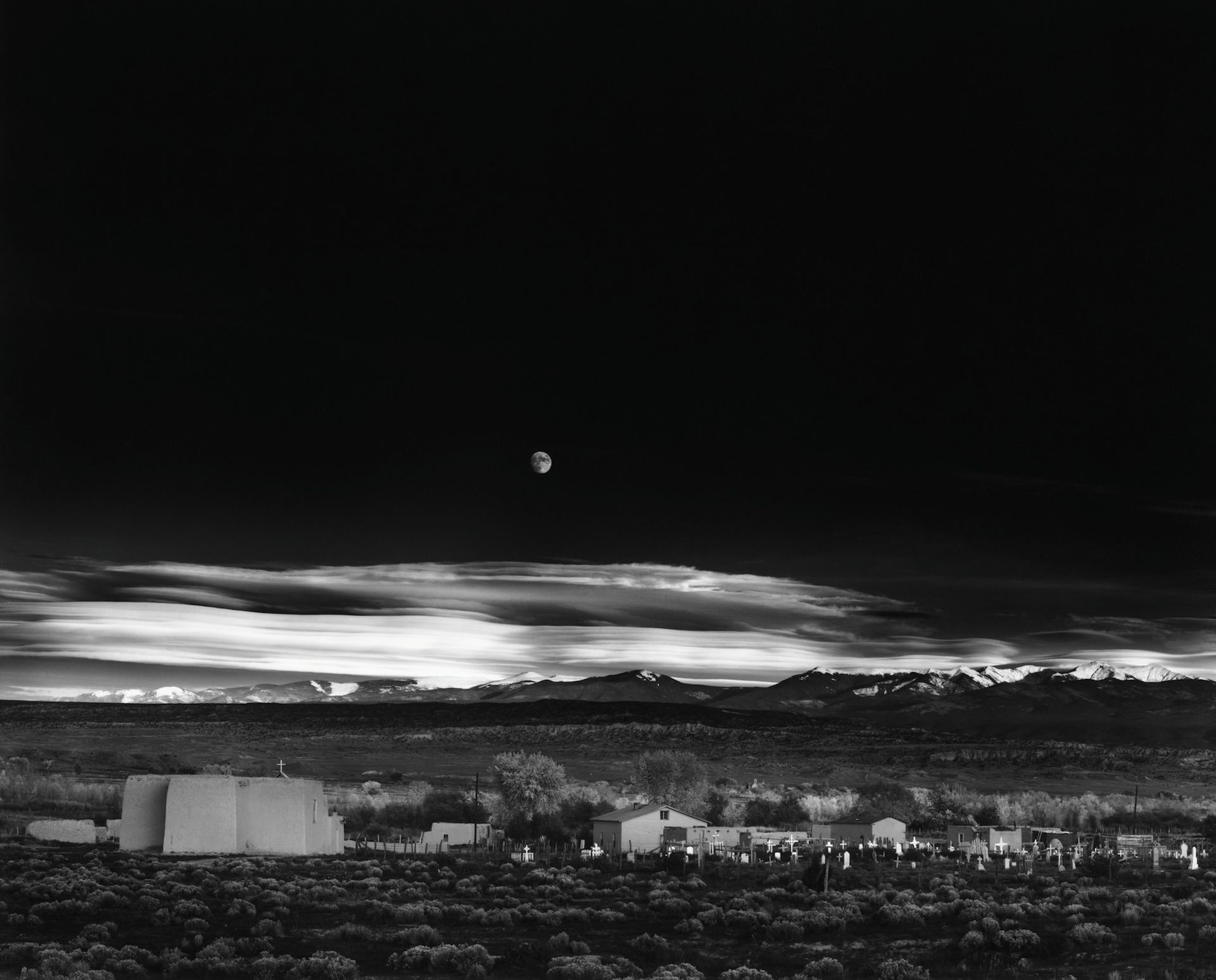
Ansel Adams’s Moonrise, Hernandez, New Mexico (1941)
Courtesy the Ansel Adams Publishing Rights Trust
Considering that the current political and technological systems in the US have created permissions structures to do away with established codes of conduct, an incursion like Danziger’s was perhaps inevitable. The Adams trust, in a public statement about the colourised image, noted that it was not notified of the image prior to the fair, and that this may be part of a commercial venture by Danziger to colourise and sell other artists’ works as well. As a business model, this would be in poor form, but if he chooses to “colourise” other black-and-white images that are in the public domain, his actions would not, strictly speaking, be illegal.
In his response to the uproar, Danziger framed his inspiration for creating the colourised photograph as being “based on [his] love of the iconic image, [his] interest in seeing how AI could be used as a tool for creativity and to create an imagining of what Adams saw in real life as he was driving along the US Highway 84 that made him stop his Pontiac station wagon and scramble to set up his bulky 8x10 view camera as the sun was setting on the adobe church and cemetery crosses while the moon appeared through the clouds”.
AI is certainly capable of generating a scene in which this photograph could have been taken, including imagining an outcropping on a hillside, or an empty patch of land on the side of a road, ideal for placing Adams’s gigantic camera setup. The clouds could have been preserved, the shape of the rocks and structures in the distance could have remained identical, and the AI-generated image could have offered a wider view of the same scene to indicate that this is indeed the location from which Adams took his photograph. The lens, which on an 8x10 camera would have likely been a 300mm, could have been swapped out for a 35mm lens presumably attached to a hand-held camera, to indicate that this is in fact a photograph of the site rather than the exact same image.


Considering the possibilities of AI today, colourising Adams’s landscape photo was surprisingly unimaginative and restrained, and the lack of additional creative choices warrants discussion. In a recent interview with Dear Dave Magazine, Danziger cited Baz Luhrmann’s film Romeo+Juliet (1996) as an example of transformative reinterpretation, and the comparison is generous enough to make one wonder if we are all looking at the same photograph.
Rather than Luhrmann’s masterpiece, I was reminded of the AI-generated image by the Dutch artist Bas Uterwijk, better known as Ganbrood, based on Steve McCurry’s famous portrait Afghan Girl (1984). titled The Second Gaze (2025) and presented during Paris Photo in 2025. Ganbrood had used the technology to have the image’s iconic figure face away from the camera, rejecting the photographer and the audience, generating a meaningful twist on a classic photograph and a welcome expansion of the conversations around post-colonialist and Orientalist photography practices of the 20th century. It remains one of the best uses of AI I have seen in photography in recent memory, both technically and conceptually.

Ganbrood, The Second Gaze, 2025 Courtesy of the artist and Heft Gallery
Danziger’s photograph, meanwhile, muddled the public discourse around copyright and ownership, fuelled the already raging fires of anti-AI sentiment and may also serve as inspiration for opening up the photographic canon to a new kind of predatory commodification. The ultimate issue with it, however, is not the use of AI. After all, it is possible to colourise any black-and-white image without the use of AI, as people have done for more than a century. The issues here are profoundly and irrevocably human.
Using AI to generate a colourised image of the context in which Adams took the photo indeed could have turned this from a surface-level creative exercise to meaningful expansion of the original and a thoughtful homage to a beloved artist. To distort a black-and-white image after the artist made the conscious choice to make it in black and white, no matter who owns the copyright, is perhaps most upsetting because it is so unimaginative—banal in its blasphemy.
In his response to the outcry generated by his image, Danziger brought up the legal research that accompanied the creation of the photo and noted that the work was “a transformative colour rendition”, adding that “while AI served as the starting point, the final image involved extensive human intervention, editing, proofing and refinement over many months”. In a hypothetical copyright lawsuit, these are the tenets a legal defense of the image would be measured against, but satisfying them in a court of law does not automatically convert to winning in the court of public opinion. More importantly, citing human intervention in an AI-colourisation process is a painfully cursory way to insist on originality or authorship, when so many of the core traits of the original image remain intact.
But again, where a work in the public domain is concerned, anyone could create unaltered or altered copies and sell them for any price they like. Part of the system of checks and balances in a market as unregulated as the art world’s must come from the buyer side. This entire episode makes clear that the tools at our disposal have made it much easier for people with capitalist intent to strip artworks of their integrity. Preserving that is now a communal charge, one that goes beyond moralising attitudes about AI and may require an update to the social contract.