

Around the age of 13, Edward Hopper converted the attic of the Nyack family home into a makeshift painting studio and private haven. Here he put into action his dream of becoming a painter. Though he had attempted some watercolours in the early 1890s, Hopper now began painting in oils, demonstrating a newfound artistic seriousness.
The first oil that Hopper painted was probably Rowboat in Rocky Cove, a quaint image of a placid stretch of water replete with distant ships, signed and dated 1895. He produced at least five more finished oils before enrolling in art school, all left in the attic, remaining unseen for decades. When they were eventually discovered and exhibited after the artist’s death, they were heralded as his first original compositions in oil. But the truth of their origins revises the accepted story of Hopper’s artistic development.
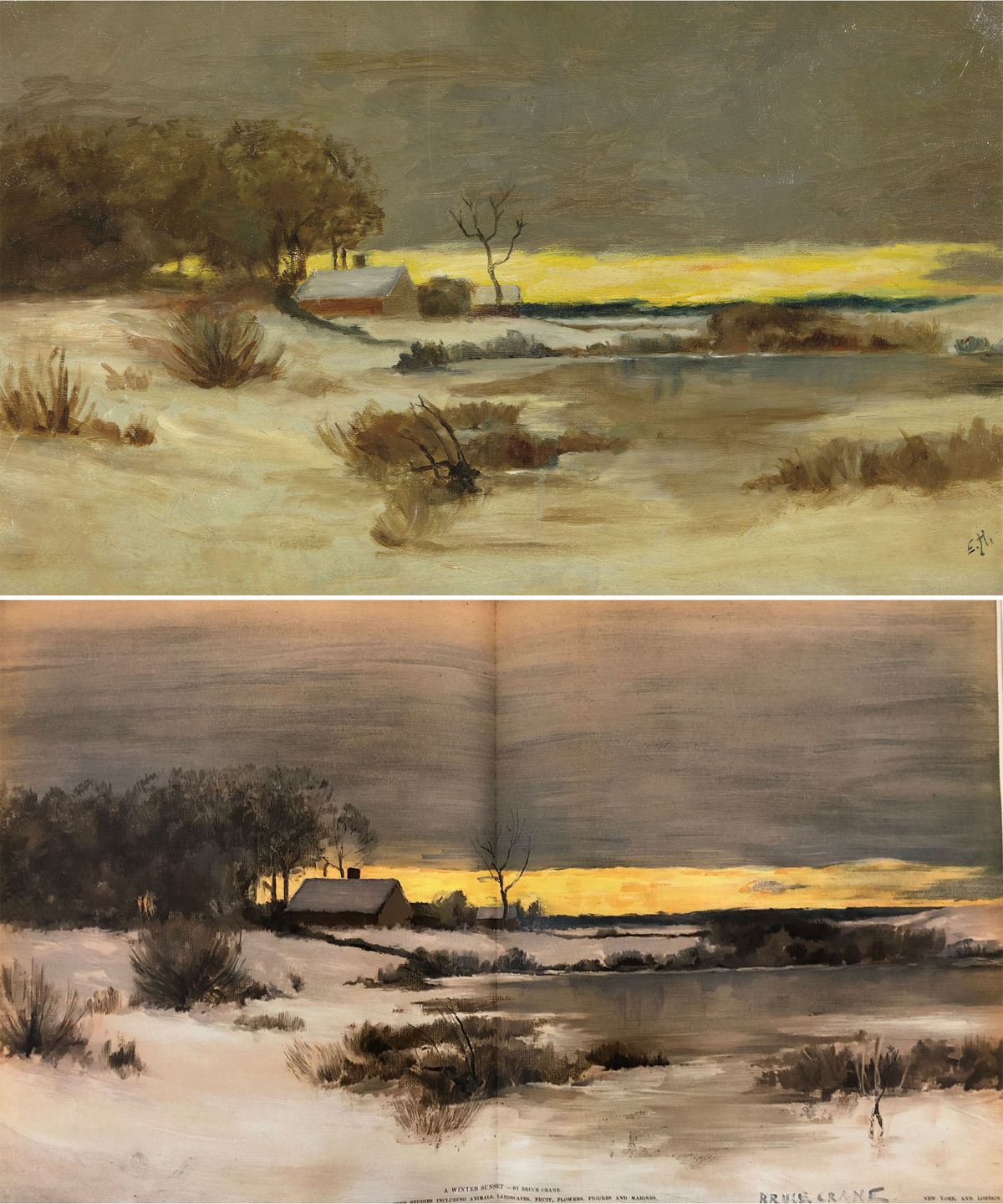
The most intriguing of these early oils is Old Ice Pond at Nyack, made between 1898 and 1900. The painting has been regarded as one of Hopper’s only confirmed depictions of Nyack in oil, seemingly offering a window into his formative environments. Depicting a snowy landscape presided over by an evocative sunset, the work has been cited as evidence of the young artist’s talent, his romantic connection with the American scene from an early age, and his prophetic interest in sunlight as an agent of mood.
The title of the painting refers to the old ice pond in Nyack, which until the 1950s existed at the top of Main Street, a short walk from the Hopper family home. Postcards and photographs of the pond reveal its placid beauty in warmer weather and frenetic activity in the winter season, when it froze over and was thronged with skaters and ice cutters. Hopper’s illustration A Pair of Slippers, of 1899, alongside several other early drawings depicting ice skaters, suggests his participation in this annual tradition, since it portrays two boys—one a likely self-portrait—slipping about on a frozen pond.
Old Ice Pond at Nyack certainly does function as a window into the little-discussed cultural environment of Hopper’s youth, albeit not in the manner previously thought. The work’s title, placing the landscape in Nyack, did not come from Hopper at all. Rather, it was bestowed by the painting’s first owner, Reverend Arthayer R. Sanborn, shortly after the artist’s death. Sanborn had discovered Old Ice Pond at Nyack and Hopper’s other early oils in the attic of Hopper’s childhood home in the late 1960s, alongside a trove of unseen early drawings, oils and watercolours. Rowboat in Rocky Cove was stowed here, too, and was titled Rowboat on Hudson by Sanborn—once more linking the painting to the Nyack scenery of Hopper’s childhood. The title was later altered, but the original affiliations to Nyack stuck, with writers continuing to relate both paintings to Hopper’s childhood environments.
Neither Old Ice Pond at Nyack nor Rowboat in Rocky Cove bear any relation to Nyack. They are actually faithful copies after paintings by other artists. Old Ice Pond at Nyack is a copy of A Winter Sunset by the then-popular tonalist artist Bruce Crane, while Rowboat in Rocky Cove is a copy after the watercolour Lake View by an unknown painter. Crane’s Winter Sunset depicts a landscape in Long Island or Connecticut, while Lake View is inscribed “Athelstane” and so possibly depicts a lake near Athelstane, Wisconsin, though this may also suggest the signature of the unknown painter.
Both paintings appeared as collectable colour plates in the Art Interchange, a widely read periodical for amateur artists that encouraged its readers to copy from its pages. Crane’s Winter Sunset appeared in the December 1890 issue and Lake View in February 1891. In both cases, the colour plates were accompanied by comprehensive sets of copying instructions, which explains the existence of numerous other extant copies of A Winter Sunset by amateur artists. The instructions for Lake View stated that the painting was “a very simple subject and well adapted to beginners”. There is little mystery, then, as to why Hopper copied the plate for likely his first serious attempt at oil painting; indeed, his beginnings as a painter seem to have been much more tentative than previously imagined.
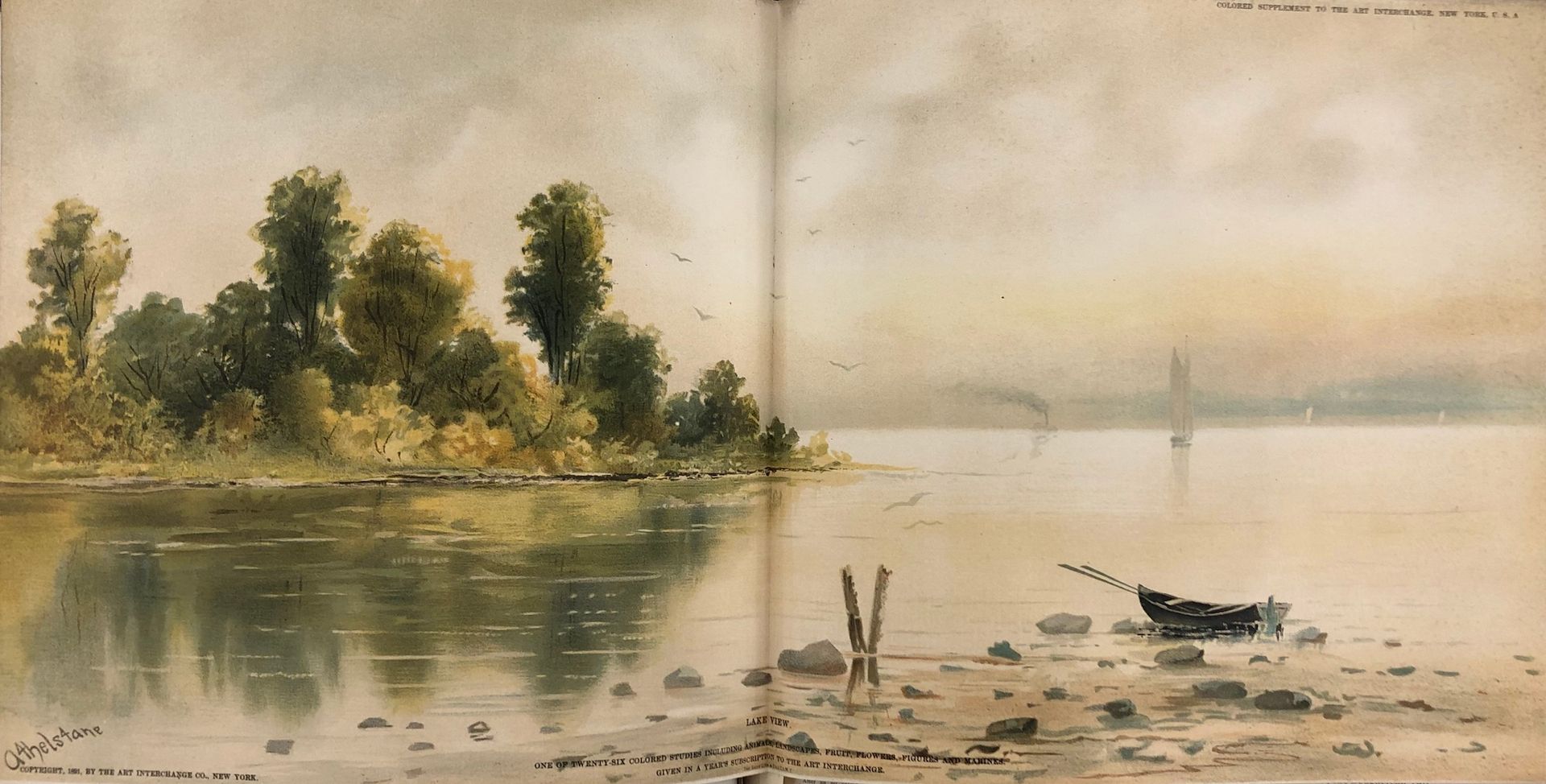
Lake View by an unknown painter, which appeared in the February 1891 edition of Art Interchange, is the basis for Edward Hopper's painting Rowboat in Rocky Cove (1895) Photo by Louis Shadwick
These were not the only copies Hopper made. All of his early oils before he enrolled in art school, long deemed original compositions, are in fact copies. His painting Country Road (around 1896) is a copy after a painting titled A Landscape Study in Color by the American tonalist artist John Francis Murphy. This work again appeared as a colour reproduction in the Art Interchange on 27 March 1886. Hopper’s Ships, meanwhile, produced around 1898, was a copy after Marine View by Edward Moran, which appeared in the Art Interchange’s issue of mid-August 1886. Another early Hopper oil, originally titled Winter Scene by Sanborn and later renamed Church and Landscape, was again a copy, not a portrayal of a “snowy Nyack Baptist church”, as one writer has claimed. Though its precise source remains unknown, its status as a copy is confirmed via the existence of two paintings of the same scene by the painter Edgar Barnes Gilson that date to 1893, as well as a Victorian porcelain plaque on which this same scene is depicted.
Finally, a previously uncatalogued early Hopper painting that Sanborn titled Clipper Ship Being Towed by Tug and originally dated to around 1900 can be revealed as a copy after Fred Pansing’s Stormy Voyage, which was published as a collectible lithograph in the Sunday art supplement of the “independently Republican” New York Recorder newspaper on 7 May 1893. The painting may therefore predate 1895’s Rowboat in a Rocky Cove, previously thought to be Hopper’s first oil, though its precise dating cannot be ascertained. These numerous copies make it clear that the Hoppers subscribed to the Art Interchange by the early 1890s and perhaps as early as 1886, when A Landscape Study in Color and Marine View appeared. Hopper’s mother probably collected and kept the plates for her children.
Across these works, Hopper made no acknowledgment that any were copies, signing them either with the initials “E.H.” of “E. Hopper”. Only Church and Landscape remained unsigned. Rather than any attempt to mislead, the signatures suggest the artist’s youthful pride in his earliest achievements in oil that were never intended to be seen publicly. In any case, it is possible that Hopper did not produce an original oil painting until he enrolled at the New York School of Art in the autumn of 1900. What’s more, contrary to prior belief, no boyhood oils of Nyack by the artist exist.

Of course, all aspiring artists copy. It has long been established that Hopper made sketches from printed material and that eventually, when he reached art school, he was encouraged to copy after other artists. But knowing that all of Hopper’s first oil paintings are copies challenges prevailing myths surrounding the artist—namely, that his gift for painting emerged during adolescence with essentially no instruction and that he was little exposed to American art groups or movements until art school.
Hopper’s copies reveal the artist’s close study of contemporaneous painting from an early age, most specifically his interest in a now overlooked style known as American tonalism that achieved widespread dominance around the turn of the 20th century. These discoveries open a window into the much broader cultural fabric of Hopper’s youth, not least the centrality of illustrated periodicals to both the values that the young Hopper absorbed and to his formative conceptions of American art and culture.
- This article has been excerpted from Edward Hopper: A Life by Louis Shadwick, published by Yale University Press, published in the US on 13 October and publishing in the UK on 24 November.