

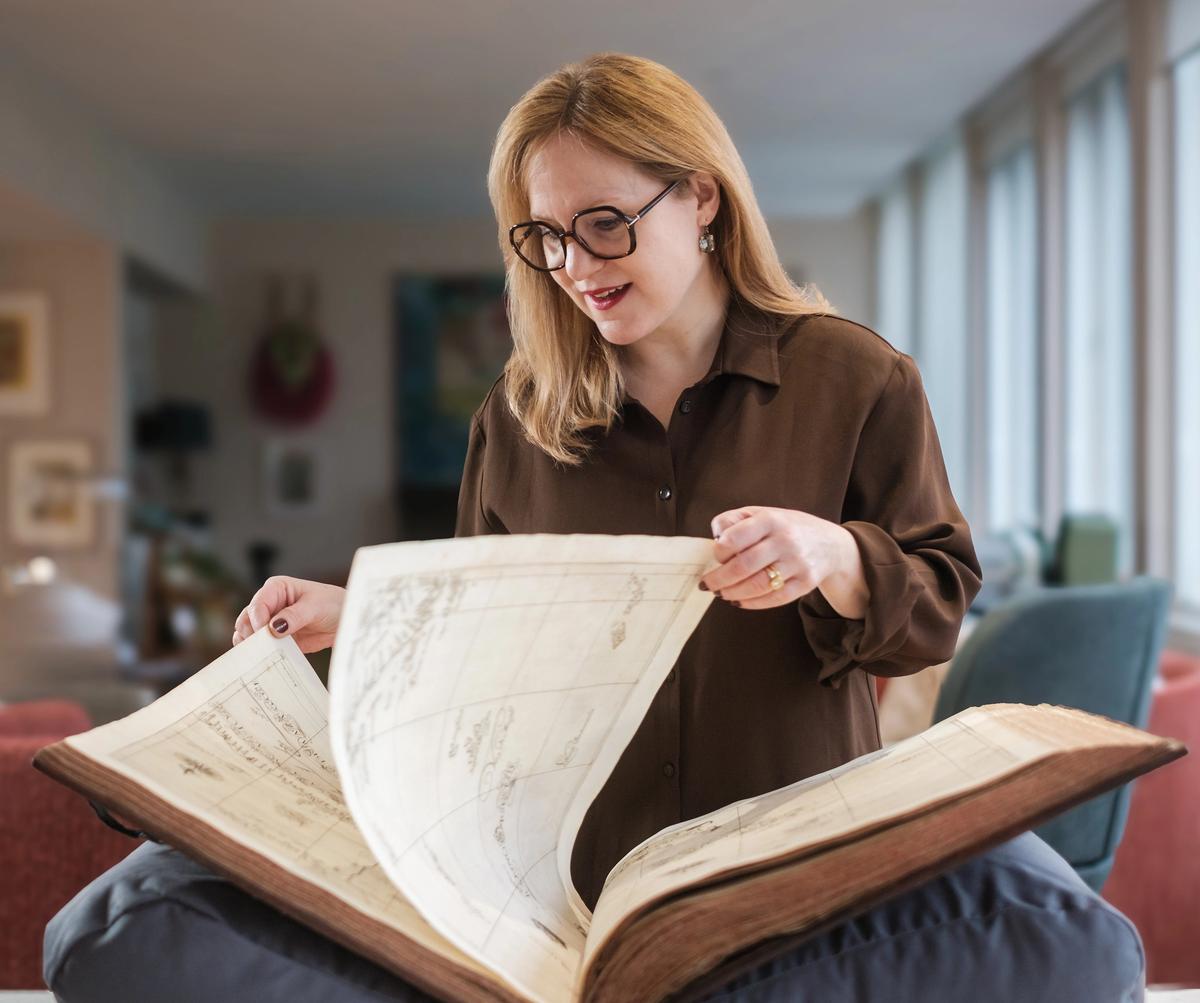
The London-based lawyer, Helen Sunderland-Cohen, oversees not one but three collections. She is the custodian of the Sunderland Collection of rare historical maps, atlases and globes that her father, Neil, originated; the founder, in 2024, of the Ex Carta collection of fictional maps; and an intuitive collector of contemporary art that she lives with in her central London home. Her personal collection includes recent paintings by Nick Goss, abstract work by Prunella Clough, and a wooden painted mask by Yinka Shonibare.
In 2021, the entire Sunderland Collection became available digitally on the site Oculi Mundi. Meanwhile, gems from Ex Carta are currently on view at the Zurich Central Library in an exhibition called Fantastical Maps from Legendary Stories (until 5 December) and in the Warburg Institute’s Night Maps, which opens in London on 21 October.

Sutherland-Cohen is a fan of Ali Kazim, whose works include Untitled (The Bird Hunter Series XIV) (2026) Courtesy the artist and Cristea Roberts Gallery, London; © Ali Kazim
The Art Newspaper: What was the first work you ever bought?
Helen Sunderland-Cohen:The first “serious” work was a lovely photograph from the 1970s, by the feminist artist Alexis Hunter. It is a self-portrait of her reflected in a mirror.
What was the last work you bought?
An exquisite watercolour from the Bird Hunter Series, by Pakistani artist Ali Kazim.
How different is it to buy work for the Sunderland Collection or Ex Carta, and work that you personally like and want to live with?
It is completely different. My own art collection is very eclectic and personal; it is mostly Modern and contemporary visual arts. There are loose themes but a lot is simply work from artists I admire, or that resonates for personal reasons. I am fascinated by both meaning and process. The map collections are quite specific: the Sunderland Collection focuses on world maps and celestial cartography up to around 1700; and Ex Carta focuses on literary or worldbuilding cartography, and ideally from first editions. The common denominator among the three is quality.
How quickly do you decide to buy a work of art?
I rarely buy spontaneously. I like to take time to understand the work and its maker. If possible, I try to meet them in person (trickier with the maps!). I also like to look: it is important to put things in context and train the eye.
What do you regret not buying when you had the chance?
Objects that I did not realise were for sale until afterwards. It can be hard keeping up, even with the magic of the internet.
If you could have any work from any museum in the world, what would it be?
I would rather they stay where they are, unless the museum is doing a terrible job at conservation. It is also great to lend objects rather than have them sit at home or in storage: it is exciting to see other people experience them and hear new perspectives.

Alexis Hunter’s 2018 exhibition Sexual Warfare at Goldsmiths Centre for Contemporary Art in south London. The first work that Sutherland-Cohen purchased was by the artist © Alexis Hunter
Which exhibition are you most looking forward to seeing in London this month?
The degree show at the City & Guilds of London Art School, where I am a trustee, happens in June and has such great energy. In October in London, I will be trying to catch the Richard Dadd at the Royal Academy of Arts, Henry Moore at Kew Gardens and Ana Mendieta at Tate Modern.
Where do you like to eat and drink during Frieze London?
At the fair itself, Jikoni—their food is wonderful. Outside the fair, I love the food and vibes at Claro London. For a degustation, it’s Restaurant St. Barts. For somewhere small and chill, Cloth Fair or Doppo. And finally for old-school fish, Wiltons.
Do you have any parties lined up?
The one I am really looking forward to is for The Soothsayer’s Chorus, an exhibition co-curated by the formidable yet humble curator Beth Greenacre and consultant Bettina Prentice. It is at Pink Floyd’s former recording studio near King’s Cross.
What is your least favourite thing about art fairs?
Entitled people who take themselves too seriously or those who are not there for the art!
Where do you go in London to get away from it all?
My home. It is very peaceful and we have big trees outside; I like to listen to the birds.
What tip would you give to someone visiting London for the first time?
Spend time on the river. And don’t worry if you cannot see everything in one go.
• Fantastical Maps from Legendary Stories, Zentralbibliothek Zürich, until 5 December
• Night Maps, The Warburg Institute, London, 21 October-17 April 2027