

Michael Landy is an artist of extremes. After graduating from Goldsmiths’ College in 1988 as one of the Young British Artist (YBA) generation—alongside the likes of Damien Hirst, Sarah Lucas and Gary Hume—he became known for critiquing consumer culture with dramatic works made from materials most people overlook or throw away. Closing Down Sale (1992) with its accumulated junk and fluorescent handwritten signs struck an apt note in a UK gripped by the recession of the early 1990s, while disposal and human waste formed the central theme of his room-sized Scrapheap Services (1995), now owned by Tate, which took the form of a fictional people-cleansing company.
In 2001 Landy created Break Down, the epic performance work he is still best known for, which involved him systematically destroying all his worldly possessions, from a single teabag to a Saab 900 car. A year later he began to make work again on a very different scale with a series of minutely observed life-sized etchings of common urban weeds.
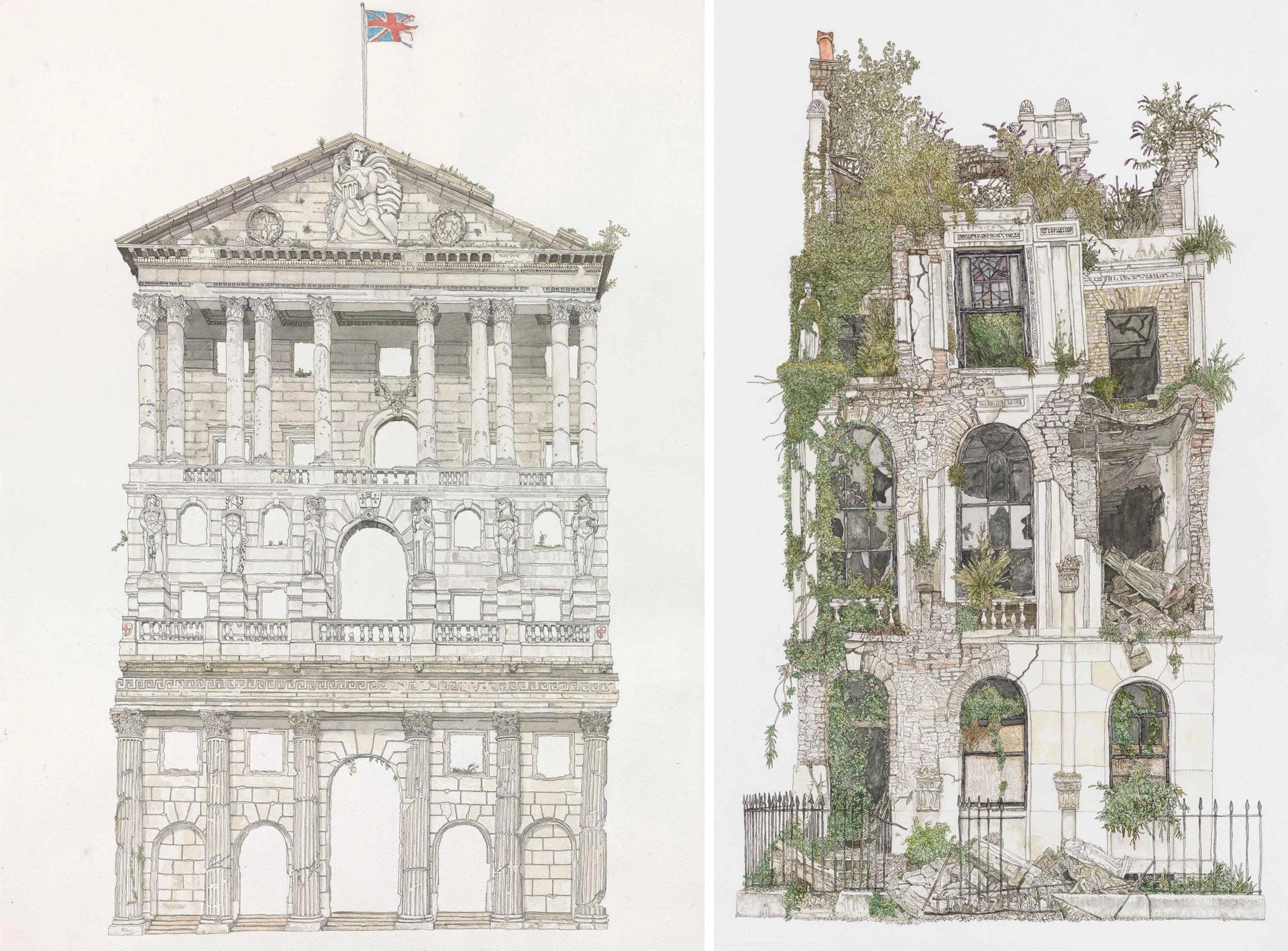
Above left: Michael Landy’s Imaginary view of The Bank of England in ruins after Joseph Michael Gandy (2023). Above right: Landy’s Oh! What a falling off do these ruins present. Sir John Soane’s Museum as a ruin (2026). These and other works from the Fauture Ruins series will be on show at London’s Sir John Soane’s Museum Both works: © Michael Landy; courtesy the artist and Thomas Dane Gallery. Bank of England photo: Todd-White Art Photography. Soane’s Museum photo: Prudence Cuming Fine Art Photography
Since then, Landy has spanned scale and media with laboriously made works ranging from giant animatronic sculptures of Catholic saints and a life-sized replica of his family’s semi-detached house to coloured pencil drawings of his father. Now Landy is yet again confirming his consummate skill as a draughtsman with Future Ruins, a series of detailed drawings and watercolours of famous and lesser-known buildings in the process of becoming ruins, going on show at the Sir John Soane’s Museum in London.
The Art Newspaper: In many ways the Soane’s Museum is an appropriate setting for your Future Ruins series, especially because it owns the work that inspired the series—Joseph Michael Gandy’s 18th-century watercolour Architectural Ruins: A Vision.
Michael Landy: Yes, my starting point was Gandy’s reimagining of the Bank of England as a ruin, which I think he gave to John Soane, who was the architect of the original Bank of England. It’s in that great romantic tradition of artists like Hubert Robert, who imagined the Louvre as a future ruin in 1796, or Piranesi, who Soane collected and met in Rome. So I’m coming out of that watercolour tradition from the 18th-century Grand Tours onwards. Obviously, Soane also had a big interest in ruination and those renderings; I recently read that near the end of his life he started to imagine his home as a ruin as well.
You present an eclectic range of Future Ruins. As well as the Soane’s Museum and the Bank of England, other buildings you present include the New York Stock Exchange, the Mar-a-Lago Club, Chatsworth House and Mussolini’s Palazzo della Civiltà Italiana, along with the Landy family home in Ilford, Essex, and the art supply shop you frequented as a student. It seems like you are honouring some buildings as romantic ruins, while with others it seems like a critique of greed and hubris.
It’s varied. Some are more nostalgic, some are more a comment on their times. In his own way, Donald Trump just keeps giving: whether it’s Mar-a-Lago, or what he’s done to the interior of the White House, or his library that looks nothing like a library. Ruined buildings, they’re kind of metaphors, aren’t they? I guess we have all sorts of monuments, whether for past sins or future sins, and a lot of ruins are very melancholic. Artists and poets project their thoughts and feelings onto them. I like memorials as well, and I also have my family ruins. And the watercolour works that I made during lockdown of various Irish cottages in various forms of dilapidation, falling into the earth.
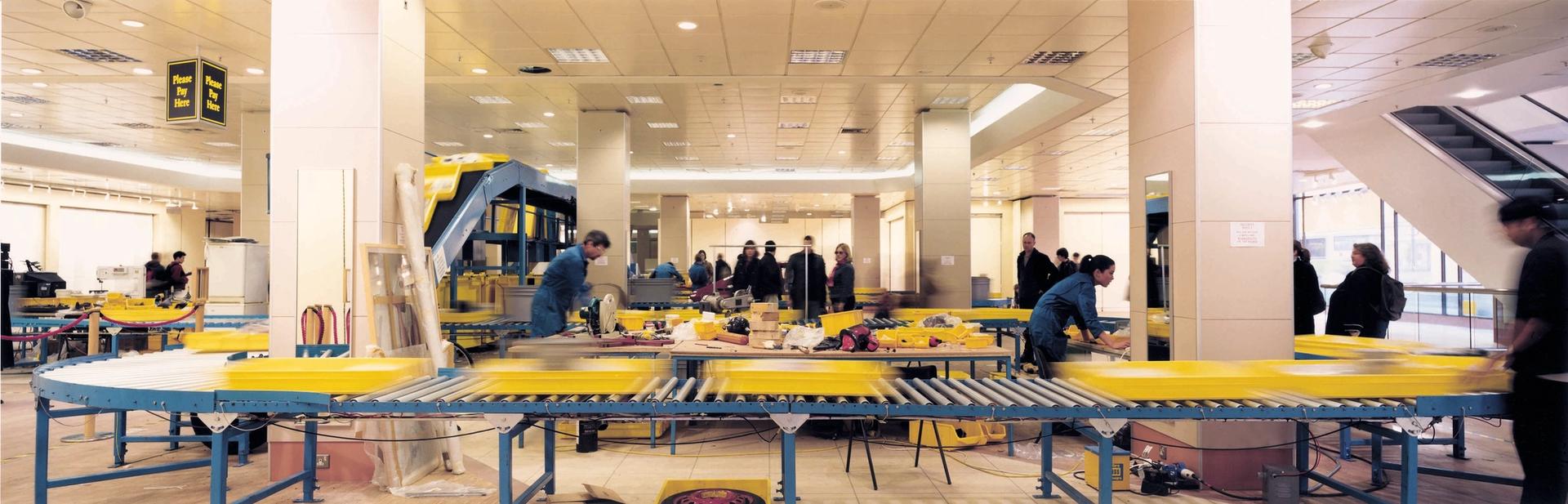
Installation view of Landy’s Break Down (2001), commissioned by Artangel, for which he destroyed all 7,227 of his possessions during a two-week performance in a former C&A clothes store on Oxford Street in London © Michael Landy. Courtesy the artist and Thomas Dane Gallery. Commissioned by The Times/Artangel Open, supported by Arts Council England. Photo: Hugo Glendinning
I think Soane talked about his museum as being a self-portrait and the accumulation of things that he acquired on his Grand Tours form a kind of self-portrait. I guess that’s what I’m also trying to create within the Soane, a portrait of myself.
The exhibition also includes a large, meticulously rendered pencil drawing, Self Portrait at the Age of 62, that you made last year.
I put the portrait in because it is like another form of ruination: as you get older, more stuff ends up on your face. Obviously there are more lines, then other bits recede and other bits get more pronounced. It’s only when you really look into your face and see what has happened that you reacquaint yourself with yourself, in a way. Then as I was drawing, it also reminded me of all the weeds and all the cracks in the mortar as a building starts to decay. That’s what I like about ruins: they are a reminder that eventually everything, if you leave it long enough, will fall back into nature. Nature will literally just pull it down and consume it, and all you’ll be left with is a bit of rubble.
Themes of ruination, decay and destruction along with an interest in the overlooked and undervalued, especially within the context of capitalism and consumption, have underpinned your work right from the very beginning.
You’re right. Recession is a kind of economic ruination and when Margaret Thatcher got in in 1979, we’d already started to scrap our manufacturing base [in the UK]. My Closing Down Sale in 1992 and Scrapheap Services in 1995 came out of that. With Scrapheap Services, as an artist I was being thrown on the scrapheap as well, so it was a way of creating my own cottage industry to re-employ myself, because at the time I was being put on various government startup schemes.
What formed was a scrapheap that was a symbol of people being literally thrown away and forgotten, which is also what happened to my father. My father was a ruin, a “total wreck case” as they called him, written off work as a miner after a tunnel collapse, and the only jobs he was able to do were around the house. Then, as his medical condition got worse, he struggled to do that, and as his body dilapidated, so the house and its façade also dilapidated. That was the life-sized version [of the house] recreated in Semi-Detached in Tate Britain in 2004. So, fragmentation, rubbish, what we value, and what we discard, have been recurring themes throughout my whole practice, and now up to Future Ruins.
It has now been a quarter of a century since Break Down (2001), when you took destruction, fragmentation and a critique of consumption to the absolute extreme by systematically pulverising all your worldly possessions. I remember at the time you described it to me as witnessing your own funeral. How do you see it now?
I guess now, because we’re obviously in a more digital age, it would be very different. When I did Break Down we still had six by four [inch] photographs, CDs, VHS players, lots of physical stuff. It was very much an analogue thing, whereas now we store everything in the cloud, so a lot of that’s all disappeared. I always said that if I could destroy my artist archive, I could destroy anything—and that’s basically what it came down to.
A lot of people saw Break Down as negative, but I saw it as positive. It talked about creative destruction, and how things can come out of destruction, out of nothing, out of whatever’s left. The Soane’s Museum is packed full of stuff, whereas my house and studio isn’t. I only have whatever I’m working on at the time, and I don’t have past works or any other stuff around me, and that’s come from doing Break Down.
The one new sculptural work in this new show, Broken Column (2026), consists of a giant column of real bins overflowing with rubbish. Not only does this resonate strongly with Soane’s collection of fantastical columns created from disparate reclaimed elements but also with both Break Down and Scrapheap Services, and especially with Art Bin, the giant container into which, in 2010, you invited fellow artists as well as members of the public to jettison the artworks they believed to be creative failures. In all of these you are playing with, and off, the connotations of destroyed, discarded goods.
Outside the Soane’s Museum I’m showing this version of his classical columns made from outdoor litter bins, still with all their tags and stickers on them, and with rubbish flowing out of them, too. I saw the filling of Art Bin with discarded artistic failures as a positive celebration of being a creative being. This Broken Column of stacked, overflowing plastic bins continues my interest in rubbish and waste and the value that we give to some things, and also what we choose to exclude from the value system.
Whether made from dustbins or painted in watercolours, ruins allow you to project your thoughts and feelings onto them. In thinking about why they were created in the first place, they allow us to consider our own mortality. When one comes to the latter part of one’s life, one starts to think about legacy—what does that all mean and why did I do this in the first place? Putting vanity to one side, what’s it all about, really?
Biography
Born: 1963 London
Lives and works: London
Education: 1988 Goldsmiths’ College, London
Key shows: 1990 Building One, London; 1995 Tate Gallery, London; 1996 Chisenhale Gallery, London; 2001 Artangel, London; 2004 Tate Britain, London; 2010 South London Gallery; 2013 National Gallery, London; 2016 Museum Tinguely, Basel; 2021 Firstsite, Colchester; 2025 Hastings Contemporary
Represented by: Thomas Dane Gallery and Galerie Sabine Knust
• Michael Landy: Future Ruins, Sir John Soane’s Museum, London, 14 October-17 January 2027