

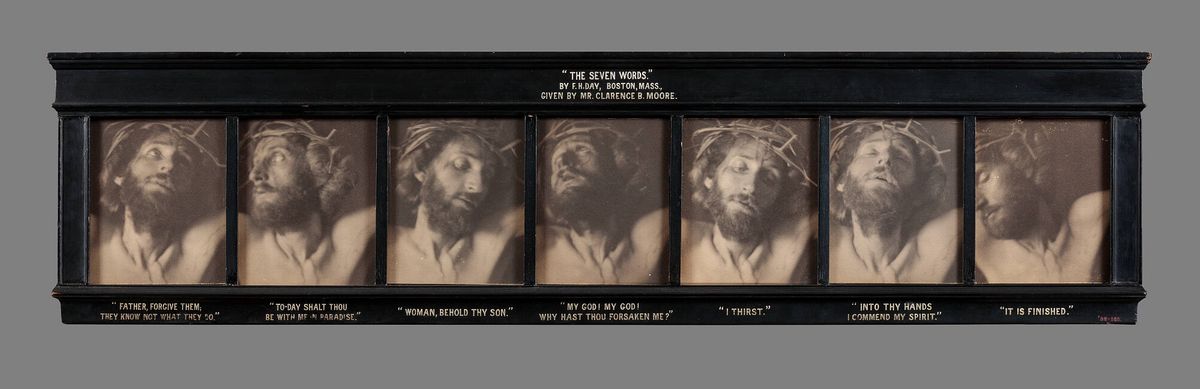
The Toledo Museum of Art (TMA) has purchased The Seven Words (1898), a groundbreaking photographic work by the American artist F. Holland Day (1864-1933).
The piece, comprising seven close-up platinum prints in a wooden frame of the artist as Jesus Christ on the cross in his final moments, is the most expensive work of photography the museum has ever purchased. It is also the first by the artist to enter the Ohio museum’s collection. The Seven Words will go on view next year, when the museum reopens after a major reinstallation of its permanent collection.
“This is the most important photograph that people don’t know about,” Adam M. Levine, the TMA’s director, tells The Art Newspaper. “We can situate it with performance art, and it’s a work that anticipates what will happen with cinema.”
Day, a leading figure in the Pictorialism movement in the US, created the work near his home just outside of Boston. He staged the photographs with costumes and props, creating a special mirror to attach to his camera so he could see how he looked.
“There’s a huge theatrical aspect,” says Erin Corrales-Diaz, the TMA’s curator of American art. “Day grew his hair long and fasted, changing his own body for this role. He had gone to see a Passion play in Germany, and it really affected him.” Day had been raised as a Unitarian Universalist, but as he travelled around Europe, he was inspired by the continent’s deeply rooted religious traditions.
The Seven Words debuted at the first Philadelphia Photographic Salon in 1898 at the Pennsylvania Academy of the Fine Arts. “The work immediately sparked debate,” Corrales-Diaz says. “Some people questioned its legitimacy, as they didn’t like using photography for spiritual subjects. Some liked it. Day showed the work to Boston religious leaders, and 29 out of 30 of them approved.”
The TMA’s The Seven Words is one of three known originals. (The others are at New York’s Metropolitan Museum of Art and the Museum of Fine Arts, Boston.) It was formerly in the collection of the Philadelphia Museum of Art, before it was deaccessioned around the time the museum moved to its current building in 1928.
“The artist designed the original frames with the inscriptions," says Corrales-Diaz, noting that only the TMA’s version and the one in Boston still have these intact.
“Erin has had her eye on this work since she first started working here in 2021,” Levine says of his colleague.
Corrales-Diaz was first introduced to Day’s work during her graduate studies. “And when I did a collection assessment here at the museum, I realised that we have a dearth of early photography,” she says, which led to a conversation with Levine and, later, with Bruce Silverstein Gallery in New York. The purchase was agreed to at the Paris Photo art fair in 2023.
The Seven Words will go on view in Toledo in autumn 2027, when the TMA reopens its reinstalled permanent collection galleries. “We will feature it in the centre of the gallery,” Levine says. “It’ll be in a sort of shrine, like a very important carpet at the Victoria and Albert Museum.” He adds that the museum’s conservation team is working on optimal light levels for displaying the fragile early photographic work for the long term.
“Today, we’re so inundated with photography that we forget its original exploratory nature. If sculpture and painting could depict religious subjects, why not photography?” Corrales-Diaz says. “Day made 250 plate studies for The Seven Words, only a dozen of which were successful. It’s one of the most ambitious, radical and beautiful projects.”
“When you see it for the first time, you can’t believe it’s a photograph. You think it’s charcoal with those deep blacks,” Levine says. “It’s exquisite as a work of both photography and performance.”