

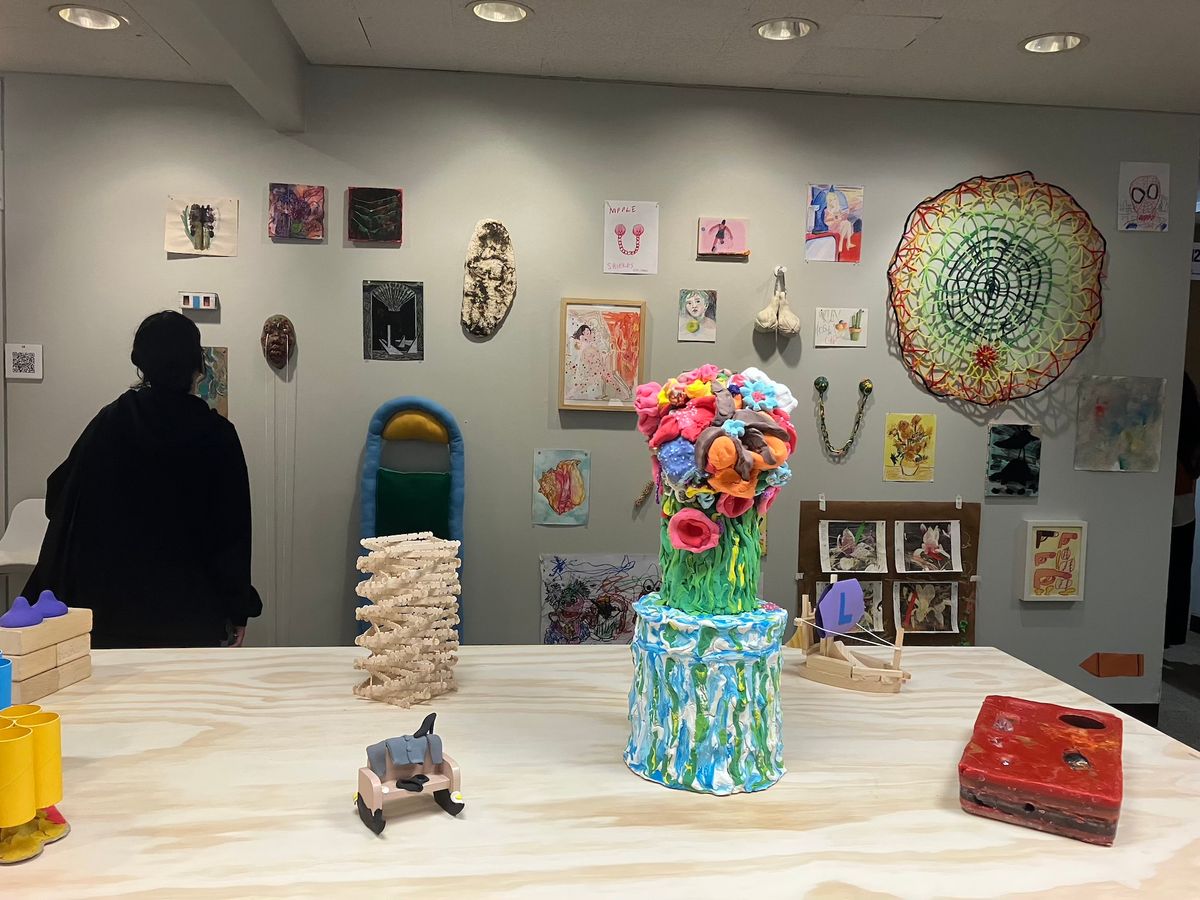
This week’s most whimsical New York art fair has turned the ninth floor of the former CBS News office building at West 57th Street and 11th Avenue into a playground maze of creativity. This edition of the Spring Break Art Show (until 28 September) is organised around the theme of “Hide ’n Seek”. Having tried out the theme on a much smaller scale in Los Angeles in February, the game is fully on at the border of Hell’s Kitchen and the Upper West Side. As ever, dozens of curators have brought in artists to create more than 100 projects spanning all media.
“People have taken the theme in different directions,” Andrew Gori, the fair’s co-founder, tells The Art Newspaper. He points to a number of projects associated with childhood, like the more than 60 artists organised by the curator Todd Bienvenu to create works using things like crayons, markers and construction paper (priced between $100 and $8,000 each).
“They’re established artists, who are also parents, engaging with children’s materials,” Gori says. “It shows their playful side.” He adds that there are artists at the fair showing works they made as kids themselves. Some have created games for visitors to play as a means of engaging with their art.
But the bright colours, humour and playfulness are not always what they seem. This is where the hiding aspect comes in—whether via a deeper meaning or a concealed message. The Romanian-born artist Adina Andrus, for example, has invented a secret language of 2,000 symbols related to her own childhood memories that she re-creates as ceramic wall sculptures ($2,750-$6,550 each). “It’s how I talk about myself without talking about myself,” she says.
As Gori points out: “The subconscious is always hiding things from you.” Fittingly, some of the most memorable stands at Spring Break this year are immersive installations that bring in an audience with humour before showing their more profound underbelly.
Louis Sarowsky’s Rock with me Courtesy Spring Break
Louis Sarowsky, Rock with me
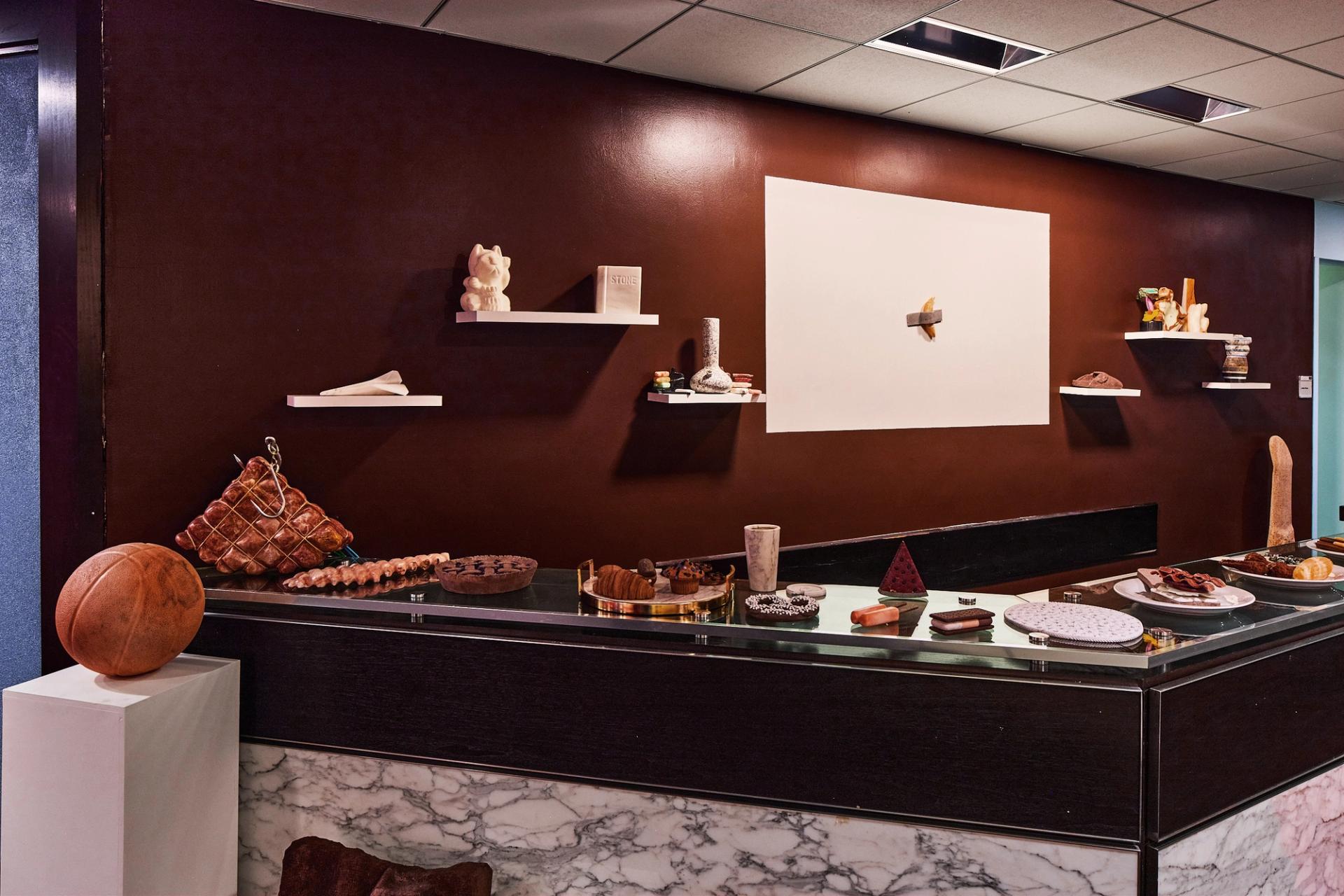
Arranged across the welcome desk of the office, the first thing visitors see is a spread of Louis Sarowsky’s impressive food sculptures made of stone. These include a Neapolitan ice-cream sandwich and a classic orange creamsicle ($1,300 each), a breakfast plate of waffles and fruit ($4,500) and a blueberry muffin ($1,800).
The skateboarder and self-taught stone sculptor carves these all out of naturally occurring stone, carefully choosing the type best suited for each colour and texture. His bacon, lettuce and tomato sandwich ($2,600) uses a different stone for each ingredient. “I like to use limestone for bread,” Sarowsky says.
Of course, no art-world buffet would be complete without a take on Maurizio Cattelan’s infamous Comedian (2019). Sarowsky’s version, Rock Basel (2026), hangs on the wall behind the front desk. Meticulously carved from honeycomb calcite (for the banana) and marble (for the duct tape), it costs a mere $2,300. Catellan’s real banana with real duct tape sold for $6.2m at auction in 2024. Clearly, the art market is still ripe for satire.
Cara Sheffler and Johannah Herr’s Scorched Earth Tiki Courtesy Spring Break
Cara Sheffler and Johannah Herr, Scorched Earth Tiki
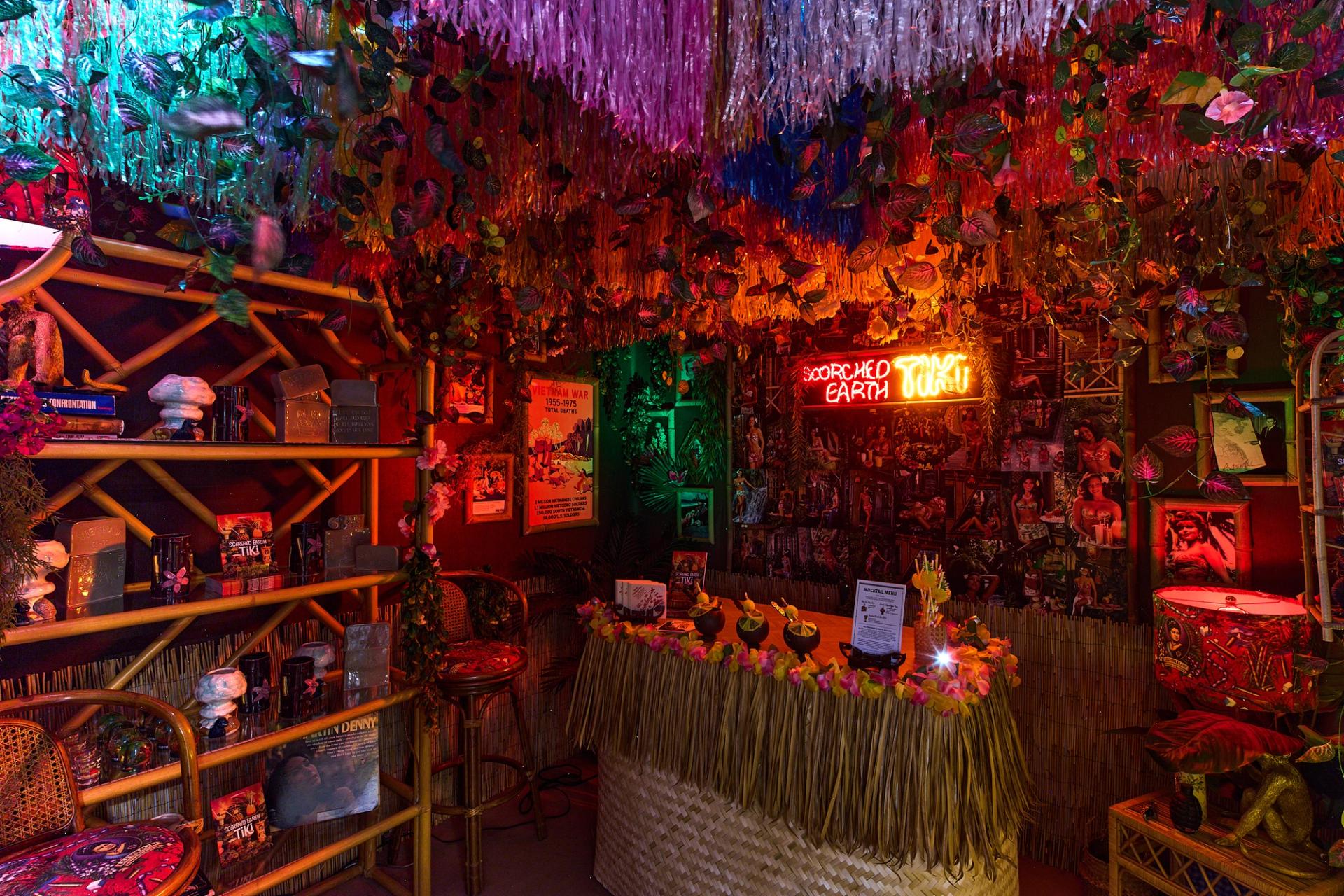
Come for the tiki drinks, stay for the depressing history lessons. This is probably the most impressive stand at Spring Break, as it packs in so much creativity into a small space. The writer Cara Sheffler and the artist Johannah Herr have an ongoing collaboration publishing artist books as ¡AGITPOP! Press. The pair is dedicated to exploring “consumer propaganda and how to subvert it”, Herr says while playing bartender in a decked-out office space fully transformed into a tiki bar.
There are mocktails for sale ($12), as well as shot glasses ($15) and miniature snow globes ($40). But these are not the typical pseudo-Polynesian tchotchkes—take a closer look, and they tell tragic histories of war and colonialism in Hawaii, the Marshall Islands, Vietnam and beyond. Mushroom clouds, representative of the US’s Cold War nuclear-weapons testing, abound in the form of string lights, handmade ceramic tiki mugs ($400) and an impressive tufted rug ($8,500).
Herr says the goal is to teach visitors about the history of the tiki bar—invented in California in the 1930s as a romanticised, escapist fantasy comprising a mishmash of appropriated Polynesian cultural markers. The most educational object for sale is the Scorched Earth Tiki recipe book ($30), where the dark histories of some of the most beautiful islands on Earth are presented in the form of drink recipes.
A shortened example appears on one of Sheffler and Herr’s specially designed cocktail napkins: “Zombie Apocalypse Now! Half dozen isotopic signatures, 29 Marshall Island atolls, 1 two-piece swimwear craze, 1 nuclear coffin (for garnish).”
Paul Gagner’s When The Moon Hits Your Eye: A Cautionary Tale, curated by Jacob Rhodes and Terra Keck Courtesy Spring Break
Paul Gagner, When The Moon Hits Your Eye: A Cautionary Tale
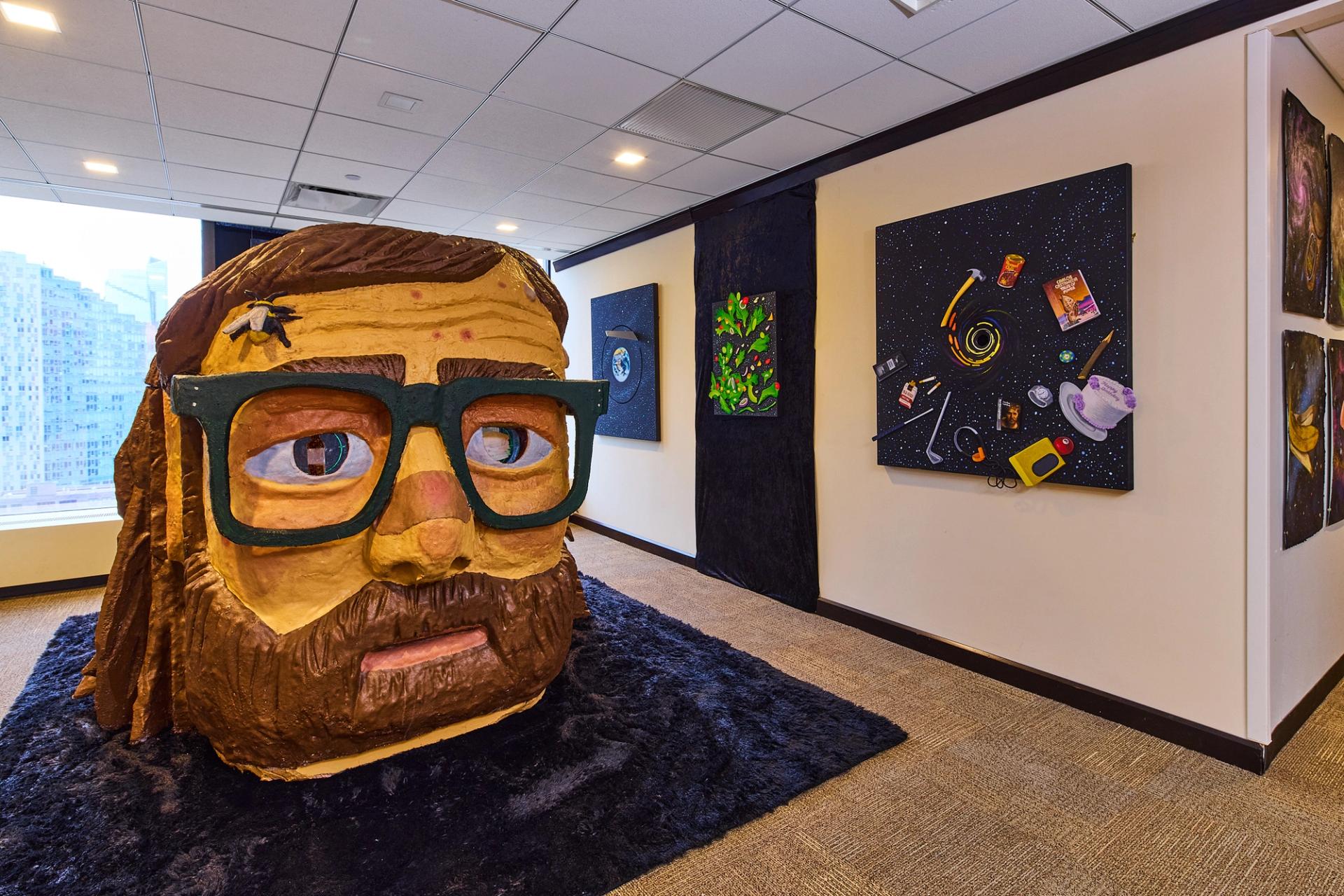
“Paul Gagner is an artist from the Midwest, and he’s very playful,” says the curator Jacob Rhodes. Judging by the giant sculpture of the artist’s head, complete with a colossal fly at his hairline ($12,000), this appears to be an understatement. Walk to the back of the giant dome, and it looks like a control room out of a science-fiction cartoon—with “uncertain mode” activated, the battery almost dead, a sandwich in one eye and a beer in the other.
On the walls on either side of this makeshift spaceship are equally irreverent paintings and wall sculptures (priced between $2,500 and $6,000 each) depicting random objects in outer space—one of them even has a theremin hidden inside it for sci-fi sound effects. “It’s all about space junk,” Rhodes says, which he adds is no laughing matter.
There are more than 8,000 tonnes of human-made debris orbiting the Earth. These likely do not include the cigarettes, candelabra and salted mixed nuts depicted in Gagner’s paintings, but the point still stands.
Slow Factory’s Everything Is Political Live Courtesy Spring Break
Slow Factory, Everything Is Political Live
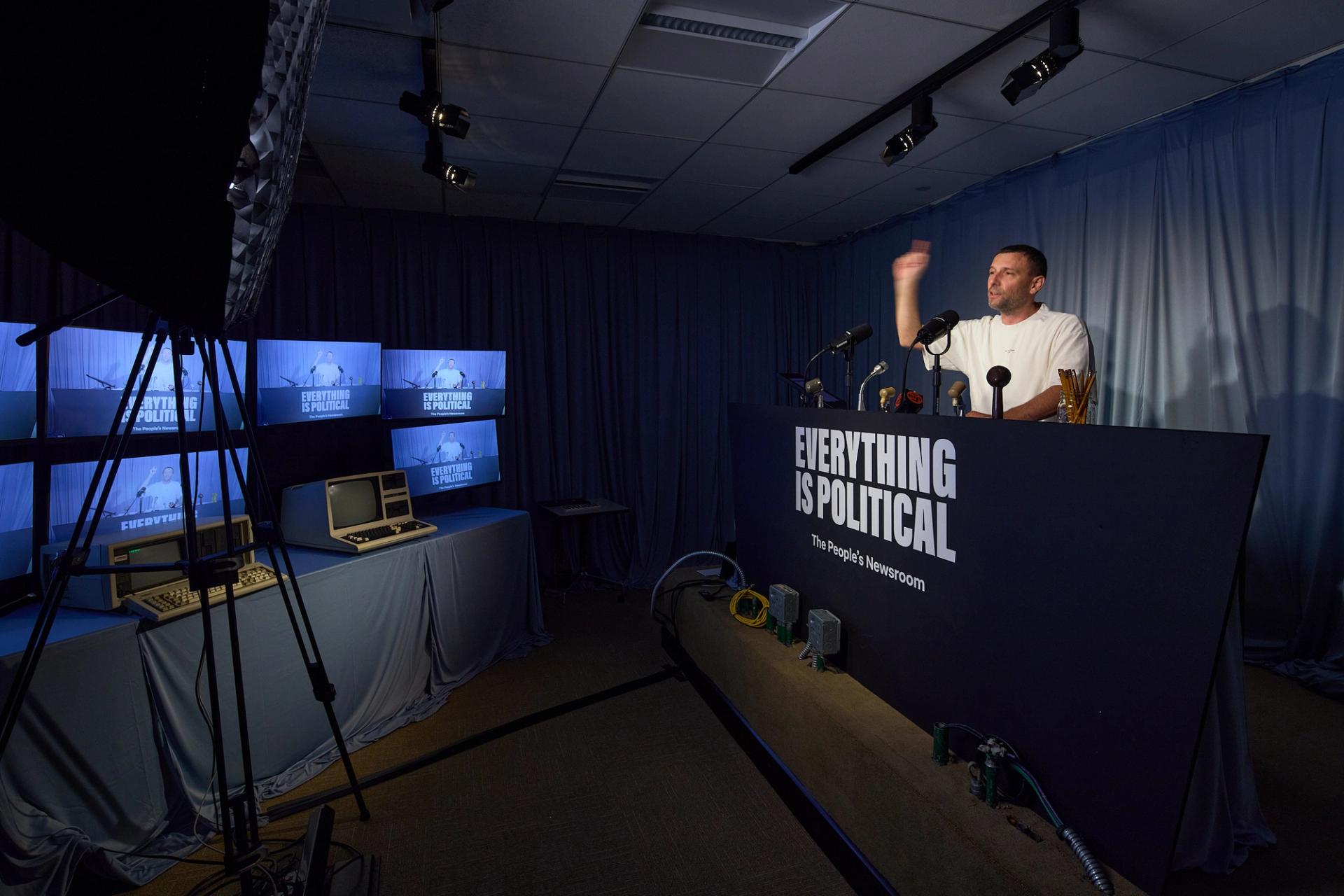
An art fair inside a former television news building would hardly be complete without a live studio set, and the collective Slow Factory delivers—they even found an old 60 Minutes sign in the building to hang just outside the door. Everything Is Political Live is an extension of the publication they launched in 2024, copies of which are available at a table in the back. “Everything Is Political is a community magazine,” says its co-founder Collis Browne. “And here, we’ve created the people’s newsroom.”
The installation invites visitors to sit behind the news desk and talk about anything they want—there are papers with prompts related to current affairs available for inspiration—with their voices and likenesses recorded as if they were news anchors. At the end of the fair, Browne and his team will go through all the footage and pick their favourite clips to create a compilation. “Everyone is a journalist if they’re telling the truth with intention,” Browne says.
Pam Korman’s Beyond Lip Service, curated by Morgan Hobbs Courtesy Spring Break
Pam Korman, Beyond Lip Service
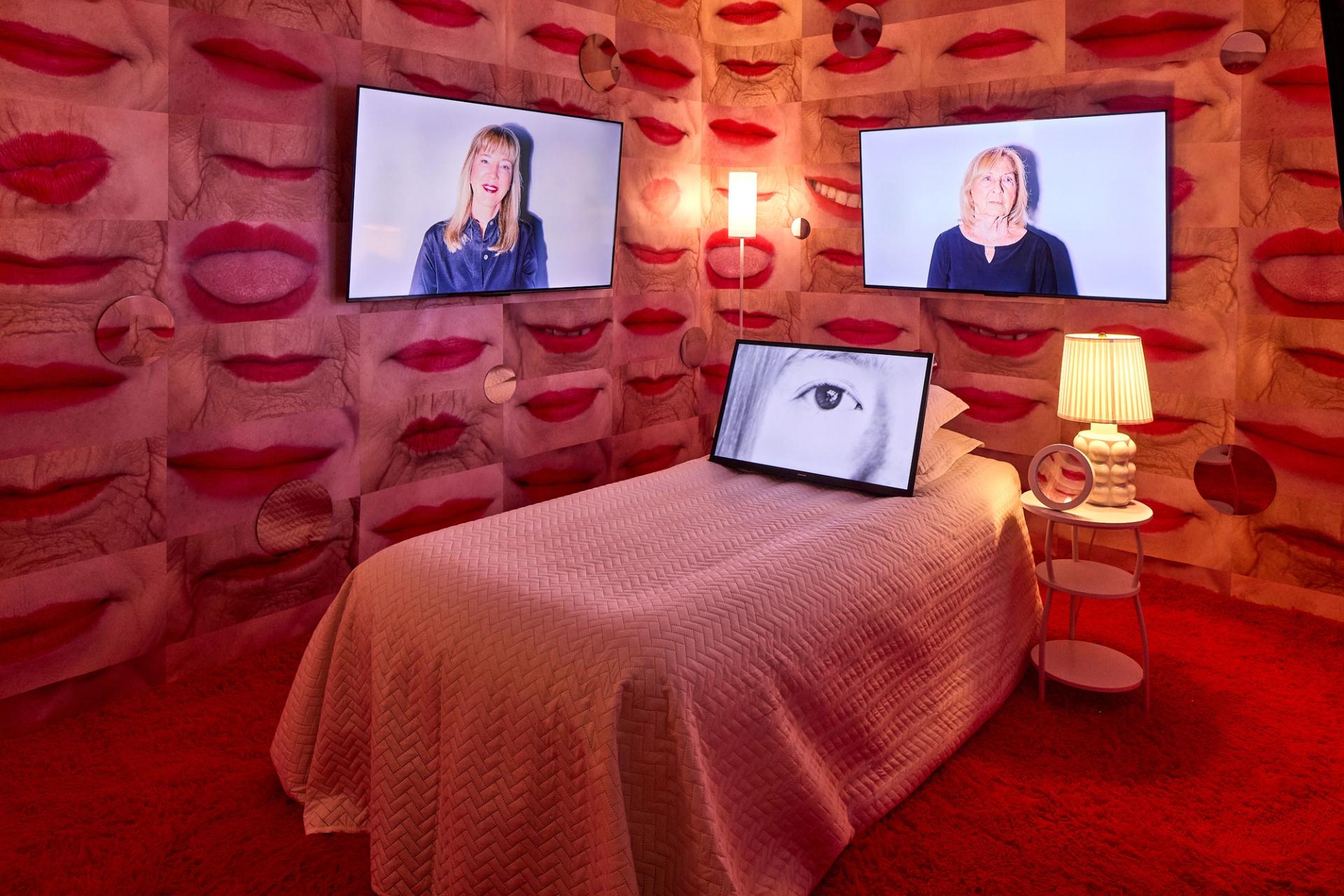
Down the hall from the newsroom is a much more personal interpretation of the Spring Break theme. The artist Pam Korman’s installation consists of a bed, a red rug and a side table with a lamp surrounded by wallpaper with photographs of lips and screens showing the faces of three generations of women—the artist and her mother and daughter.
Korman says she was inspired by Andy Warhol’s Screen Tests, using a similar method to explore the hidden similarities in the gestures of women from the same family. “It’s about maternal legacy, and how these kinds of things are handed down,” she says. “I found my own identity in my female ancestors.” The whole setup is available for $30,000.
- Spring Break Art Show, until 28 September, 555 West 57th Street, New York