

In an industry with few regulations, the art world has a peculiar obsession with climate control. Based on research from the 1970s intended to provide temperature and relative humidity ranges for museums in London, the guidelines became the status quo across the industry. For decades, professionals codified a climate range of plus or minus 2°C and plus or minus 5% humidity into museum practices and loan agreements worldwide, applying these numbers to institutions in environments wildly different from London. In recent years, however, professionals have started to push back against these stringent standards, citing high energy bills, an overall desire to reduce the environmental impact of the cultural sector and a growing call to centre collection care over blanket guidelines.
Steps to re-evaluate climate control have been under way for more than a decade. In 2015 the Bizot group of international museum directors issued new suggestions called the Bizot Green Protocol, which widened the temperature and relative humidity ranges. These were updated again in 2023, encouraging a more adaptive approach instead of insisting on consistent numbers.
Still, institutions are prioritising the numbers and very often use the 1970s guidelines. “People love numbers—they help us make decisions,” says Caitlin Southwick, a conservator and founder of the non-profit Ki Culture, which helps cultural institutions achieve sustainable practices. “Professionals might not want to rock the boat, but the updated Bizot protocol specifically states that they are not advocating for the replacement of one set of numbers with another, they’re advocating for bespoke approaches based on the object, building, environment and science-backed research.”
While the art world is slow to adapt, the need to rethink climate control guidelines is clear. Heating, ventilation and air-conditioning (HVAC) systems often account for 60%-70% of a museum building’s energy consumption, bringing large carbon footprints and high energy bills with them. Climate rules are written into loan agreements, requiring borrowing institutions to maintain specific ranges. If a museum’s HVAC system cannot support these ranges, they may be excluded from loans, furthering inequity in access and programming.
Progress, however, is being made. In March, five Los Angeles institutions announced their commitment to collectively adopt the Bizot Green Protocol. Comprised of the Getty, the Hammer Museum, Hauser & Wirth, Museum of Contemporary Art and Los Angeles County Museum of Art, the commitment expands on Getty’s most recent PST Art initiative, Art & Science Collide, which saw the creation of a Climate Impact Program spearheaded by the artist Debra Scacco and climate consultant Laura Lupton.
“The Southern California museum landscape is a critical one because it’s on the frontline of so many climate conversations in a broader resiliency and disaster-planning way,” Lupton says. “Los Angeles County is the number one at-risk county in America, according to the Federal Emergency Management Agency, because of the high risk of wildfire, drought, earthquake and other social resiliency factors. The lived experiences of the effects of the climate crisis are palpable and immediately felt and are infiltrating the walls of the museums.”
Creating a consortium helps institutions hold each other accountable, share information and signal to the broader industry that collective progress is possible. “The group buy-in is the missing step needed for a watershed moment across the industry, where there is a consensus that broader guidelines and science-backed approaches to climate control are understood as the standard,” Lupton says.
Spreading the word
Other cohorts rethinking the climate control regime are popping up across North America. Through her programme Getting Climate Control Under Control, Southwick has worked with museums and foundations to update their guidelines, including the Portland Museum of Art in Maine, which implemented updated Bizot ranges and achieved energy savings of around 9.5% during its trial period. Likewise, the Royal Ontario Museum in Toronto used its time in the programme to plan future operations as it undergoes an expansion project.
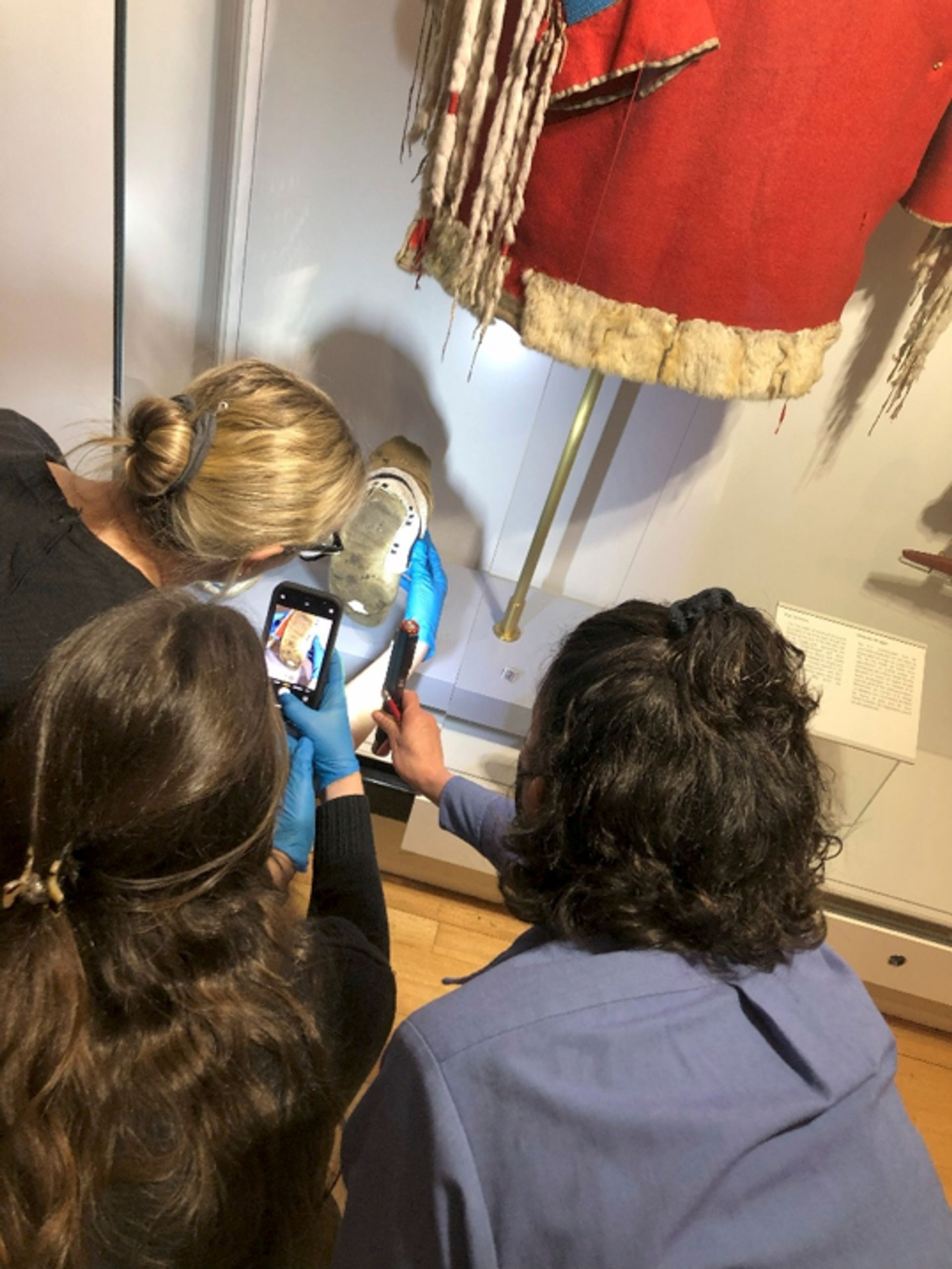
Melissa Maltby, Carly Wolowich and Antonia Guidotti conducting a condition check of a shirt given by Chief Sweet Grass during Treaty Six talks in 1876 and side seam moccasins, overlay and Crow-stitch beadwork Photo: Heidi Sobol, courtesy of the Royal Ontario Museum
The Arkansas-based Art Bridges Foundation, a non-profit that supports museums with loans of art to increase access to collections, also participated in the programme and updated the loan agreements for 25 museums. Some institutions opted for broader Bizot ranges, noting that the ranges are starting points that can be expanded based on the object and building needs, while others adopted a clause of mutual trust.
“We are more willing to work with partners to accept larger fluctuations in temperature and humidity for loaned objects,” says Gretchen Dietrich, the executive director of the Utah Museum of Fine Arts, which worked with Art Bridges and Southwick to update its loan agreements. “In the past, we strictly required humidity controls with plus or minus 5%, which is a challenge for almost every arts organisation in the western US.” Next year, 30 additional museums will participate in the Getting Climate Control Under Control programme.
As changes trickle through the industry, so too do the resources available. This summer, the non-profit Environment and Culture Partners (ECP) launched the Min/Max tool, which is designed to show institutions how alterations to their climate ranges might impact energy bills and carbon emissions, allowing users to input information like their HVAC system type, climate region and building specifications.
While the Min/Max tool can help improve operations, it can also assist in fundraising for climate initiatives. “We realised about five years ago that it’s hard to make a case for change without raw data,” says Sarah Sutton, a co-founder and the chief executive of ECP. “This is especially important for senior leadership like finance, who might not be in the climate discussion. If we can prove that you are going to save money, that might help get the entire museum on board.”
As climate change worsens and extreme events like heatwaves continue to stifle communities worldwide, the work these museums and climate experts are doing is becoming increasingly urgent. “The reality is that with heatwaves, HVACs simply can’t keep up,” Southwick says. “They cannot keep the parameters at all, and actually in attempting to do so are breaking down.”
Southwick points to the National Museum of Brazil in Rio de Janeiro, which in 2018 was largely destroyed by a fire ignited by an overheated HVAC system. “An HVAC breaking down is much more dangerous and much riskier to an object than controllably and safely acclimatising collections to broader ranges,” she says.
To cope with heatwaves this summer, several museums in Europe and elsewhere closed or reduced their hours. While many of these decisions were reportedly for the protection of staff and visitors, the collections may also have been a factor. With more bodies inside, HVAC systems have to work harder to maintain temperature and relative humidity ranges, straining machines already on overdrive.
What will it take to rethink climate control across the sector? “Education and time,” says Al Carver-Kubik, a grants and research programme officer for ECP. “There’s information out there from many different sources, and we need to put all of that together. The answer to many of the questions when it comes to temperature and humidity for museums is, ‘it depends’. That’s not a useful answer, but the more we ask the questions and share information, the easier it’ll be to find sustainable solutions.”