

While cities across the United States were being transformed by sleek glass towers in the mid-20th century, on the Great Plains a more fantastic vision of Modern architecture was being built. Now known as the American School, this rebellious strain of design had no boundaries in style, form or materials. Two architects who taught at the University of Oklahoma in Norman in the 1950s and 60s, Bruce Goff and Herb Greene, led this approach to organic shapes that responded directly to their environments. Goff was recently pulled off the sidelines of architectural history with a major retrospective at the Art Institute of Chicago. Greene, who is now in his 90s, remains less known.
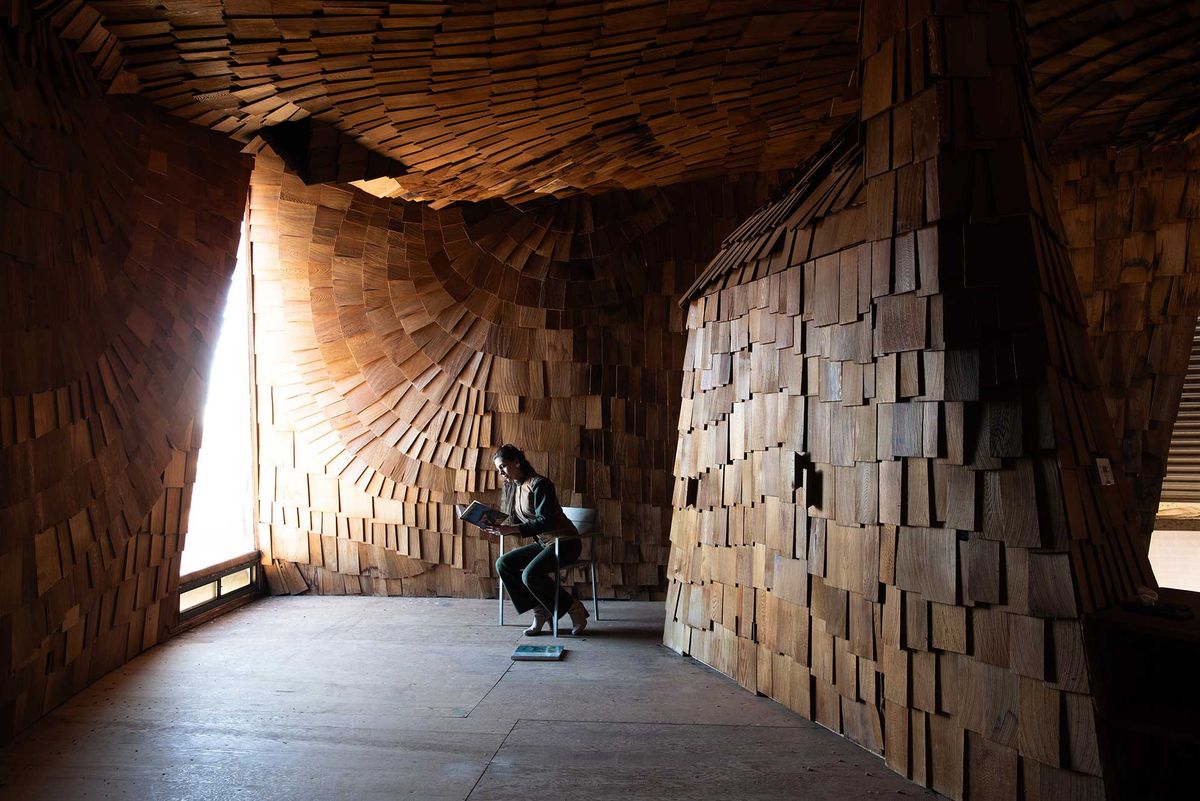
In Norman, Greene’s Prairie House is being revived following years of deterioration. After it was completed as the Greene family’s residence in 1961, the architectural photographer Julius Shulman published images of it in Life. The magazine described its shape as “bird- and beast-like” for how it swooped low, as if camouflaging itself in the grass. Both inside and out, its curved walls are covered with unfinished cedar planks and shingles in layers resembling feathers or scales. Communal spaces in the two-storey interior face the sunrise. The narrowest side of the amorphous house faces west to buffer against the winds and storms, with one large half-circle window opening like an eye to let in the colours of the sunset.
“You feel like you’re inside something that’s living,” says Lila Cohen, the president of the Prairie House Preservation Society (PHPS), Greene’s great-niece and an architect in her own right. “Uncle Herb is a strong believer in the way that we learn as human organisms is through the sense of touch. That’s why there’s so much texture everywhere. And then the warm colour and the cedar smell – it’s just this whole experience that you can only have when you’re there in person.”
Demolition dread
After the longtime owner who bought the house from Greene in 1968 died in 2016, the Prairie House’s future was in peril. Its wooden exterior had decayed and its futuristic aluminium carport had weathered. That same year, Goff’s nearby Bavinger House, celebrated for its spiralling form, was abruptly demolished. “That really set off a big alarm amongst the architectural community that these places don’t last forever,” says Beau Jennings, PHPS’s interim executive director.
Formed in 2022, PHPS is a nonprofit that now manages the Prairie House as one of the rare surviving American School homes in the area. Its team of volunteers is working to restore the home for regular public access while raising awareness of the history it represents. The New York-born Greene had moved to Oklahoma to study with Goff before becoming a faculty member alongside his mentor in 1958. Together, they taught that every work of architecture should respond to its context. Even in Oklahoma, far from the country’s architectural urban centres, there could be bold statements created with what was available.
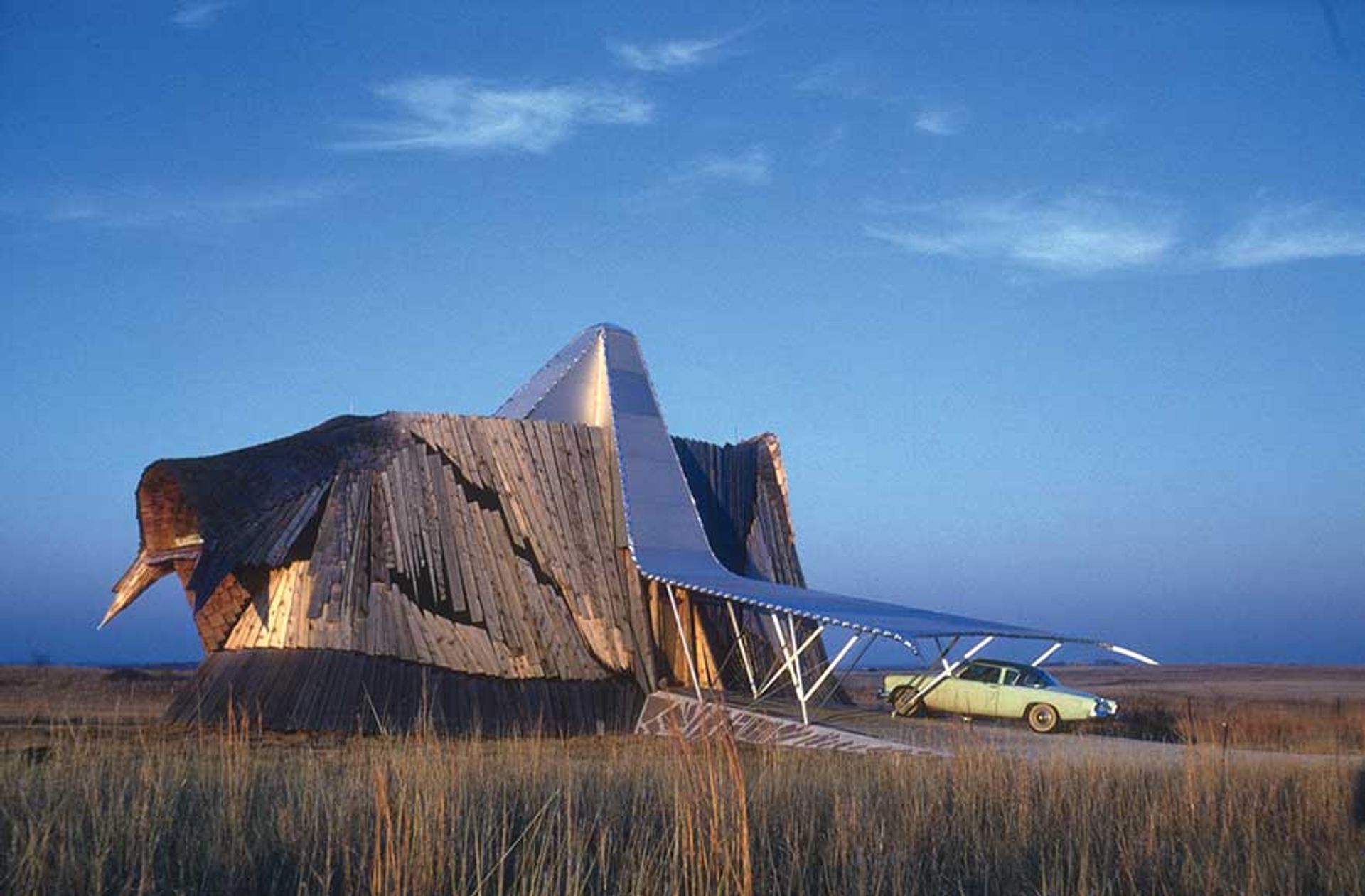
Spirit of the place: 1961 image of the organic form created from cedar boards and other local materials Photo: Robert Alan Bowlby
“I don’t know that Prairie House happens elsewhere,” Jennings says. “Things like it and the Bavinger House are products of the environment, where there are not always resources and you’re forced to be a little more industrious and find your own way and use the materials you have because you may not have the funds to get the materials you might want. There’s an ethos there that Prairie House embodies; it’s really hyper-specific and unique to the place.”
Because the Prairie House was in private ownership for so many years and is not visible from the road, even locals mainly know of it from the Life photographs. In the initial years of its stewardship, PHPS has offered the first-ever public tours, education programmes and sketching events, while working on long-term stabilisation and restoration. This year, the group is focusing on fundraising to support a new master plan for preserving the building as a community-oriented space with more regular access.
“It is very important for us to have it be an active space where creative activities can happen, like concerts, poetry readings, art workshops and presentations,” Cohen says. “Even when Uncle Herb and [his wife] Mary lived there, people would come from all over and would share what they were learning and what they were reading. There’s this exchange that we’d like to see happen there between artists, architects, writers and people who want to exercise their creativity.”
Cohen is also working on a feature-length documentary about Greene and the American School to give greater visibility to this nonconformist movement in architecture, where every house was individual to its place and people.
“The Prairie House is a poem to the prairie,” Cohen says. “It was built to reflect the prairie, to understand the prairie and to celebrate the prairie. It doesn’t look like a house. It’s really a sculpture.”