
Although Vincent van Gogh is most unusual in signing his work with just his first name, there has been no detailed investigation into why and how he used his signature. Some of the answers are now given in a study by the Amsterdam-based art historian Julia Engelmayer, Simply ‘Vincent’: An Overview of Van Gogh’s Signed Paintings, which has been posted online by the Van Gogh Museum.
Engelmayer starts with the figures, which may come as a surprise. Van Gogh created around 1,000 paintings, of which 840 survive. Of these, 133 bear a signature (or, in two cases, just an inscribed title). This represents only 16% of his canvases, an unusually low proportion for a 19th-century artist. Van Gogh’s colleague Paul Gauguin was much more prolific in this regard, signing 60% of his paintings—perhaps an indication of his overbearing confidence.
Van Gogh is even more unusual in that he signed with only his first name. He did this for two reasons. Vincent’s relations with most of his family, and particularly his father, were strained, although he remained very close to his brother Theo. In a December 1883 letter to Theo, Vincent wrote that, “in character I’m quite different from the various members of the family, and I’m actually not a ‘Van Gogh’”.
The other reason for sticking to his first name is that only the Dutch can easily pronounce his family name (with a guttural “ogh”): the English tend to say “Gof”, the Americans “Go” and the French “Gog”. As Vincent explained in March 1888 in another letter to Theo, he wanted just his Christian name to appear in a Belgian exhibition catalogue. It should be “the way I sign it on the canvasses, i.e. Vincent and not Vangogh, for the excellent reason that people here wouldn’t be able to pronounce that name”.
Signatures
Another surprise is the predominant colour that Van Gogh used for his signatures: red. This is found on 75 of the 133 signed works, just over half. It was then uncommon for artists to sign in such an eye-catching colour. Since Van Gogh was a reticent signer, it may seem curious that when he did so, he used an almost overbearing colour.
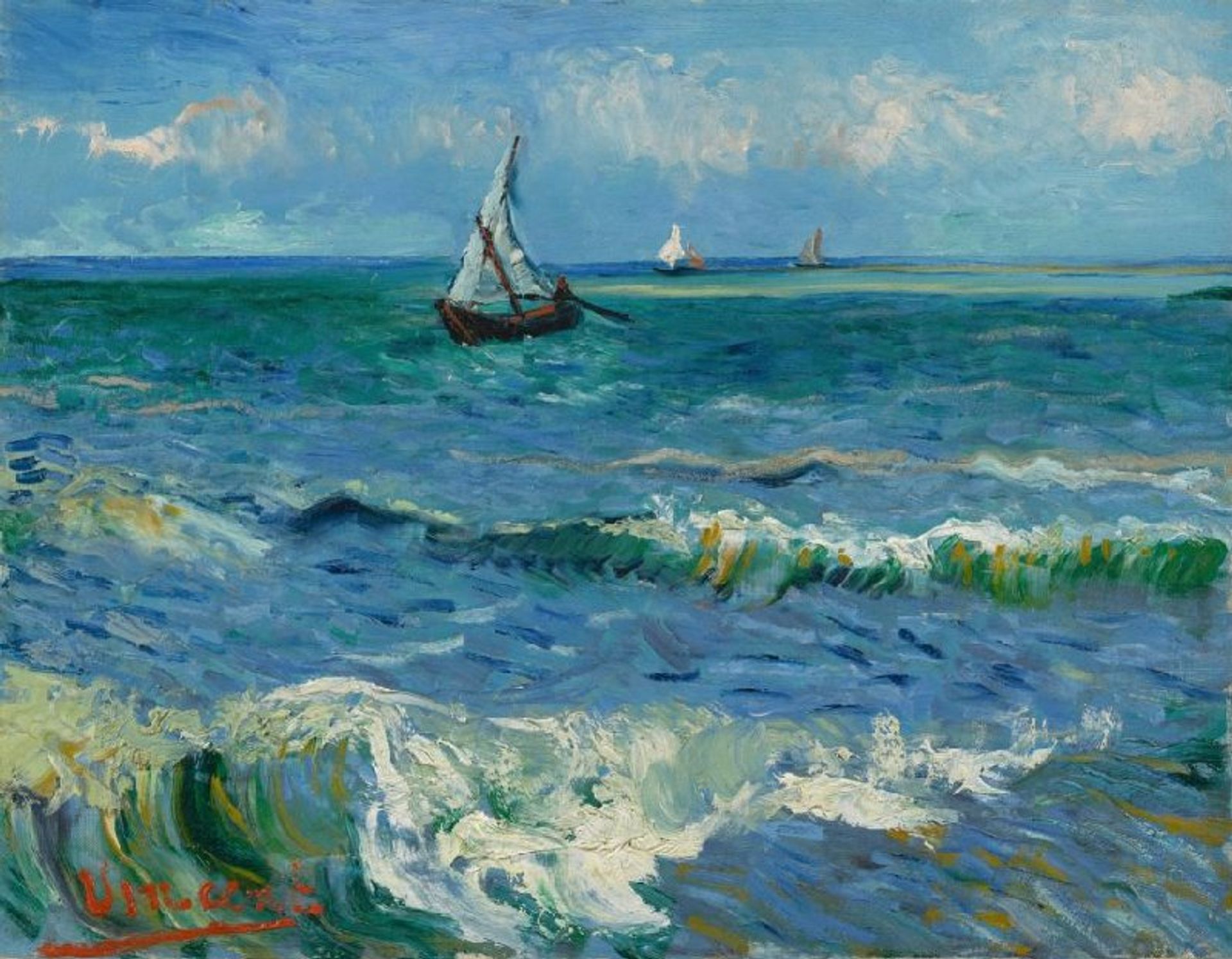
Van Gogh’s Seascape near Les Saintes-Maries-de-la-Mer (June 1888), with its prominent red signature in the lower-left corner
Van Gogh Museum, Amsterdam (Vincent van Gogh Foundation)
The fact is that Van Gogh loved using colour contrasts and complementary colours to striking effects when painted next to each other. For example, in Seascape near Les Saintes-Maries-de-la-Mer, he admitted that he was playing with arresting hues: “There’s a very outrageous red signature, because I wanted a red note in the green.” Red and green are complementary colours, directly opposite each other on the colour wheel.
Most artists sign their work horizontally, but over half of Van Gogh’s signatures are set at an angle, often at around 45 degrees. A striking example is in Portrait of Dr Félix Rey (January 1889), depicting the doctor who treated him after he mutilated his ear. Engelmayer suggests that sometimes angled signatures are “intended to create imbalance and a sense of unrest” in his striking compositions.
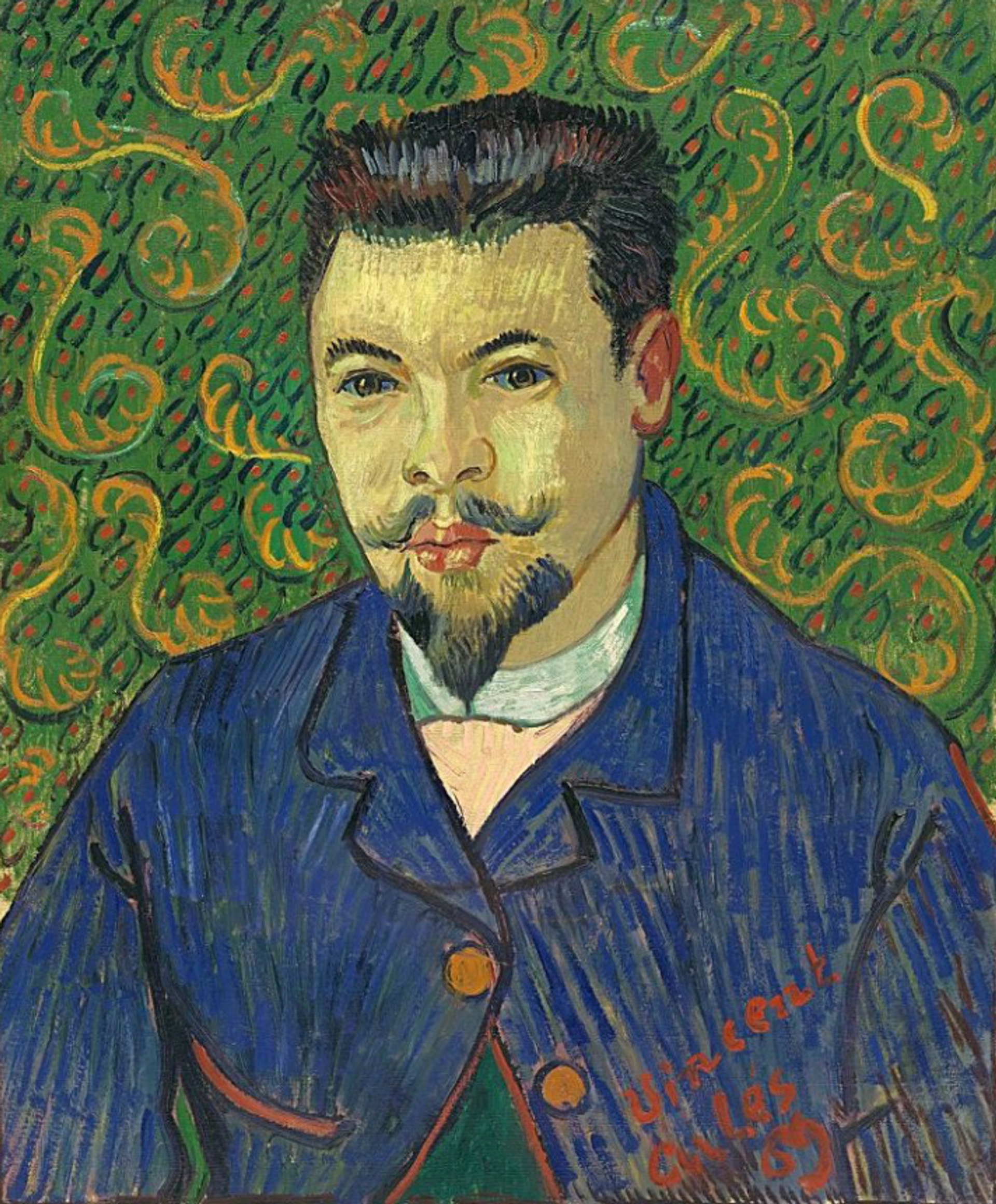
Van Gogh’s Portrait of Dr Félix Rey (January 1889), with its angled signature in the lower-right corner
Pushkin State Museum of Fine Arts, Moscow
Another distinctive feature of many of Van Gogh’s signatures is his use of a horseshoe-shaped “V”. These appear in 31 paintings from the artist’s Arles period. Examples include a portrait of his friend Joseph Roulin entitled The Postman (January 1889), and his Sunflowers series (1888).
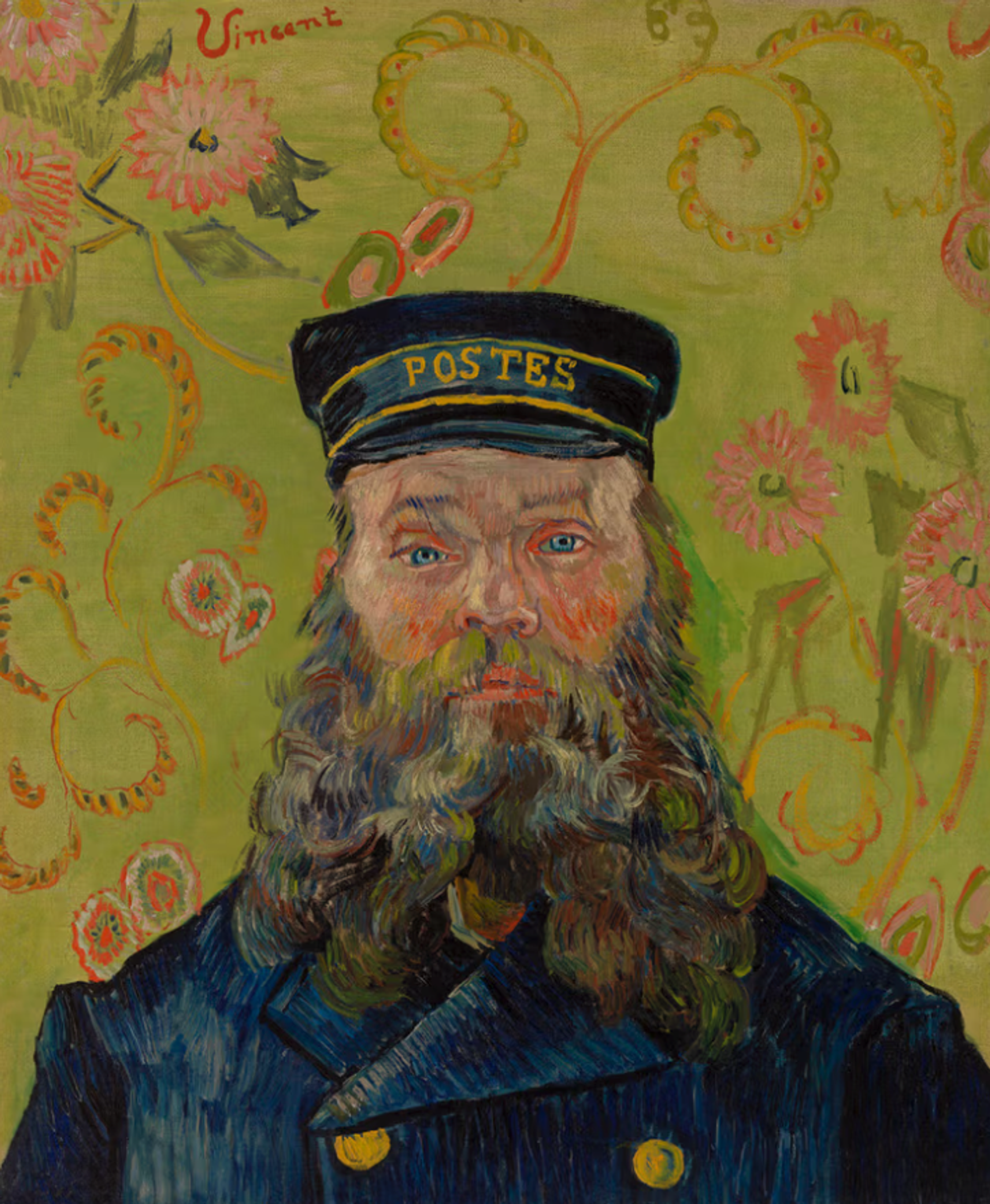
Van Gogh’s The Postman (Joseph-Étienne Roulin) (November-December 1888), with a horseshoe-shaped “V” in his signature in the upper-left corner
Barnes Foundation, Philadelphia
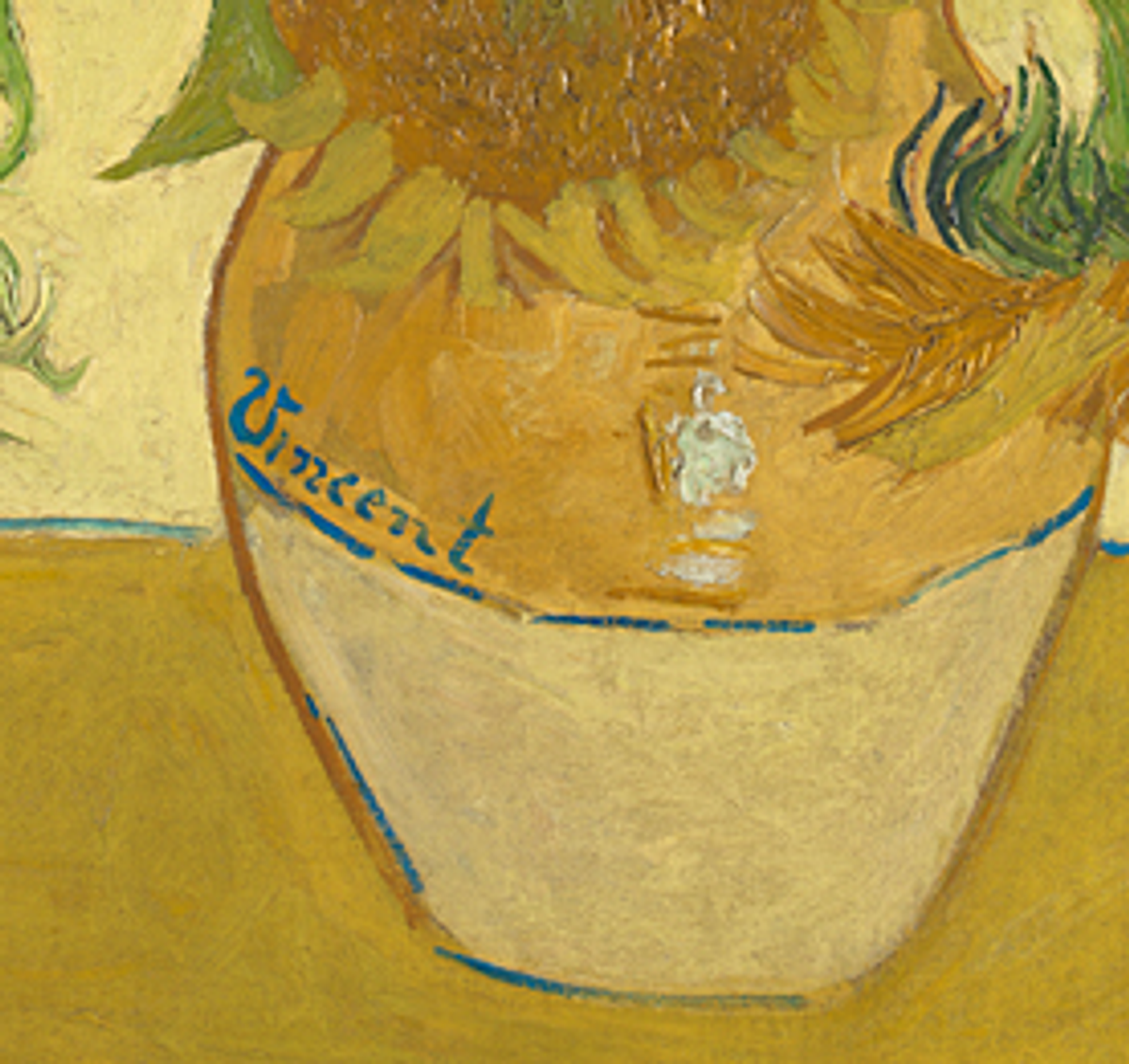
Most of Van Gogh’s signatures are in the corners, but very occasionally he would sign an element in the actual composition. On his sunflower paintings, he proprietorially inscribed his signature on the pot, emphasising that the sunflower was his own special motif.
On Van Gogh’s Chair (December 1888), the signature is placed on a curious box at the back of the composition. The meaning of the box remains obscure, since it is unclear whether it contains sprouting onions or flower bulbs.
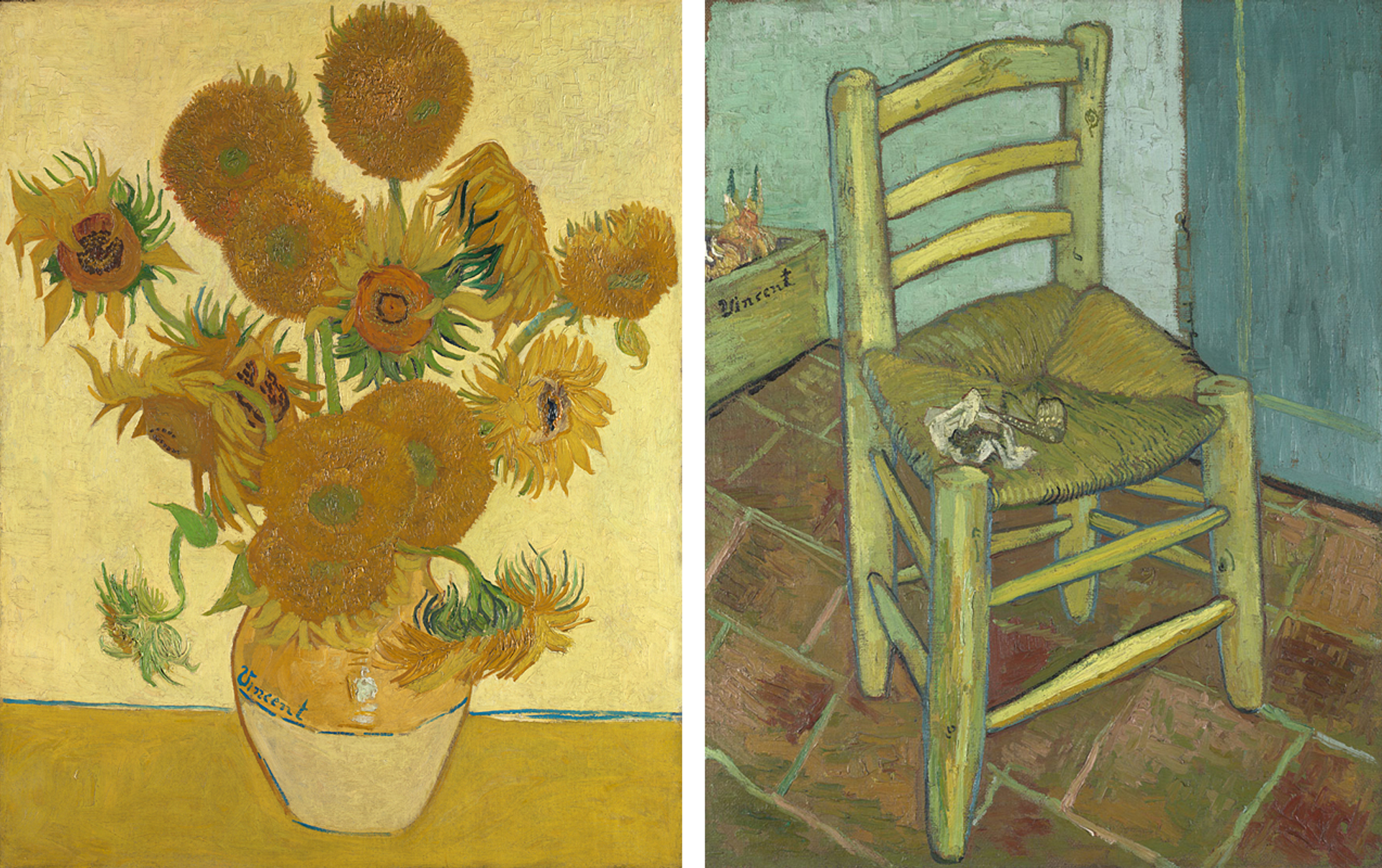
Van Gogh’s Sunflowers (August 1888) and Van Gogh’s Chair (December 1888), with signatures inscribed on objects
Both images courtesy National Gallery, London
Signing off
There were two main reasons why Van Gogh signed a painting. It was usually when he was particularly pleased with a work (believing that it might possibly sell) or when it was a gift for a friend or family member.
However, many paintings which are now regarded as his masterpieces were never signed. These unsigned works include Starry Night (June 1889), now at New York’s Museum of Modern Art.
Although Van Gogh’s earliest oil paintings date from 1882, he only began to add his signature in 1884. He signed 17 works in Nuenen, where he lived with his parents. It was in Paris, where he stayed with Theo from February 1886 to February 1888, that he was most prolific in his signing (57 paintings). Based in the world’s art capital, Van Gogh pursued his hope that he might be able to exhibit and sell his work, but sales eluded him.
Van Gogh continued to sign works after his move to Arles (50 paintings, but fewer in the last few months there following the ear mutilation). After his retreat to the asylum at Saint-Rémy-de-Provence, signing became rare (only seven paintings, presumably a reflection of his acknowledgement that he would not sell his work). At the end of his life, during his short stay in the village of Auvers-sur-Oise, he signed only one of his 73 paintings (and added an inscribed title on another).
As Vincent wrote to Theo in August 1888 from Arles: “I’d begun to sign my canvases, but I soon stopped; it seemed too silly to me.” This may have been a way of telling Theo that he was becoming increasingly despondent about selling his work.
In fact, the only identified painting which Van Gogh ever sold during his lifetime was completed ten weeks later, The Red Vineyard (November 1888). It remained unsigned.
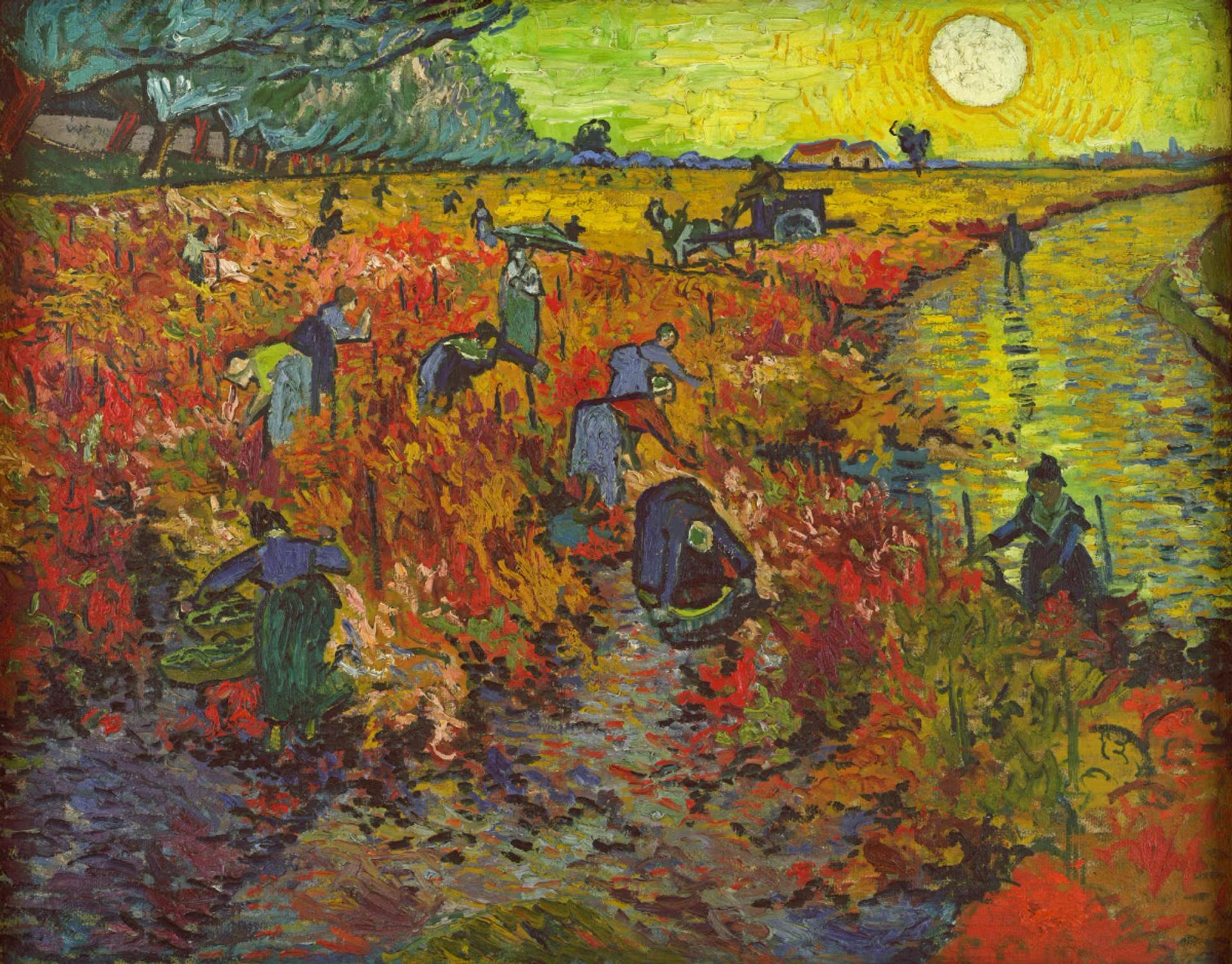
Van Gogh’s The Red Vineyard (November 1888), which was not signed
Pushkin State Museum of Fine Arts, Moscow
Engelmayer’s study does not deal with Van Gogh’s drawings. These were signed more often, but still represent only roughly a fifth of his output.
Today, when a Van Gogh painting comes up for sale at Christie’s or Sotheby’s, the auction houses go out of their way to stress if it is signed. For those with the funds, few things impress guests more than owning a canvas with the simple inscription, “Vincent”.