

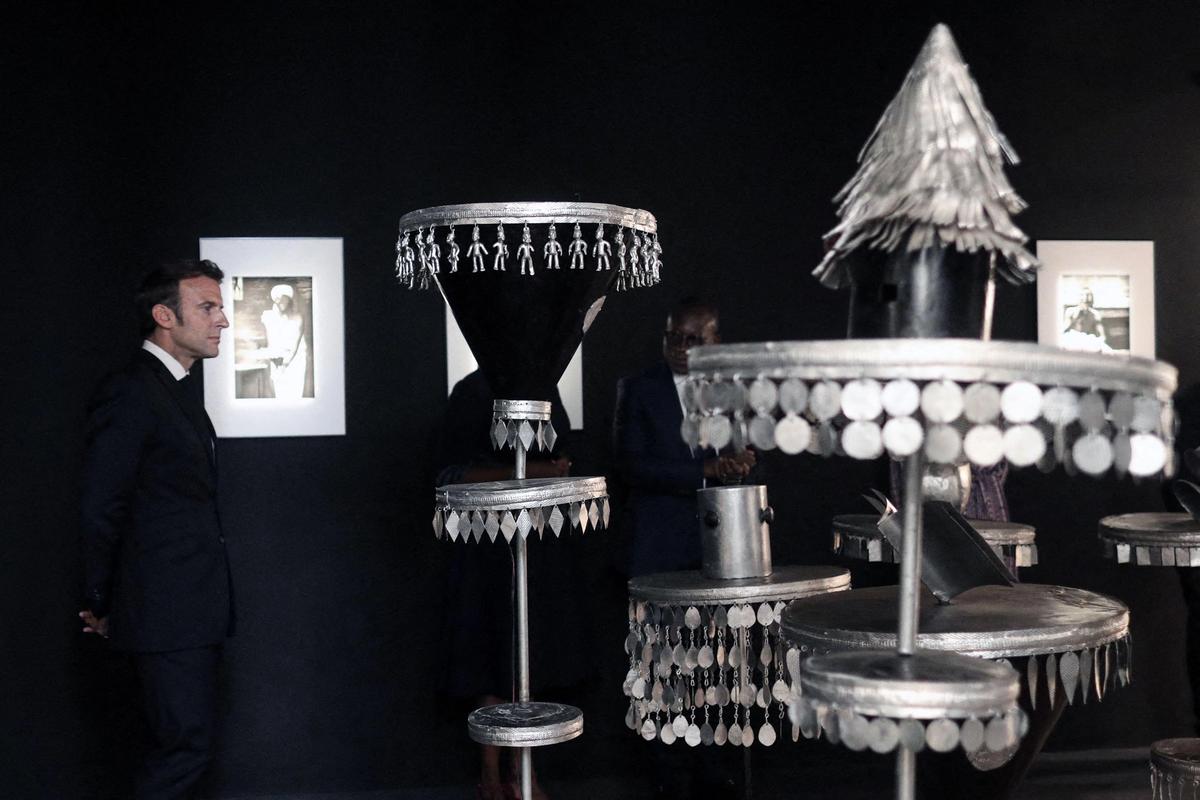
The French parliament is due to adpot a framework legislation for the deaccessioning of cultural items plundered from former colonies. Nine years after President Emmanuel Macron pledged repatriation of African heritage, the new law finally opens the way for the return of items illegitimately taken by force. The bill was initiated in 2023, but it has been delayed by political instability and changes of government as well as the sensitivity of the subject.
Presenting the bill to MPs before the vote, the new culture minister Catherine Pégard, praised its “universal character”, aiming to “promote a dialogue between the peoples”. She also reaffirmed the sacrosanct principle of “inalienability” of French public collections and insisted that the procedures for restitutions will be “strictly supervised” under the new law, which is inspired by a 2023 report by former Louvre director Jean-Luc Martinez. Although the minister thanked scholars Bénédicte Savoy and Felwine Sarr for a previous report commissioned in 2018 by President Macron, the law appears much more selective and controlled than what they had recommended.
Under its provisions, the request for a restitution must be introduced by a state, which would commit to protecting the relevant items and displaying them to the public. It would then be examined by a bilateral scientific committee, opening the way to a decree for their restitution, if it is proved that they had been stolen, looted, sold under duress or given by someone who did not have the authority to do so. Military items, public archives as well as the shares of archaeological digs are excluded. Furthermore, the legislation applies only to the period between the Vienna Congress of June 1815, in the wake of Napoleon’s fall, and April 1972, when Unesco’s convention for the protection of cultural heritage came into force. All cases relating to objects allegedly stolen after 1972 must be submitted to a civil court. Even if the government was at first reluctant, the senate has imposed the creation of a national scientific commission, which will publish an annual report.
While the vote was unanimous, some MPs expressed their reservation on the date of 1815, pointing out that it excluded not only booty from Napoleon’s army throughout Europe and Egypt but also earlier transfers of cultural properties from the Americas, such as the Aztec or Maya Codices claimed by Mexico. An amendment proposed by leftist MP Éric Coquerel to suppress the 1815 dateline was rejected by the assembly. The culture minister opposed the amendment, pointing out that a French-Mexican scientific commission has been working on the subject since 2024 and have suggested digitisation of the illustrated manuscripts.
Requests for restitutions are also pending from Algeria (personal effects of the rebel leader Abdel Kader), Benin (most notably a statue of the Vodun god Gou), Ivory Coast (around 150 objects), Madagascar, and Mali (objects taken by the 1931 Dakar-Djibouti ethnographic expedition). Mali is also requesting, along with Senegal, the return of the “hoard of Ségou”: gold and jewels from the Toucouleur kingdom which were unearthed by French troops in 1890. Ethiopia and Chad forwarded a general request in 2019 with no list attached.