

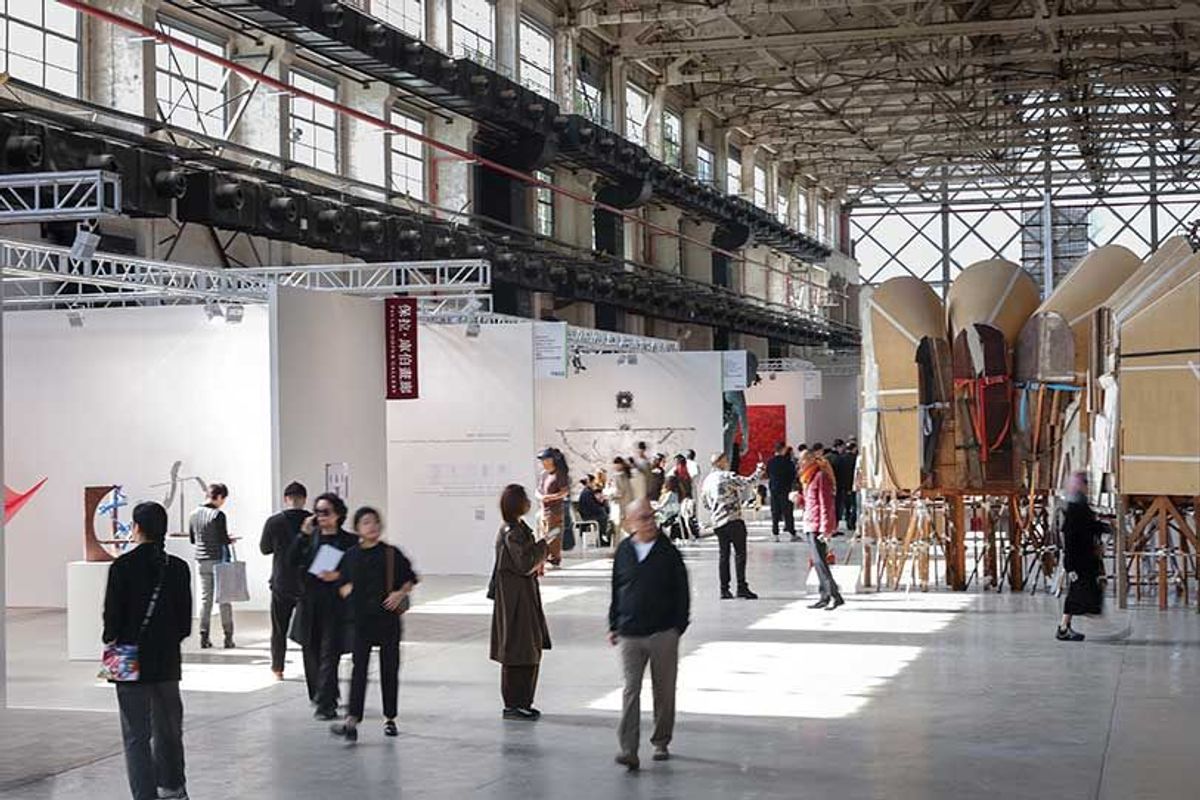
Shanghai is a restless city. Its impatient hustle may spare its art scene from the plateau of middle age as it navigates a crisis of transition after the Covid years derailed its late 2010s momentum. Going into Shanghai’s annual art week (10-15 November), with two established fairs anchoring an explosion of art events across the city, its galleries, artists and institutions are assessing how the city’s art market can weather China’s economic slowdown and whether the cultural momentum of the past three decades can be sustained.
Art here doesn’t operate as an isolated system; it is constantly in conversationCherry Xu, collector
“Shanghai has so many galleries, so many museums, so many eccentric little spaces that you could come in the middle of summer and still see art non-stop,” says Lorenz Helbling, who founded ShanghArt in 1996. One of the first contemporary art galleries in China, it now has locations in Shanghai, Beijing and Singapore. The Swiss transplant says the volume of artistic activity in the city of 25 million people can be compared to New York’s, though the scene can be harder to find. “You can make a lot of fun things here.”
The city’s two large-scale fairs, Art021 Shanghai (11-14 November) and West Bund Art & Design (10-15 November), established in 2013 and 2014 respectively, set the barometer and prime the mood. So far, Shanghai’s core galleries have largely survived China’s property crash and deflationary economy, but they need young artists and new collectors to continue buoying their businesses.
Lise Li, who founded Shanghai’s Vanguard Gallery in 2004, says the city is “still in an upward phase, just growing much more slowly than before”. During art week, Li’s gallery will participate in the second iteration of the boutique fair Hangover Shanghai (11-15 November) and in Art021, while showing the artist Tang Chao in the gallery and collaborating on a group show at the artist-run 33ml Offspace. Several artists represented by Vanguard are having big moments nearby: Liao Fei will simultaneously be showing at Hangzhou’s Imagokinetics and the artist group known as Jiū Society has an exhibition at Nanjing’s Beiqiu Museum of Contemporary Art.
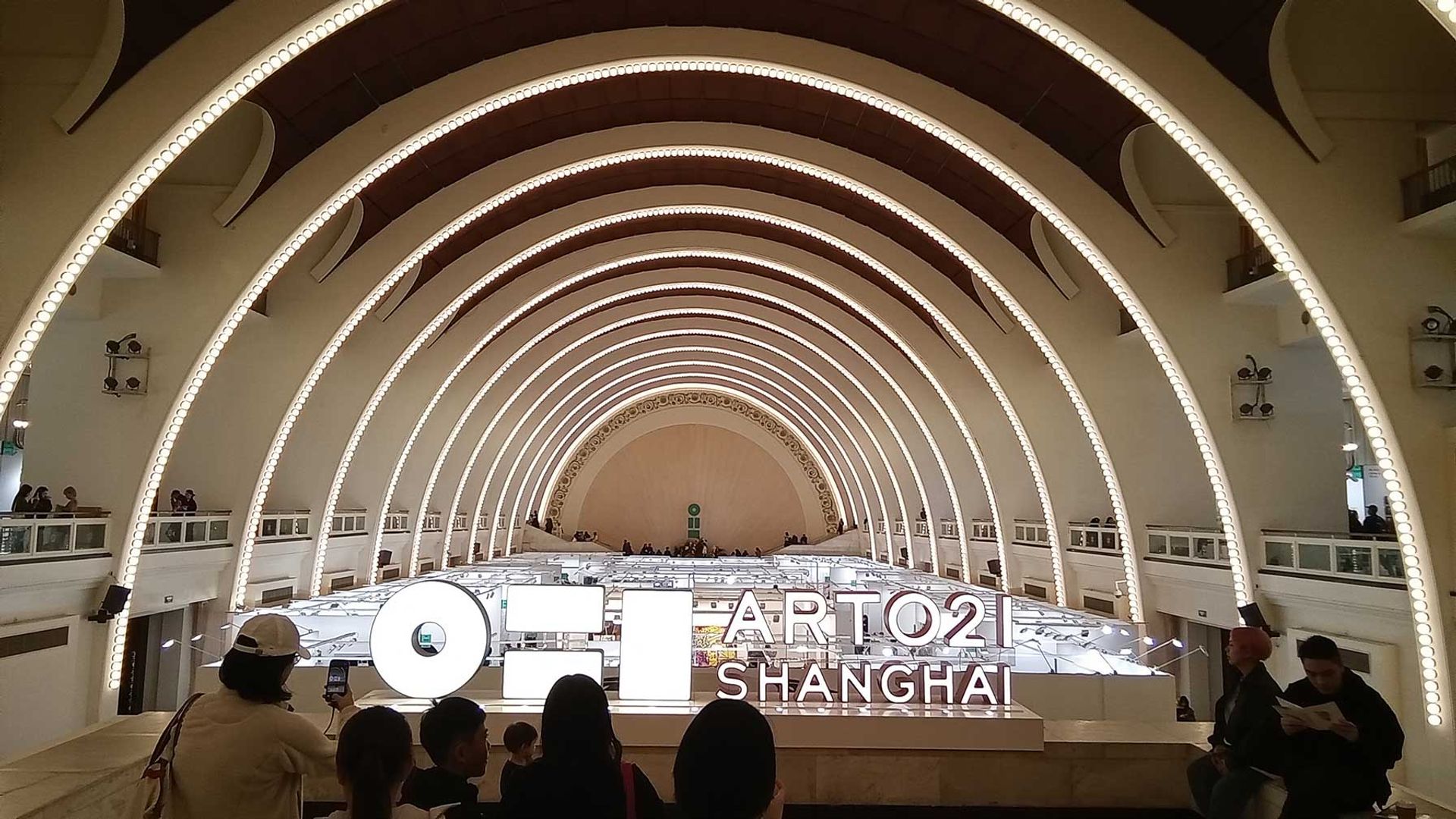
Established in 2013, Art021 Shanghai (pictured in 2025) is one of the most successful art fairs in the city Photo: Lisa Movius
Though the buzz of the 2010s has quieted, Li says, “there are quite a few more art institutions, and more newcomers are getting involved. The number of young artists is increasing rapidly; we see a lot of new faces every year. But most exhibitions are relatively conservative, which is rather a pity.”
The market has “changed considerably” compared to what now “might be called the ‘golden 15 years’ of China’s contemporary art market: the shift in the broader economic environment over the past few years has been impossible to ignore”, Otto Neu says. In 2022 he co-founded Nan Ke Gallery, which has a group show about art and literature on view during the fair week. “For artists and galleries alike, it is certainly a challenging moment. We probably have to work twice as hard as we did before simply to survive and keep things moving.”
Change, Neu adds, does not have to be negative. He cites the Chinese expression “great waves wash away the sand and leave the gold behind”, adding that “difficult periods can force an industry to become more focused, more rigorous and perhaps more honest about what really matters. In that sense, this may also be an important stage of maturation for Shanghai’s art scene.”
In addition to this month’s two international art fairs, Shanghai’s many resident artists—ranging from established figures like Ding Yi, Zhang Enli and Yang Fudong to mid-career and emerging talents—can rely on year-round programming at a healthy variety of homegrown and imported galleries. Western outfits like Almine Rech, Perrotin and Lisson maintain spaces in Shanghai, as do Asian powerhouses including Japan’s Ota Fine Arts and Korea’s Arario Gallery. ShanghArt has been joined by several influential local galleries, among them Antenna Space, Gallery Vacancy, Capsule Gallery and Don Gallery.
Major state-backed museums like the Power Station of Art, Museum of Art Pudong and West Bund Museum (which is partnered with the Centre Pompidou in Paris) have a complement of private museums that have proliferated since the 2010s. The Rockbund Art Museum, Long Museum and Yuz Museum are the best known, but smaller, newer, specialised or further-flung institutions like Fotografiska and the Museum of Glass, and non-profit spaces like Pond Society, Longlati and Prada Rong Zhai, have also enriched the Shanghai art ecosystem.
Vanguard Gallery’s Li credits Shanghai’s “open-city vibe” and its large base of collectors and visitors, along with the museums, galleries and artists, plus a citizenry curious “about fashion and new things, a strong history of business, and a diverse cultural structure. The main downside is that the cost of living is too high.” The lack of art information platforms, even in Chinese, is the other main challenge, she says.
The sense of openness is what drew the collector Cherry Xu to open her art-meets-fashion space Cheruby in the city last year. With new initiatives, “the boundaries between artists, designers, musicians and people working in fashion are becoming increasingly blurred”, she says, opening the art world to new audiences. “This kind of natural crossover between different fields is something very particular to Shanghai,” Xu says. “Art here doesn’t operate as an isolated system; it is constantly in conversation with design, music, fashion, technology and a broader youth culture, with these different communities influencing one another.”
Pragmatic chaos
Compared to Beijing’s art scene, Neu says, Shanghai’s creative community maintains a “healthy sense of distance. There is a certain independence between galleries, institutions, artists and collectors, which has shaped a rather distinctive ecosystem here”, a happy, pragmatic chaos of sorts. Beijing’s art scene is built on personal connections, Neu says, while in Shanghai, “between institutions, between galleries and even between galleries and collectors, there is often an understanding that business is business, friendship is friendship, and collaboration does not necessarily require complicated personal obligations or relationships”.
However, Neu adds that those divisions could become vulnerabilities in the current economic upheaval. “Perhaps this is precisely the moment when Shanghai’s art community needs to become a little more connected and cohesive than it has been in the past—not by giving up its independence, but by finding better ways to support one another,” he says.
Helbling says that Beijing is “more split up into scenes which work on their own”, while Shanghai has various circles that interact and are more permeable. He likens the city’s art community to its fairly compact geography, with the art neighbourhoods all within comparably easy reach of each other.
Twenty years ago, Shanghai was the upstart artistic challenger to Beijing, the political capital home to China’s leading art academy. Hong Kong’s concurrent cultural rise proved complimentary to Shanghai’s, and many in Shanghai say the expanding art activity in Korea, Japan and Singapore—as well as in mainland Chinese cities like Chengdu, Shenzhen and nearby Nanjing, Hangzhou and Suzhou—have been net positives for the local scene.
“This situation didn’t happen overnight; it’s the result of years of collaboration between Shanghai’s art institutions, galleries and fairs, as well as the collectors and artists living here,” Li says. “It’s not simply due to fairs or art weeks alone. The rise of art in new Chinese cities has also become developed, likely influenced by Shanghai and Hong Kong.”
Shanghai “was one of the earliest cities in China to develop a contemporary art market, and its relatively open culture and international outlook have given it a particular advantage”, Neu says. “Whether we are talking about collecting, aesthetic awareness or public understanding of contemporary art, Shanghai has accumulated more than two decades of experience and audience development. That kind of cultural infrastructure takes time to build.”
He adds that growing art scenes in other mainland cities represent “something very positive for Shanghai rather than a threat. A stronger regional art ecosystem ultimately creates more audiences, more conversations and more opportunities for everyone. Healthy competition and exchange between cities can only make the broader Chinese art scene more dynamic.”
Regionally, Xu says, Shanghai “has a very distinct local culture, its own audiences and creative communities, [while] its relationship with other Asian cities is becoming much more direct. It feels increasingly natural for artists, curators and other creative practitioners to live and work across different cities in Asia, and for us to look to what is happening in Tokyo, Seoul, Hong Kong, Singapore, Bangkok and elsewhere in the region, rather than instinctively treating Europe and the US as the only points of reference.” For Shanghai’s art week, Cheruby is showing a solo exhibition by the multidisciplinary Thai artist Tanat Teeradakorn.
More dialogue
“Shanghai has an interesting place within this network,” Xu says. “It has a relatively mature art infrastructure, but also very strong fashion, design, commercial, technological and popular cultures, and these worlds exist very close to one another in everyday life. It also has a large and increasingly young audience, so when an artist comes to Shanghai, they are encountering more than an established ‘art world’; they are entering a complex and fast-moving urban environment that is constantly being reshaped by new forms of consumption, technology and youth culture. That complexity creates a lot of possibilities.”
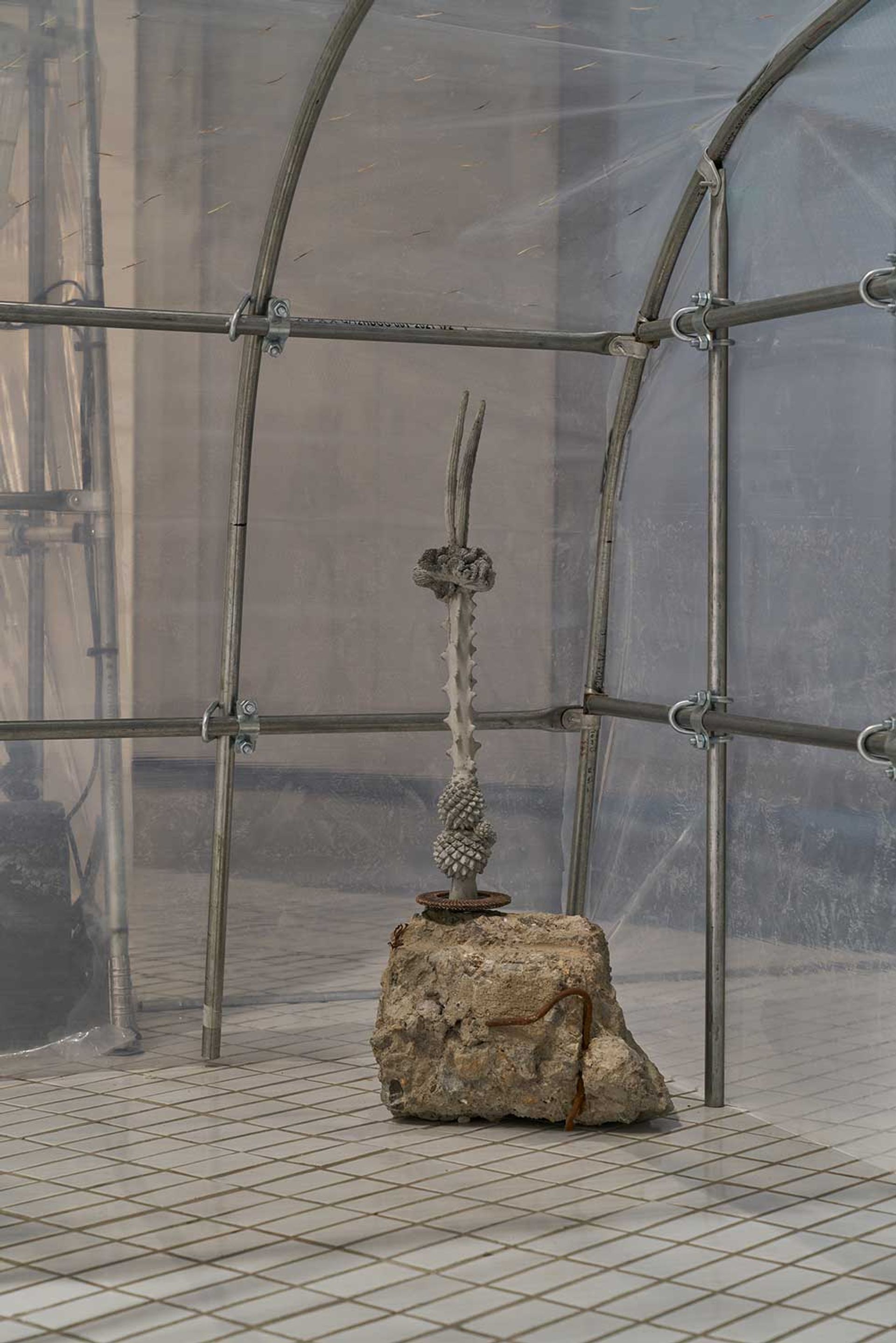
Zhang Ruyi, whose 2022 exhibition at Beijing’s UCCA Center for Contemporary Art is shown here, is among Shanghai’s mid-career artists to watch Photo: Sun Shi; courtesy UCCA Center for Contemporary Art
After helping to build the careers of some of Asia’s biggest art stars, Helbling now focuses on cultivating rising talents through more group shows and dialogue. “You always look at what artists are doing,” he says. “Many of them now operate between here and the West—educated here and in the West”, with networks and roots in both cultures.
After suspended mobility during the Covid years, dual-culture artists in Shanghai and across Asia have resumed their frequent travels between regions. Often the children of artists or collectors, young Chinese artists are very well versed in both Western and Asian artistic traditions, giving them a sophisticated perspective. “They have an interesting job to do to figure out what kind of art makes sense today,” Helbling says.
He recalls the “loneliness” of Shanghai’s 1990s avant-garde, now rendered “impossible” by contemporary art’s citywide popularity. Still, he views the 2000 internationalisation of the Shanghai Biennale, the first contemporary art fair SH Contemporary (2007-14), and the flowering of galleries and museums as all part of one era.
“There was from the 1990s when Shanghai opened up until the Covid time, and there is after Covid time,” he says. “The first 30 years, and now the second 30 years.”