

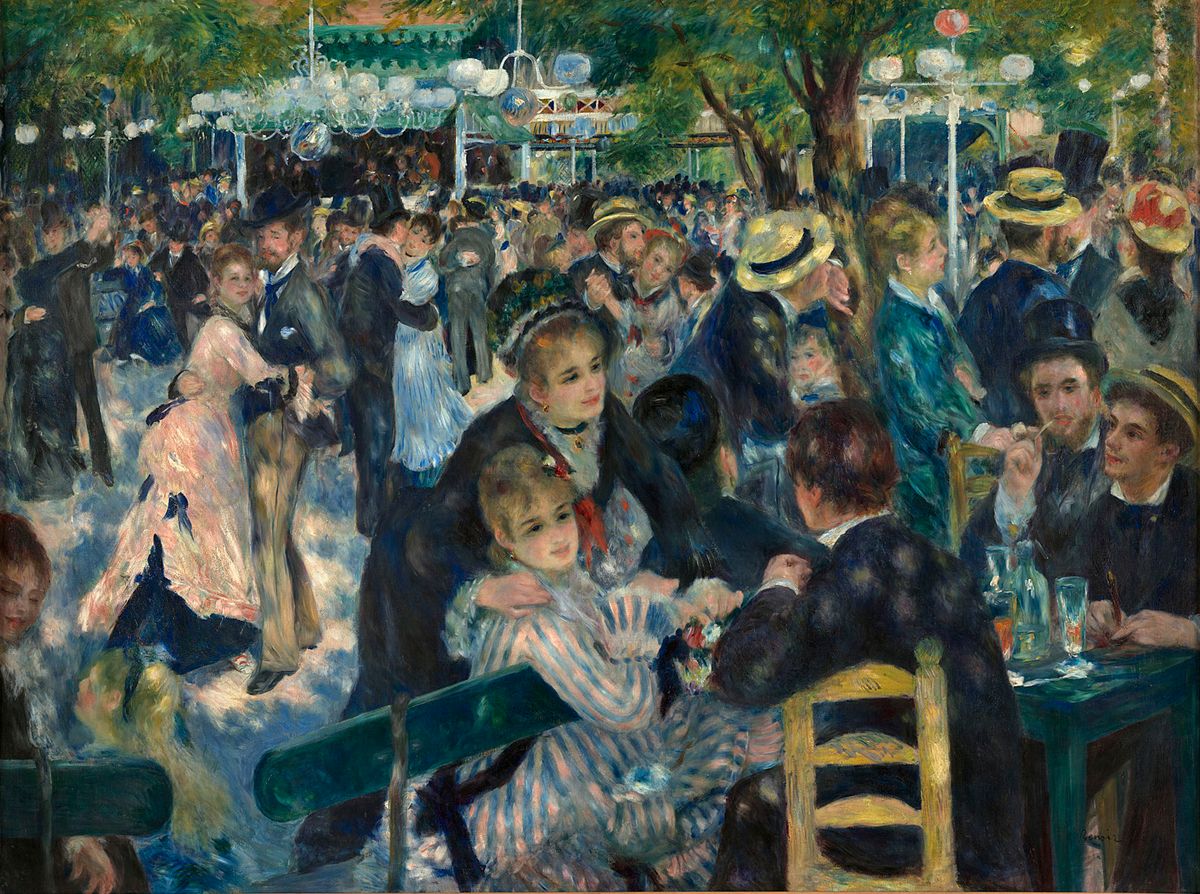
“These young people are enjoying life, the beautiful weather, the morning sun shining through the foliage; what do they care about the rest of humanity?” So wrote Georges Rivière, writer and champion of Pierre-Auguste Renoir, of the French painter’s Dance at the Moulin de la Galette (1876), one of the highlights of Renoir and Love at London’s National Gallery (until 31 January 2027). “They are happy,” Rivière added, “and these are the words that come to mind of all who see this charming painting. None has given me more pleasure than this one.”
“Beautiful”, “happy”, “pleasure”—these terms sit uncomfortably with what John Elderfield, former curator at New York’s Museum of Modern Art, described to the painter Howard Hodgkin as “the modern attraction to difficulty”. Paul Perrin, co-curator of the Renoir show, writes in its catalogue that the “blissful couples and air of happiness” in Renoir’s 1860s to 1880s paintings have made them “immensely popular” yet also prompted “contempt for their apparent lack of complexity and depth”. His assessment was newly confirmed by the critic Eddy Frankel, writing recently in The Guardian: “I’ve hated his work for decades.” For him, Renoir only appeals “when his nudes look like a super-psychedelic, ultra-horny version of Rubens”.
Renoir himself understood that milder emotions irked critics. “It’s hard to get people to admit that a painting can be great painting and still be happy,” he wrote. But love, as framed in this show, has multiple forms, among them empathy. Specialists suggest that Renoir was not ignorant of the “anguished or miserable” elements of life that Perrin describes as being essential to many conceptions of modernity. When Rivière wrote about young people dancing in ignorance of the rest of humanity, he didn’t need to add that happiness can be fleeting and is often most intensely felt at its briefest.
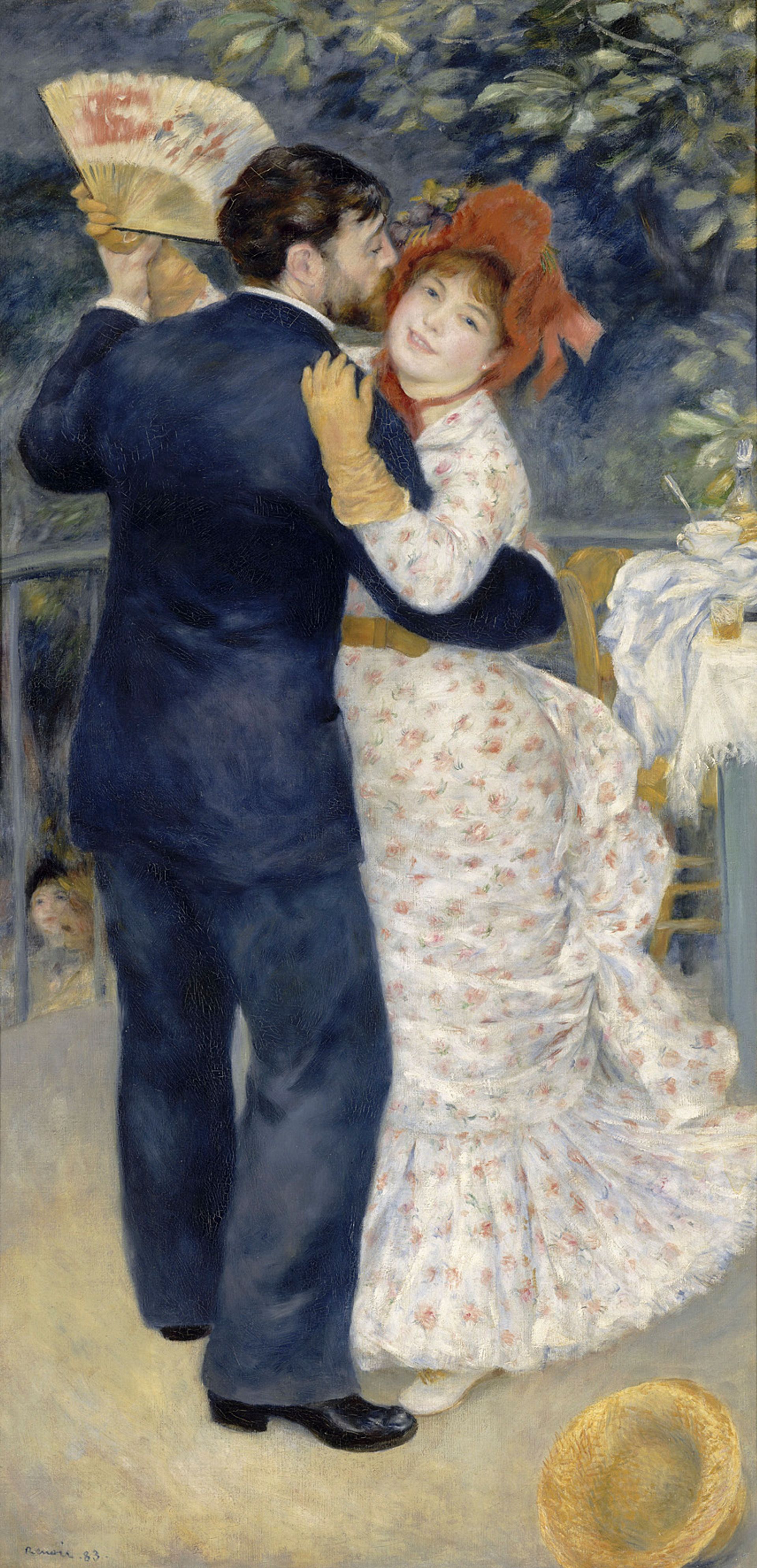
Renoir’s Dance in the Country (1883) © RMN-Grand Palais (Musée d’Orsay)/Hervé Lewandowski
The writings of Baudelaire, and the paintings of Renoir’s peers like Degas and Manet, tell us how visible hardship would have been at the time. And Renoir, unlike those two peers, grew up in working-class Paris, so had lived experience that gave him, as Rivière wrote, “a keen sense of pity” for the poverty of “Montmartre families”. But Renoir clearly felt that if he did want to create great, happy art, he had to avoid troubling subject matter: “There are enough annoying things in life for us not to make more of them,” he said.
Rococo pleasures
Another factor in Renoir’s commitment to joy and play was his deep admiration for what he saw as the golden age of French painting: the Rococo. As Mary Morton writes in the Renoir and Love catalogue, the work of artists like Jean-Antoine Watteau and Jean-Honoré Fragonard “embodied graceful pleasure and a harmonious relationship between the human figure and nature”.
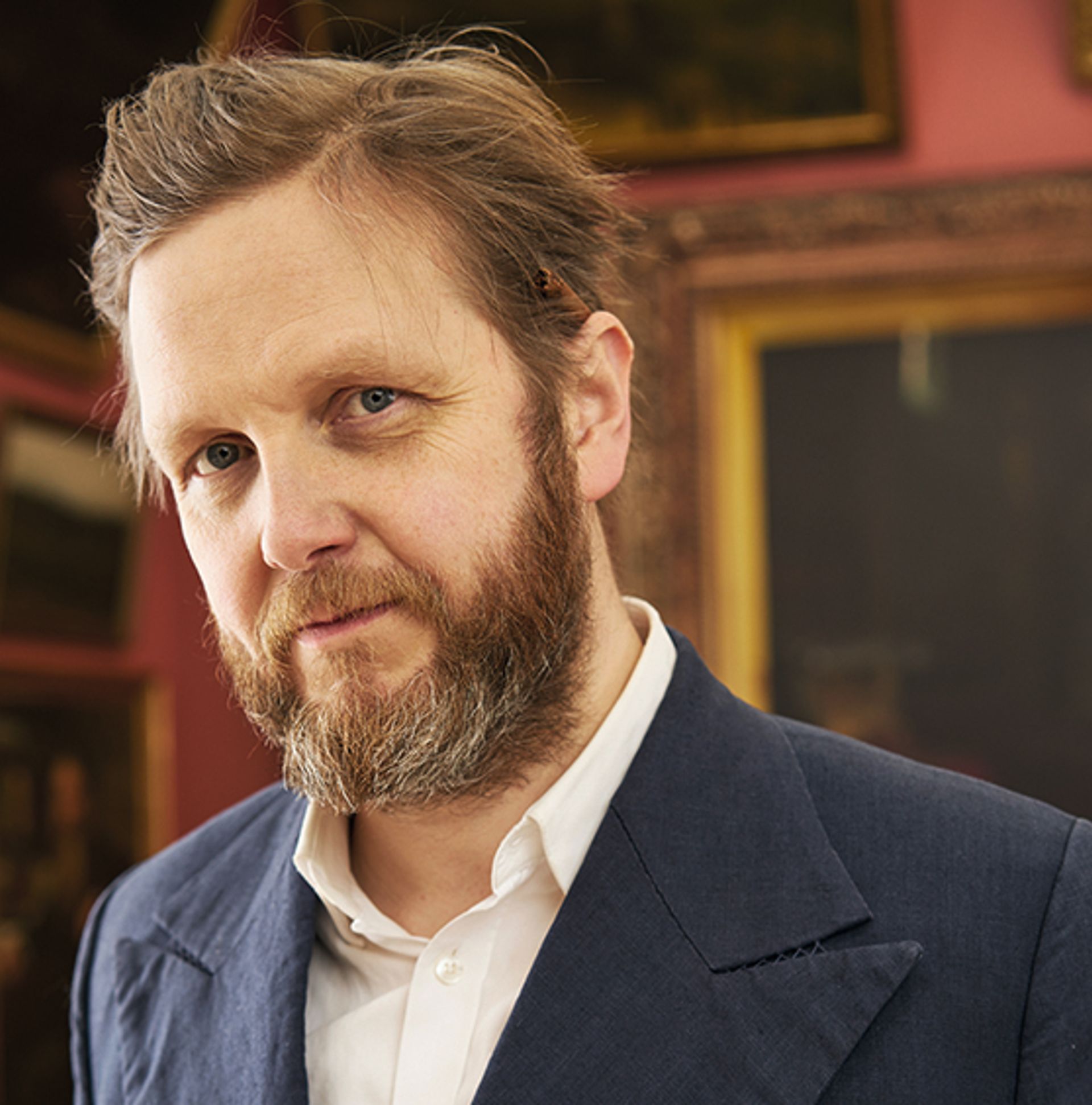
Artist Ragnar Kjartansson Rafael Pinho
Renoir shares this infatuation with Rococo with a contemporary artist who I think has come closer than anyone else to creating a great art of happiness: Ragnar Kjartansson, whose exhibition Weekdays in Arcadia opens at the Goodwood Art Foundation in Chichester this month (26 November-12 April 2027). Kjartansson told me in 2017 that his fascination with the period lies in the “contrast of really intellectual minds and… silly-billy nothingness”. At Goodwood, he will show No Tomorrow (2022), a video installation that extends his 2017 dance collaboration with choreographer Margrét Bjarnadóttir and composer Bryce Dessner. When I saw the original ballet, in which a group of female performers dressed in jeans and white T-shirts dance with acoustic guitars for the duration of the piece, one moment made me instantly grin: arranged in a grid, every other dancer would take it in turns to leap into the air while the performer next to them stood still, prompting a joyous effect of corporeal effervescence. Kjartansson told me he and Bjarnadóttir felt No Tomorrow was “a Watteau painting in disguise”.
Kjartansson’s most famous piece, The Visitors (2012), a video installation in which he and his friends perform a song in different rooms of a half-derelict mansion in New York State, provokes a similarly ecstatic response from its viewers. But Kjartansson was conscious, perhaps with the reputation of artists like Renoir and of the Rococo period in mind, that he was “in danger of becoming the feel-good artist”. And indeed, part of what makes him such a compelling figure is that the light of his work always comes with copious amounts of shade. At Goodwood, he is interested in “the idea of encountering monuments to sorrow and shakiness in the woodlands”. And yet, I suspect he will find ways to make us smile amid the melancholy.
Achieving joy in art is difficult. Perhaps the most perceptive observer of this fact is one of Renoir’s artistic heirs, Henri Matisse, who spoke of the anguish behind the pleasure in his work: “this happiness, this light and this serene wisdom that [have] seemingly become mine are sometimes earned through the harshness of adversity”. Matisse and, I think, Renoir—like Kjartansson—knew that achieving happiness is a deadly serious business.