

Glacial, calculated, distant, sly: these are among the adjectives used to describe the “godfather of conceptual art” Marcel Duchamp (1887-1968). In the opening chapter of Impossible, a monograph by the prominent Duchamp scholar Francis M. Naumann, the artist appears as a (mostly) reticent introvert. But over the course of 192 richly illustrated pages, that familiar, spectral figure becomes flesh and blood: tender, wistful, even romantic. Duchamp falls in love.
Naumann’s account of the French-American artist’s relationship with the Brazilian sculptor Maria Martins (1894-1973) unfolds through a series of speculative scenes that draw, at times uneasily, on the conventions of the romance novel, interwoven with formal analysis that demonstrates reciprocal artistic influence. The author’s nearly five decades of writing on Duchamp, along with the rigorous notes and chronology included at the back of the volume, help temper any initial scepticism about the balance between projection and documentation. From Duchamp and Martins’s first meeting in March 1943 until their respective deaths five years apart, Naumann argues that the two sustained a profound emotional connection, even if the most intense—and presumably physical—phase of their relationship lasted less than a decade. Despite Duchamp’s evident longing, Martins never left her three children or her husband, a Brazilian ambassador to the US.
What first attracted the two artists intellectually to one another is not fully known. But from early on, Duchamp was no longer indifferent, at least where Martins was concerned. Asked to design an announcement for an exhibition at Julien Levy Gallery in December 1943, he placed a cupid figure atop a chessboard depicting an endgame problem with no way to win. “There is no solution,” the artist had famously said, “because there is no problem”. Now, however, there was a problem. Despite a previous marriage and a long-term relationship with the American artist Mary Reynolds, Duchamp had never been in love before. At this point, 26 years had passed since he made Fountain and 20 since he had declared The Bride Stripped Bare by Her Bachelors, Even (The Large Glass) definitively unfinished. It was the problem of Martins, Naumann suggests, that reanimated Duchamp’s interest in making—shifting the affair from a biographical register into a lens through which to view Duchamp’s late work.

The Impossible, III (1946) by Maria Martins is a comment on her relationship with Duchamp © MoMA, New York
Intimate exchange
As the relationship develops, Naumann focuses on the lovers’ sculptures, exchanged or produced in parallel, as a metonym for the physical encounters he is otherwise obliged to omit. There is Paysage fautif (faulty landscape), an intimate piece made with his own seminal fluid on plastic and backed with black satin, that Duchamp gave to Martins in 1946. And then her cast bronze The Impossible, III (at the Museum of Modern Art in New York) from the same year, in which two creatures, their heads ringed in tendrils, reach toward one another in a gesture that is at once an embrace and a devouring. Martins was, Naumann writes, “unquestionably referring to the impossibility of her relationship with Duchamp”. The goddess figures borrowed from Brazilian folklore that populated her second show at the Valentine Gallery in New York became increasingly abstract and psychologically charged as her career progressed, perhaps reflecting Duchamp’s own preference for the cerebral over the real, the concept over the image.
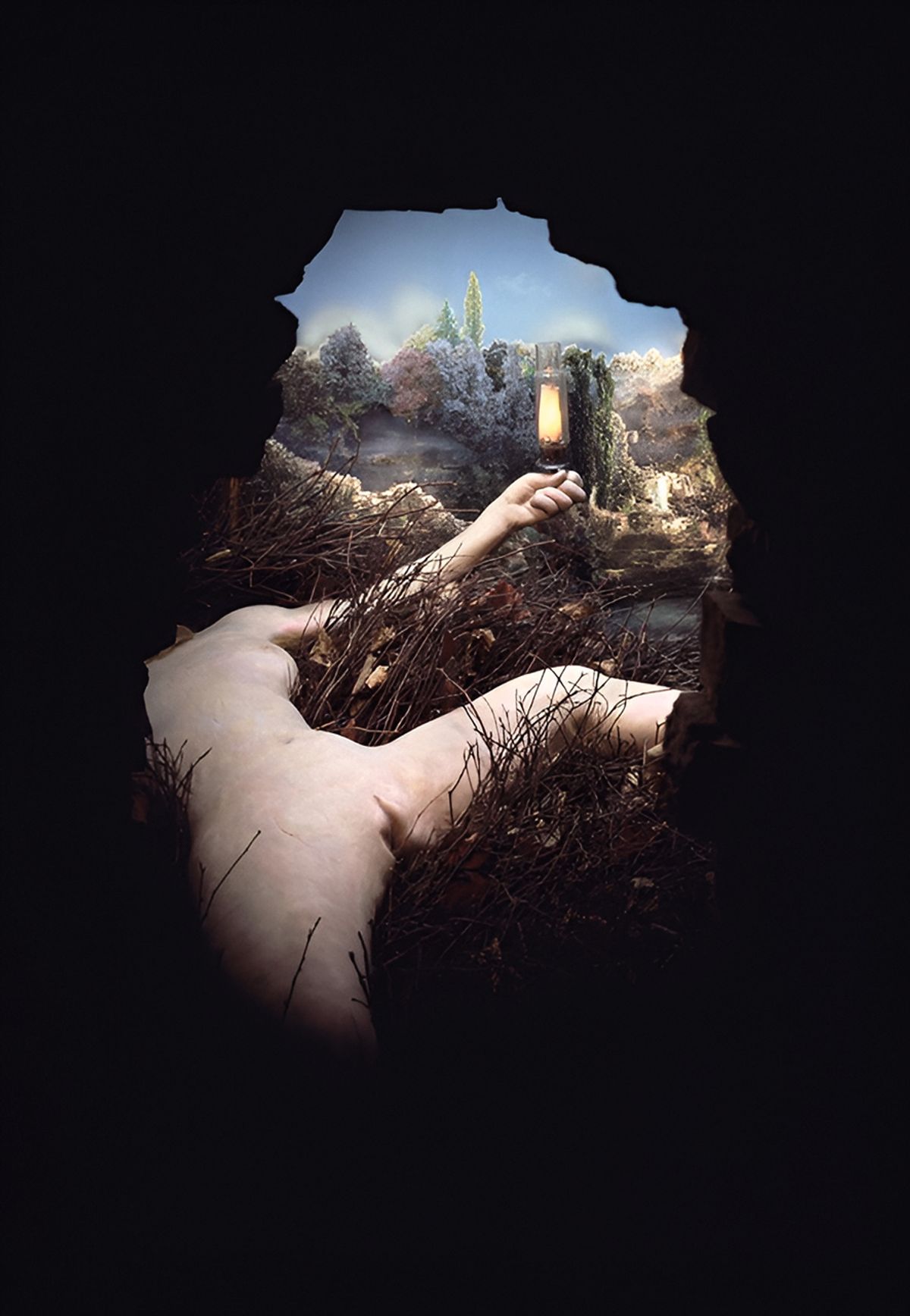
There is then no shortage of confusion surrounding Duchamp’s final work, Étant donnés: 1º La chute d’eau, 2º Le gaz d’éclairage (Given: 1. the waterfall, 2. the illuminating gas, 1946-66). Why, after decades of apparent withdrawal, would the celebrated Modernist devote 20 years to a highly illusionistic installation of a nude woman posed in a landscape that recalls Gustave Courbet’s The Origin of the World (1866)—the very tradition of “retinal art” he had long disavowed? Naumann’s retelling, which frames the work as the culmination of their coupling, is in this sense instructive. Martins emerges not merely as muse or model but as collaborator. She lends her body to be cast, but also choreographs its position, advises on process and technique. There is no precedent in Duchamp’s oeuvre for the imagery, yet echoes of Martins’s prints and sculptures persist in both the figure and the vegetal setting. Even after she returned to Brazil and their contact waned, Duchamp retained, through work on the diorama, a means of beholding her body and sustaining their artistic tête-à-tête.
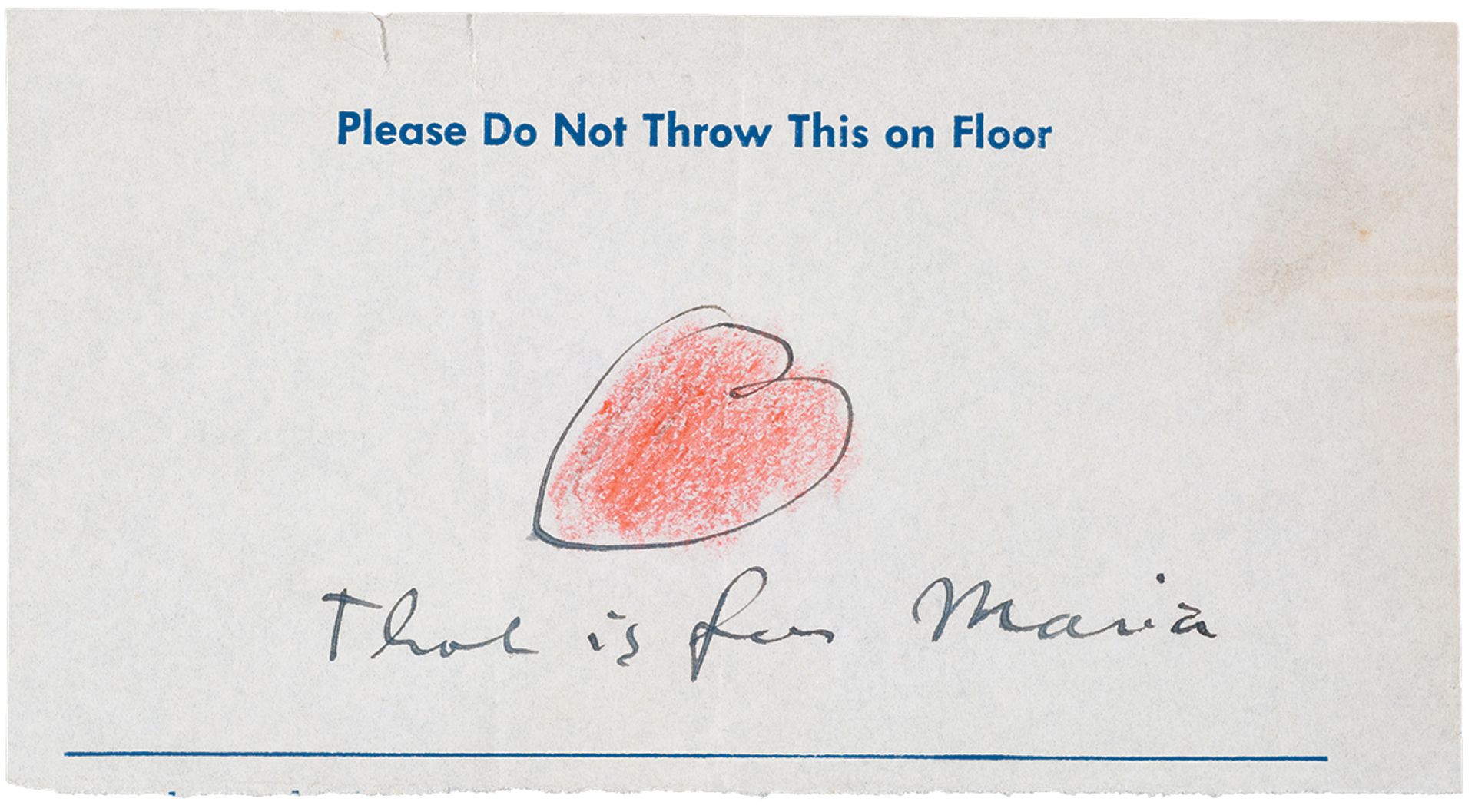
Duchamp’s notebook page inscribed with “That is for Maria”
Interspersed passages from Duchamp’s letters to Martins reveal the force of his affections, rendering it difficult to regard Étant donnés as anything other than an act of devotion, however strange or disconcerting it may appear from the outside. The florid sentiments strain against the claim that it is just another one of his jokes. “At heart, my little one, I am profoundly sad, for I can see all our days passing rapidly and fading away,” he writes. And elsewhere: “I feel totally lost now that we are cut off from each other… This isolation hurts.” Reproduced in one of the final chapters is a notebook page with the words “Please do not throw this on the floor” typed above a hand-drawn heart, filled in with red crayon, and scrawled below it: “that is for Maria”.
Martins’s voice silent
Although Martins’s letters to Duchamp are not available to the public, it is said that she kept a photograph of him in her studio, and another on her charm bracelet, alongside a lock of his hair—observations that complicate Naumann’s repeated casting of her as a “femme fatale” who “did whatever she needed to get a man to fall in love with her”. The absence of her subjectivity on the page creates an asymmetry that the text acknowledges yet cannot quite overcome. What she truly made of Duchamp—of his work, their relationship—remains largely unknown.
After her husband’s death in 1965, Martins returned to New York and visited Duchamp, who was by then married to Alexina “Teeny” Duchamp. As Naumann notes, it is possible that he signed and dated Étant donnés then and there, unable to complete it until finally, at long last, they were together again.
• Impossible: The Love Affair between Marcel Duchamp & Maria Martins, and the Artwork It Inspired, by Francis M. Naumann, published by Abbeville Press, 192pp, illustrated, $30 (hb), 31 March