

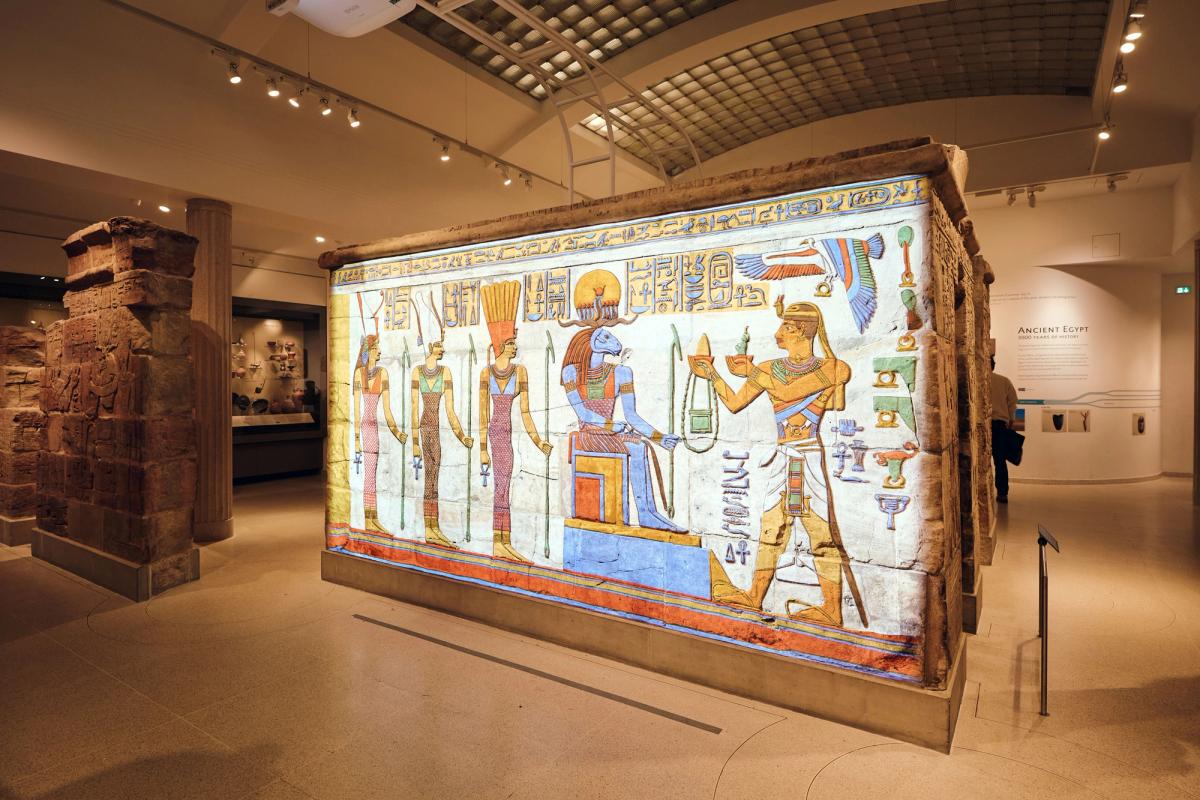
A shrine built almost 3,000 years ago in northern Sudan will regain its original glowing colour later this month. Housed at the Ashmolean museum in Oxford, and the only freestanding building in Britain dating back to the time of the pharaohs, the Shrine of King Taharqa (690BC-654BC) will be recoloured through a digital projection that has been made after extensive research on surviving scraps and traces of pigment.
Fragments of red paint survive in crevices of the sandstone carvings, but microscopic analysis and hyperspectral imaging—combining photography and spectroscopy—also revealed evidence of colours now invisible to the naked eye, including yellow and “Egyptian blue”, a brilliant pigment used to depict divine figures.
According to Liam McNamara, the Ashmolean's keeper of antiquities, the carvings and inscriptions tell the story of the construction of the shrine: how the young Taharqa, later the king of Kush in Nubia and Pharaoh of Egypt, saw the ruins of the earlier brick temple to Amun-Re, built by Tutankhamen, with “the sand drifted to its roof”, as he journeyed north towards Thebes. At Taharqa's coronation he vowed to restore it and went on to build the shining new shrine within a new temple. Scorch marks on the stones of the shrine, also revealed in the project, bear witness to its eventual destruction in turn.
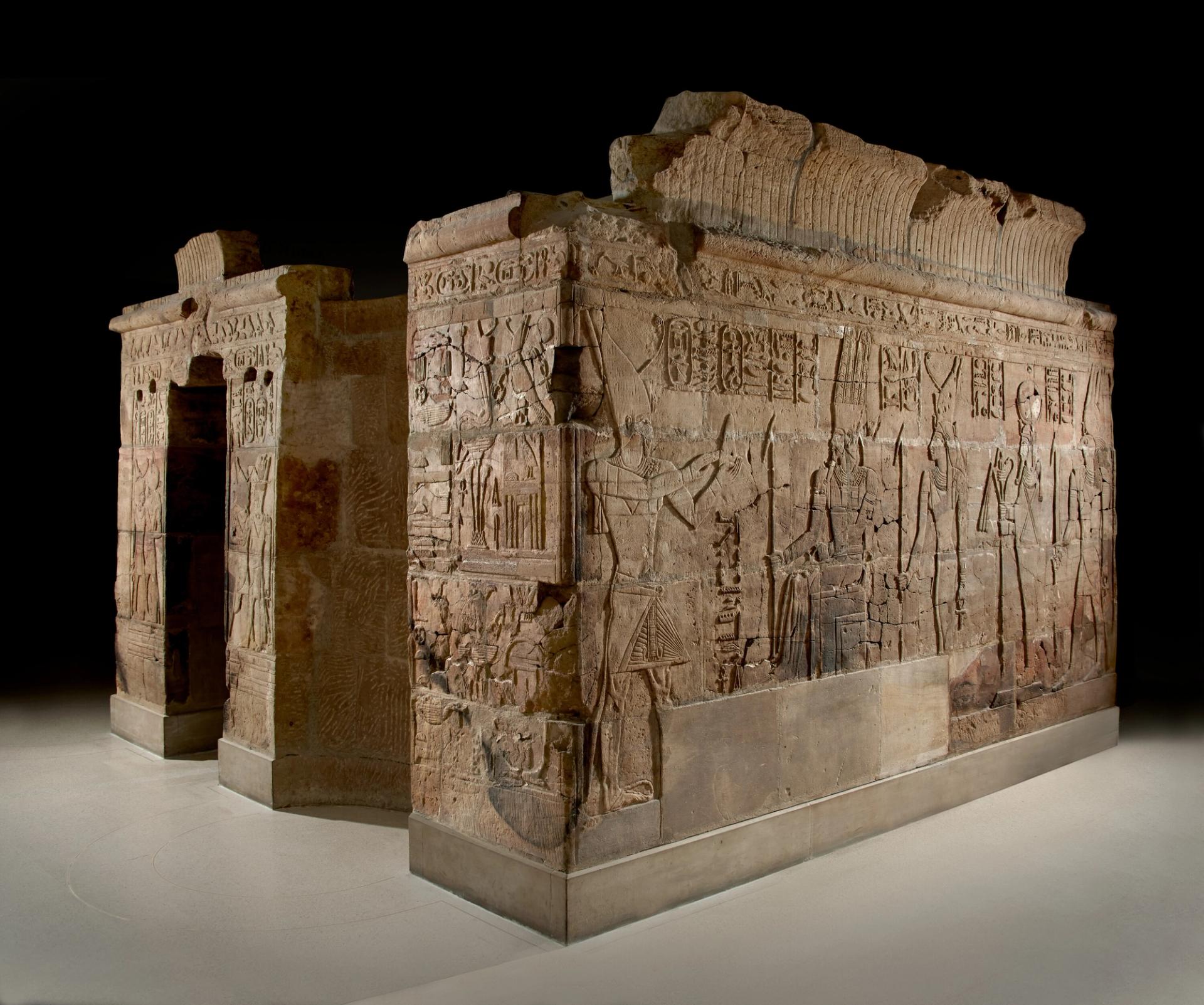
The Shrine of King Taharqa Courtesy of Ashmolean Museum, University of Oxford
The relief carved sandstone blocks were originally plastered and brightly painted, showing Taharqa with the gods of Memphis, Heliopolis and also Amun-Re represented as both a Theban and a local Gematen deity. Taharqa himself is depicted both as an Egyptian pharaoh wearing the Double Crown of Upper and Lower Egypt, and in other scenes as a Kushite king with a ram’s head and sun disc earrings and the Kushite crown surmounted by two cobras.
The Shrine of King Taharqa came to Oxford from Khartoum in 150 crates 90 years ago as a gift from the Sudanese government to the Oxford University Excavations in Nubia, which had excavated it and other monuments over several seasons. It was given to the museum in 1936 by Nora Griffith, in memory of her husband Francis Llewellyn Griffith, who had led—and largely paid for—the expeditions. He had taught himself Ancient Egyptian at Oxford since there was no department, and went on to become the first professor of Egyptology and a renowned scholar.
McNamara describes the monument itself as a fascinating insight into the art and archaeology of ancient Sudan.“The new projection—and the scientific research behind it—will allow visitors to appreciate and understand the shrine’s original painted decoration like never before,” he adds
The project has been supported by James Upton, the Ashmolean's chair of the board of visitors and his wife Béatrice. The projection onto the shrine will be free for all visitors to the Ashmolean’s Ancient Egypt and Sudan galleries, from 13 November.