

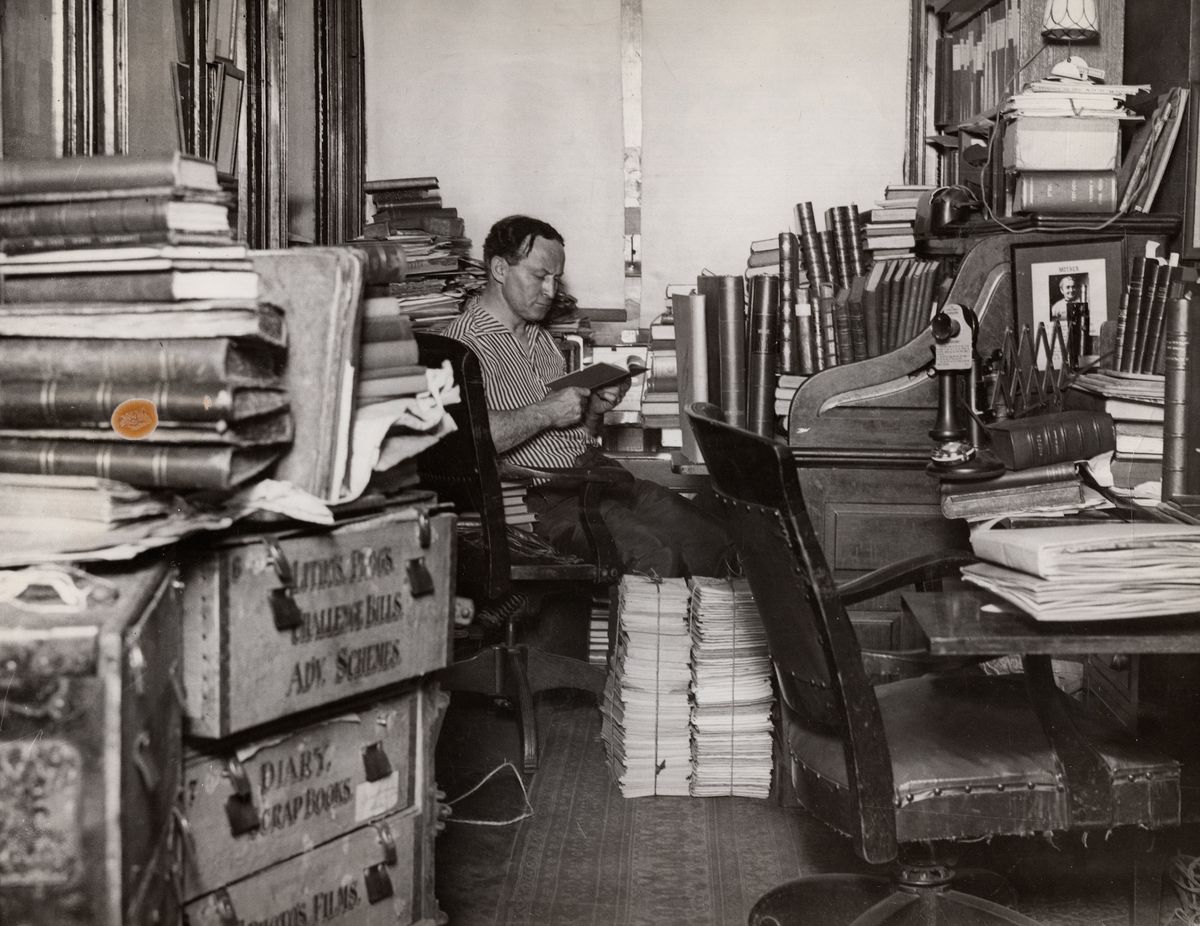
The famed escape artist Harry Houdini dreamed of retiring to his library and spending the rest of his life writing about the many topics that filled its volumes: the history of conjuring, witchcraft, psychic phenomena and the drama of the stage.
“Every hour which I could spare from my professional work was given over to study in libraries, to interviews with retired magicians and collectors, and to browsing in old bookstores and antique shops where rare collections of programmes, newspapers and prints might be found,” he wrote in his 1908 book The Unmasking of Robert-Houdin. In the townhouse he shared with his wife, Bess, at 278 West 113th Street in Manhattan, ephemera and books were crammed into shelves and stacked in precarious piles.
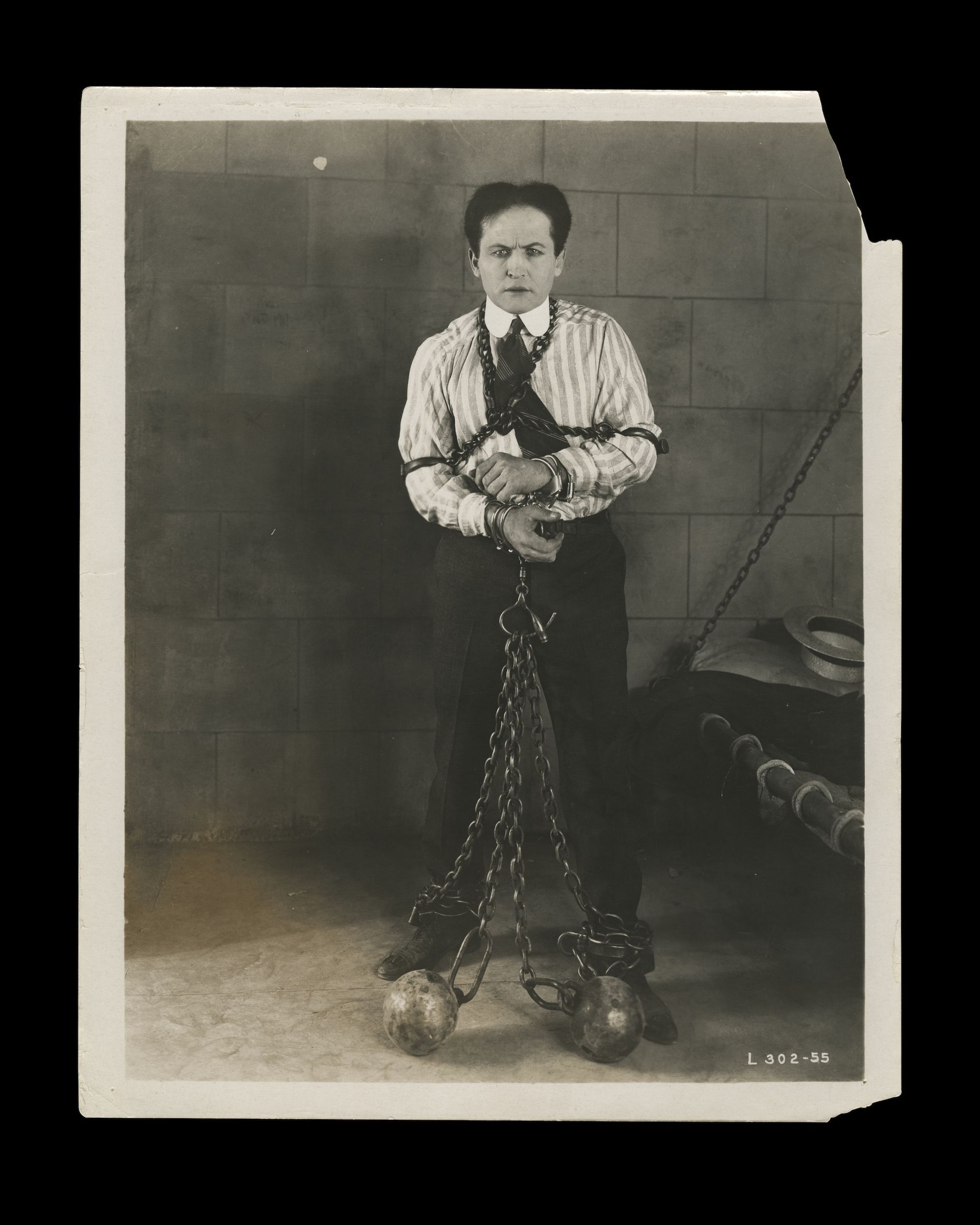
Unidentified photographer, Harry Houdini in a publicity photo for his silent film The Grim Game, 1919. Harry Houdini Papers, Harry Ransom Center, The University of Texas at Austin.
On 31 October 1926, he died suddenly while on tour at the age of 52 from a ruptured appendix. The thousands of items he had devoted years to amassing were dispersed, with his magic collection going to the Library of Congress. The drama collection, after passing through a series of hands, arrived at the University of Texas at Austin in 1958, where it is held by the Harry Ransom Center.
“There was a misconception, even within the magic community, that what came to the Ransom Center was just an incredible collection of Houdini’s personal papers, not realising that there’s material on magic dating back hundreds of years that doesn’t exist anywhere else, and that had all come from Houdini, too,” says Eric Colleary, the centre’s curator of theatre and performing arts.
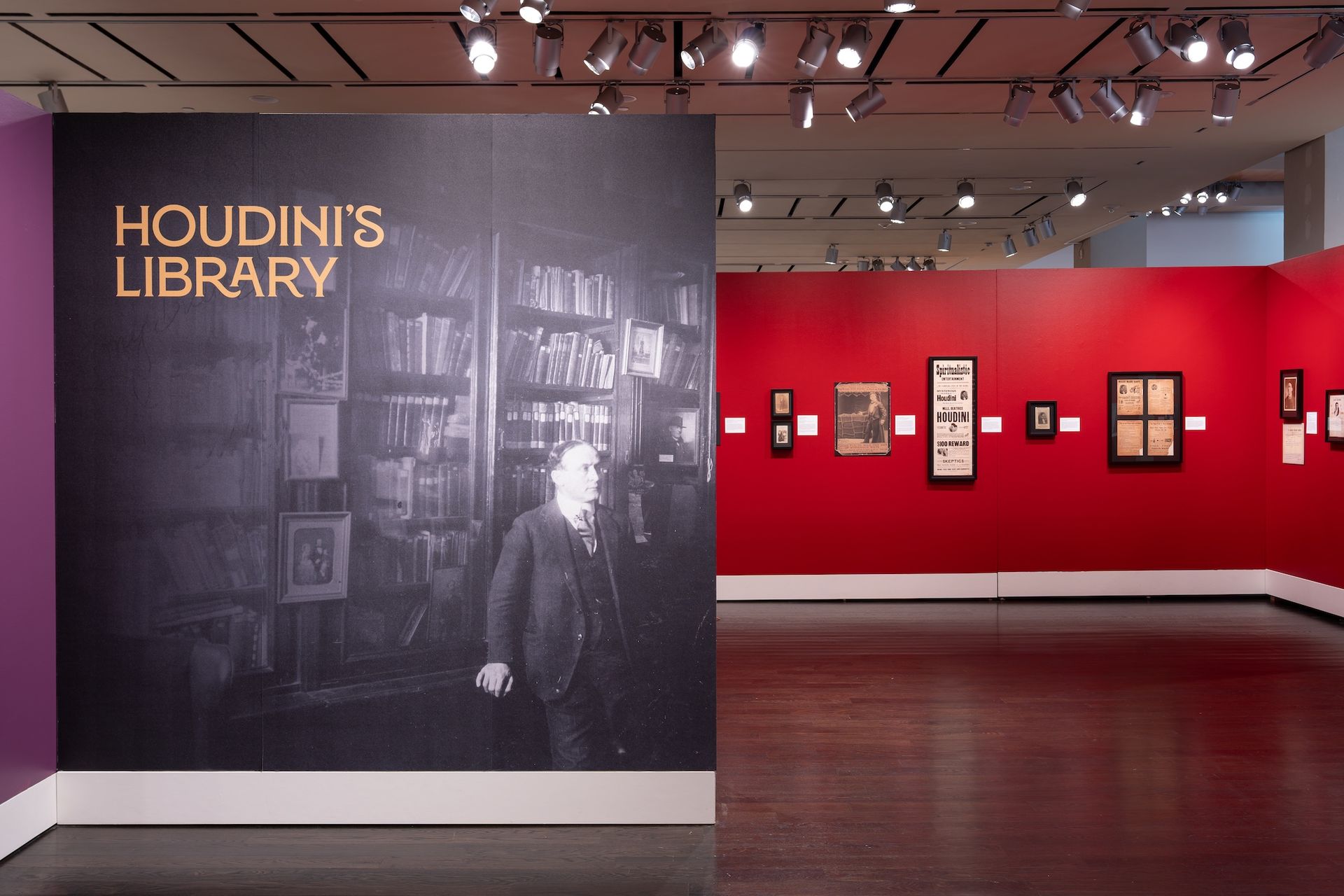
Installation view of Houdini's Library at the Harry Ransom Center Photo: Trent Lesikar
After he joined the Ransom Center in 2015, Colleary started noticing traces of Houdini’s collection everywhere, whether engravings of mechanical automata or theatrical playbills dating back to the 18th century that most others at the time treated as disposable. “He mentioned it in almost every interview he gave,” Colleary says. “He figured out ways to work it into letters that had nothing to do with his collection. It was really important to him.”
Colleary has now spent over a decade unravelling the depth of Houdini’s bibliophilia, an effort that has culminated in the Houdini’s Library exhibition at the Ransom Center (until 24 January 2027) and a book of the same name out now from Abbeville Press. The curator’s detective work to illuminate this lesser-known side of the legendary magician included tracking down a lost mahogany bookcase that had held his theatrical materials and examining Houdini’s typescript catalogue that is now at David Copperfield’s International Museum and Library of the Conjuring Arts in Las Vegas. The 53-page document is not exhaustive of Houdini’s holdings but shows his deep engagement with them through his personal annotations, including his frustration at some volumes. For an 1881 edition of Thomas Frost’s The Lives of the Conjurers, for instance, he remarked: “This book is a pack of mistakes and wilful errors from the start to the finish.”
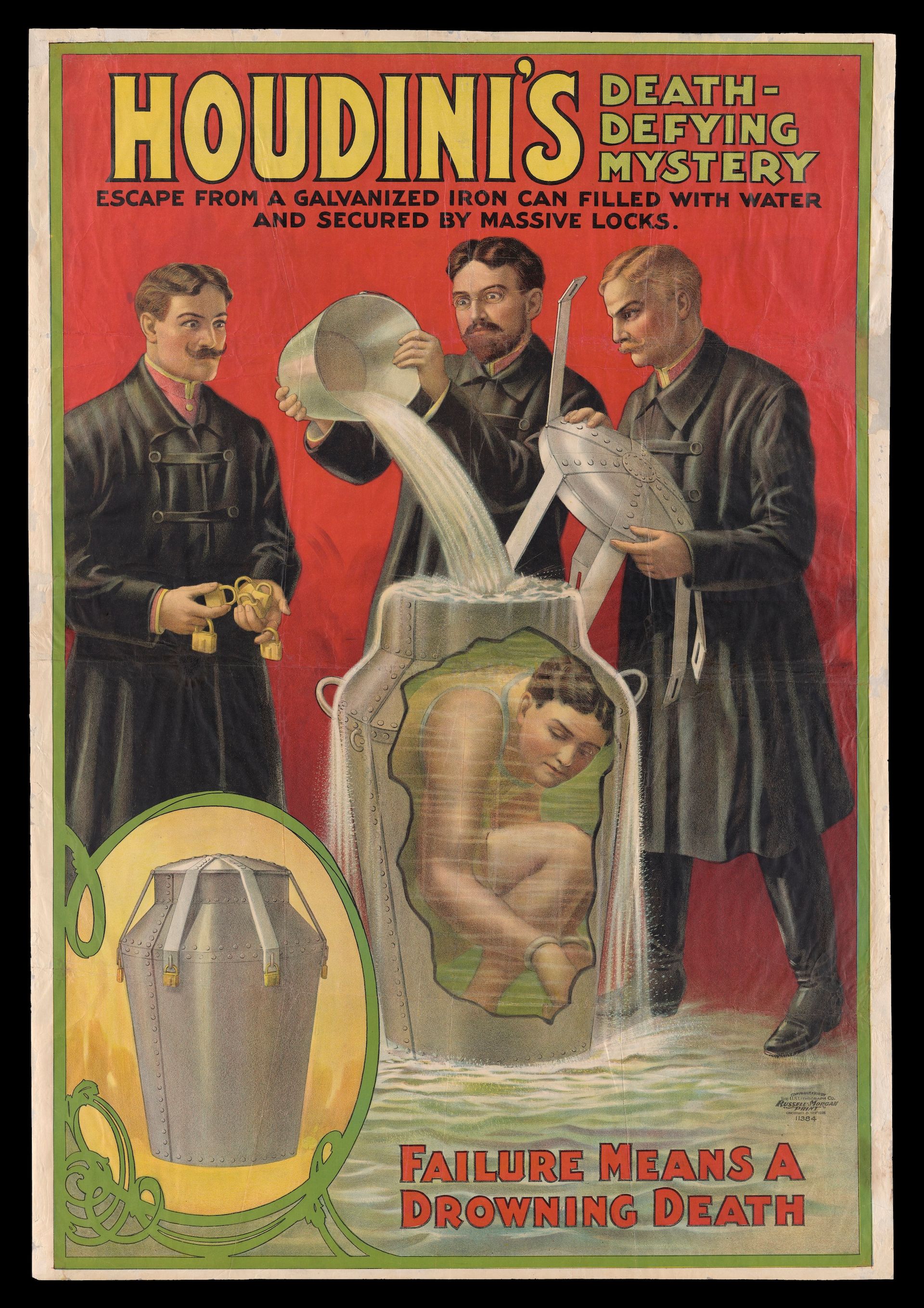
Russell, Morgan and Co (active 1867-present), poster featuring Harry Houdini in his milk can escape, 1908 Harry Houdini Papers, osf 9. Gift of the Hoblitzelle Foundation, Harry Ransom Center, The University of Texas at Austin
It was his disappointment with that book in particular that propelled Houdini’s collecting with the aim of bringing together enough primary sources to write a better record of magical history. The desire for magic to be recognised as a serious academic area of study mirrored his advocacy for the professionalisation of magic, such as serving as an early president of the Society of American Magicians.
Houdini had little formal education. Born Ehrich Weiss in 1874 in Budapest, his family immigrated to the US in 1878. They settled in Appleton, Wisconsin, where there was no public library. Yet he had formative memories of the theological books kept by his father, a rabbi.
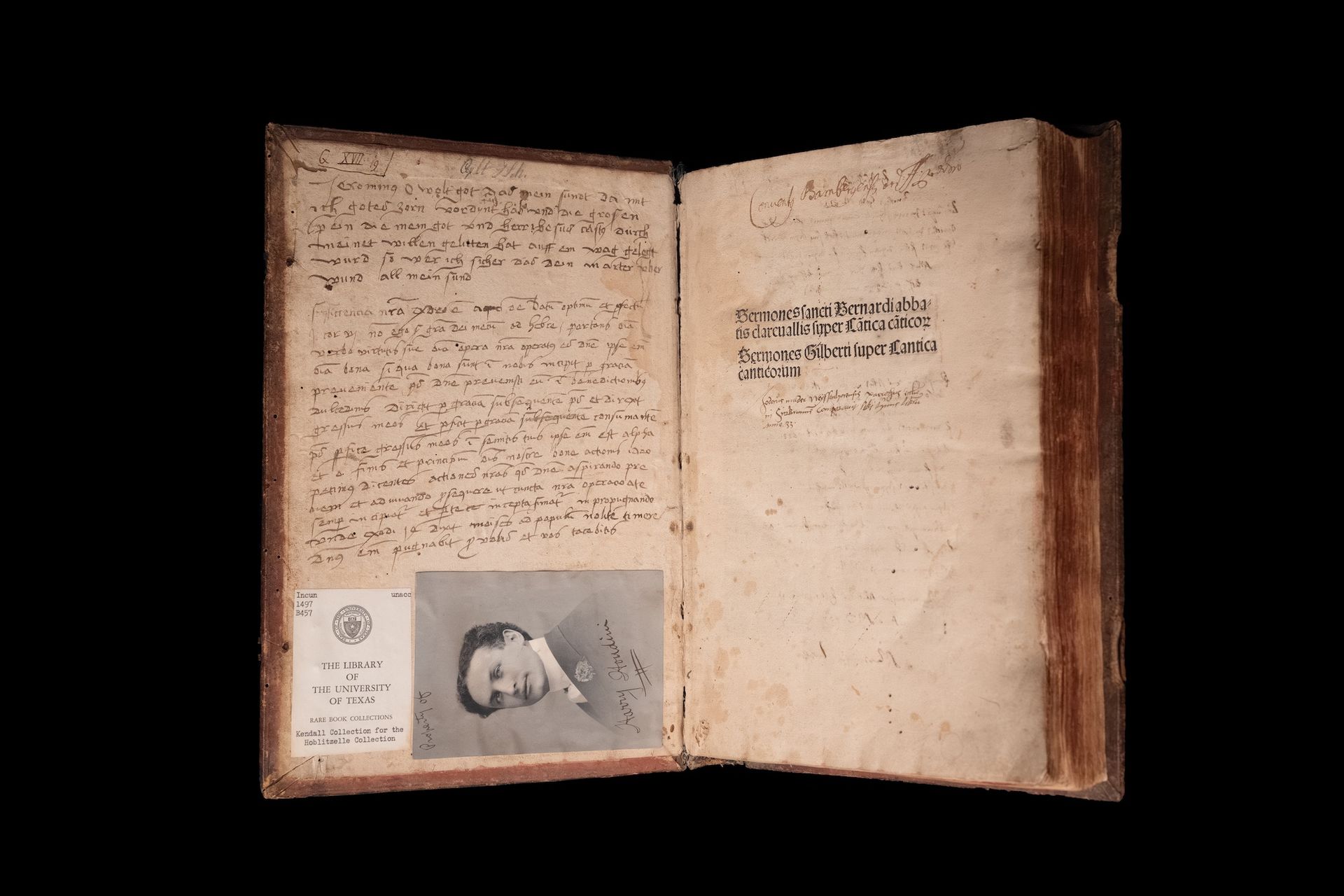
Houdini's edition of the sermons of Bernard de Clairvaux (Strasburg: Johann Prüss, 1497) Harry Houdini Library, Incun 1497 B457. Harry Ransom Center, The University of Texas at Austin
“One of the things his father instilled in him was that having a library was a gentlemanly thing to do. It was a way of demonstrating your knowledge and that you had access to it,” Colleary says. “But you also had to be able to use it.”
Always an autodidact—revealed by his shaky spelling, like “I bot…” written inside numerous covers—books were how he first learned about magic. Reading the memoirs of the French magician Jean-Eugène Robert-Houdin inspired his adopted name. As the “Handcuff King” would later quip in an interview: “When I have come to a town, the police have tried to show me that their shackles could hold me, and have failed; the booksellers have tried to sell me many books, and have succeeded.”
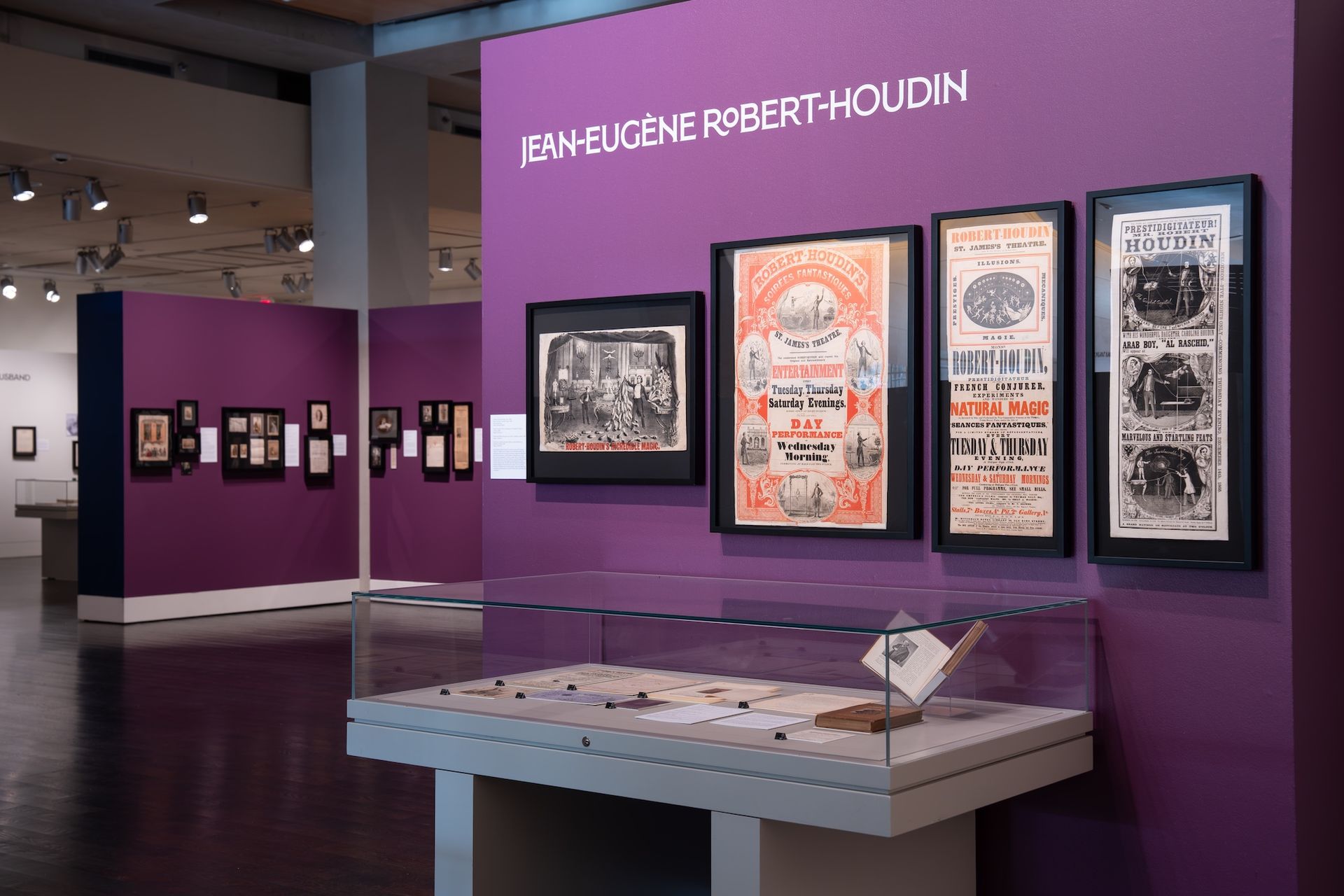
Installation view of Houdini's Library at the Harry Ransom Center Photo: Trent Lesikar
On view at the Ransom Center are examples of his obsessive collecting from every angle related to magic and the stage, from Reginald Scot’s 1584 Discovery of Witchcraft—an exposé of the occult that also includes some of the first published information on sleight of hand—to broadsides advertising appearances of Henry “Box” Brown, whose great feat of illusion was escaping slavery by mailing himself in a wooden crate.
“Houdini felt very strongly that all of human knowledge was in books, and we just needed to be curious enough to go and look for it,” Colleary says. “Now with the internet, you’re so targeted and focused, you don’t get to stumble upon something you didn’t expect, and that was at the core of what Houdini loved about his collection: that ability to encounter the unexpected.”
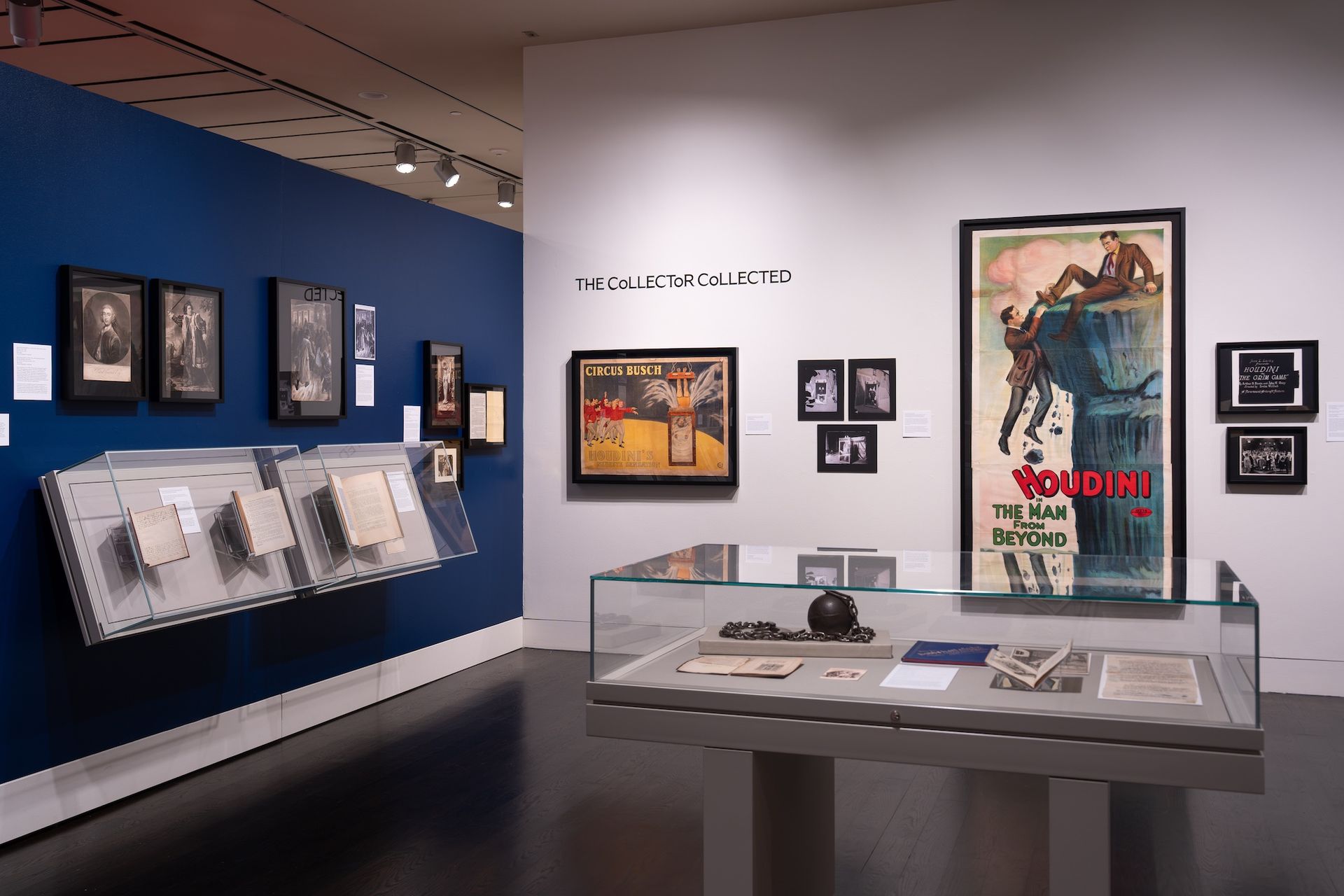
Installation view of Houdini's Library at the Harry Ransom Center Photo: Trent Lesikar
- Houdini’s Library, Harry Ransom Center, Austin, Texas, until 24 January 2027