

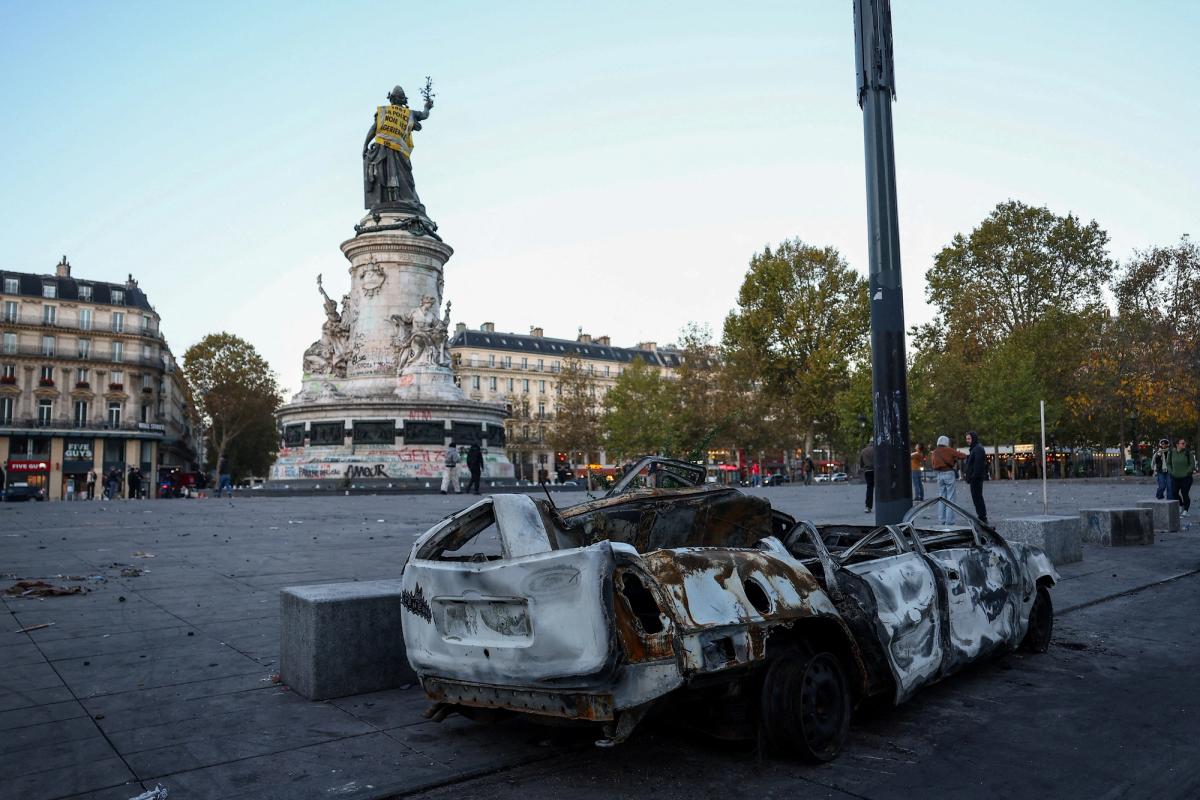
When the French sculptor Léopold Morice designed his 9.5m-tall allegory of French republicanism for the Place de la République in Paris, in the late 1870s, he gave the figure a Phrygian cap. With the bloody Paris Commune of 1871 still fresh in everyone’s minds, this was a contested choice, the so-called “liberty cap” being a symbol of the republic at its most revolutionary.
With similar vestimentary symbolism, protesters attending the nation-wide demonstrations in the French capital this Saturday (17 October) scaled Morice’s Marianne with banners and flags and dressed her in a yellow vest—in reference to the gilets jaunes (yellow vests) protests of 2018-20. Emblasoned with the slogan “2026, the police mutilates high-schoolers”, Marianne’s new yellow vest underscored the widening rift between France’s establishment and its embattled youth. In the weeks leading up to what organisers called the “day of action”, pundits and activists alike have begun using the moniker “gilets jeunes” (young vests) to describe this new school pupil and student movement.
The demands of the pupils and students are both immediate and practical—and all-encompassing. Media outlets have mostly pointed to initial protests at the Lycée Antoine-de-Saint-Exupéry in the Parisian banlieue of Créteil, in mid-September, as the trigger for the movement. However, some pundits are noting that pupils at schools in French overseas territories of Guyana and Mayotte began protesting in late August. All are united in their demands for more teachers and repairs to school buildings. They also want an end to Parcoursup, the online platform the government introduced in 2018 to determine where pupils go after finishing secondary school, and which pupils say is leading to unfair selection.
More broadly, protestors are taking a stand against the rise of the far right, rising living costs and climate change, citing the record brutal heatwaves of 2026 as the moment so many people in France finally experienced, directly, the ecological crisis.
On Saturday, between 550,000 (according to the minister of the interior Laurent Nuñez) and 800,000 (according to the organisers) protesters attended largely peaceful marches across France.
Fringe groups of agitators and looters caused widespread damage, forcing entry into city halls, ransacking shops, and setting cars and buildings on fire. Heritage sites have been affected: city officials in Limoges have said the historic town hall, inaugurated in 1883, was “almost 100% destroyed” after a fire caused the roof and belfry to collapse. The local prefect Maurice Barate called the damage, in an interview with the AFP news agency, a “catastrophe for heritage”. And Le Monde reports that, in an alarming breach of security, protestors got very close to the Elysée Palace.
Meanwhile in Lyon, a tourism office was burned down and 162 local businesses reportedly destroyed.
The police, which authorities have acknowledged were overwhelmed, have responded with force and tear gas. Over 2,400 arrests have reportedly been made and nearly 1,000 police and first responders wounded. One 17-year-old protestor in Saint-Etienne reportedly lost a hand to a grenade.
Art Basel and art schools
Art world participants have been both involved in and impacted by the unrest. The Musée du Louvre closed its doors today (19 October) after protestors blocked access to the site. “Dear visitors, due to a student social movement, the museum is closed for the time being. We apologise for the inconvenience caused,” read a post from the museum on X. According to the art historian and curator Mark Godfrey, on Instagram, the opening of Jeu de Paume’s exhibition of work by the Canadian artist Stan Douglas had to be delayed. The Art Newspaper contacted the arts centre for comment. The Art Basel Paris fair, meanwhile, which is due to hold VIP preview days on Wednesday and Thursday before opening to the public, on track to open “as planned”, a spokesperson told The Art Newspaper in a statement. The statement adds that the fair “has extensive protocols in place“ and will “work closely with a private security company and, where necessary, the Paris Police Prefecture to always ensure a safe environment.”
“As part of these measures, anti-ram barriers are installed around the Grand Palais to prevent unauthorised vehicles from entering the site and adjacent pedestrian areas,” the statement continues. “Additional security personnel have been deployed to patrol the perimeter of the fair 24 hours a day. Visitors to the fair will undergo thorough security screening protocols including metal detectors and bag inspections upon entry and exit.”
Meanwhile students at a number of art schools across the country, from the Haute École des arts du Rhin in Strasbourg to the École nationale supérieure des arts appliqués et des métiers d’art in Paris, have joined in the strikes. Ahead of the 17 October demonstrations, several students told The Art Newspaper their goal has been to lend their support to the high-school protestors but also to express their concerns about how the government’s austerity measures—enacted in response to France’s exploding national debt—and political instability ahead of the 2027 general elections are affecting the cultural sphere too. As Paco, a second-year student at the École Boulle, said on 16 October, “we’re fighting for our future”. According to a report in Le Monde, unions have said the protests that have led to the closure of the Louvre were led by students from the École du Louvre, a higher education institution located inside the Louvre Palace.
Jean-Baptiste Carobolante, who teaches at the École Supérieure d'Art in Dunkerque and Tourcoing, said not only are many art schools bearing the brunt of cuts to local authority cultural spend, “because culture is often the first sector to be sacrificed”, reactionary politicians are also castigating cultural actors as the political opposition. “And why fund political opponents?” Carobolante said the thinking goes. The Art Newspaper contacted Carobolante and others to see if they wished to provide additional comment following the 17 October demonstrations.
In a televised address on Sunday 18 October, the French president Emmanuel Macron affirmed the government’s dual responsibility to heed the protestors’ legitimate anger and act on its causes, while ensuring republican order is maintained. He said he understood the country’s young people, insisting they have been at the core of his political mission for over a decade. This will come as news to the young protestors themselves, whose primary contention is that they want to be heard—and haven’t been—and who struggle to see a future for themselves.
Ahead of Saturday’s demonstrations, those art school students The Art Newspaper spoke to said they wanted to see “a convergence of struggles”, with young people joining forces with the gilets jaunes, the firefighters (who were protesting a lack of funds and equipment in September), the farmers and more. As one student put it: "We have arrived at a pivotal moment in history.”