

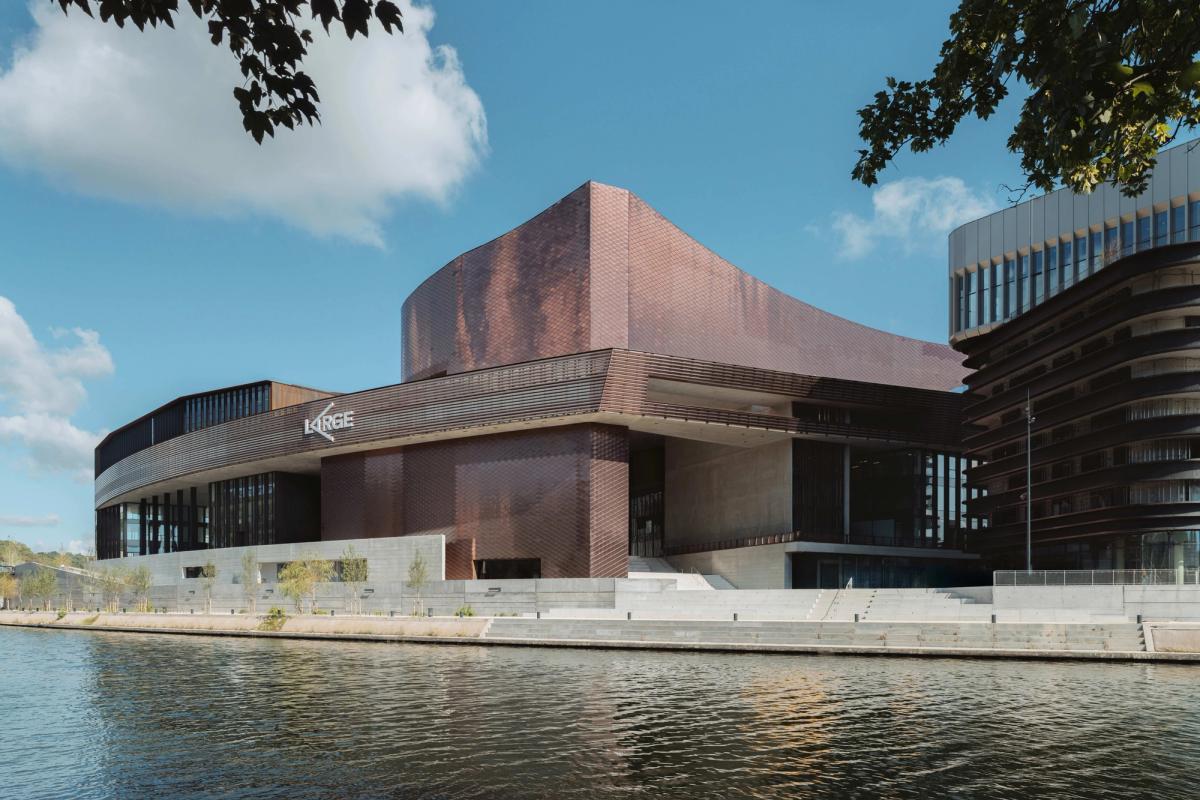
The French capital's newest contemporary art centre opens this Saturday (17 October) on the Ile Séguin, in Greater Paris's western reaches. Dubbed simply Large (or “le Large”), it is the latest philanthropic venture from the Emerige real estate group, and takes centre-stage in the wider Pointe des Arts development. Instead of a private museum in the vein of the Cartier and Louis Vuitton foundations, Large is a non-profit, without a dedicated collection, emphatically focused on public access and on promoting the French art scene.
The Pointe des Arts complex has been designed by the Spanish architecture firm, RCR Arquitectes, in collaboration with the Paris-based CALQ design agency. The three buildings combine Corten steel—the kind that rusts on purpose—with cladding scales of copper-coloured aluminum and glass. Together they house an eight-screen cinema, retail space, office space and Large.
Located at the core of the development, Large is a wedge of a building six stories tall, comprising 2,500 sq m of exhibition space. Its director Paula Aisemberg says art will greet visitors from the moment they enter.
The inaugural exhibition riffs on the island’s automotive history as the site of car-maker Renault's primary manufacturing plant for the better part of the 20th century. Entitled Imaginary Engine and curated by Cecilia Alemani, the show will put works from Renault's own collection, the Fonds Renault pour l’Art et la Culture in conversation with 17 new commissions from contemporary artists.
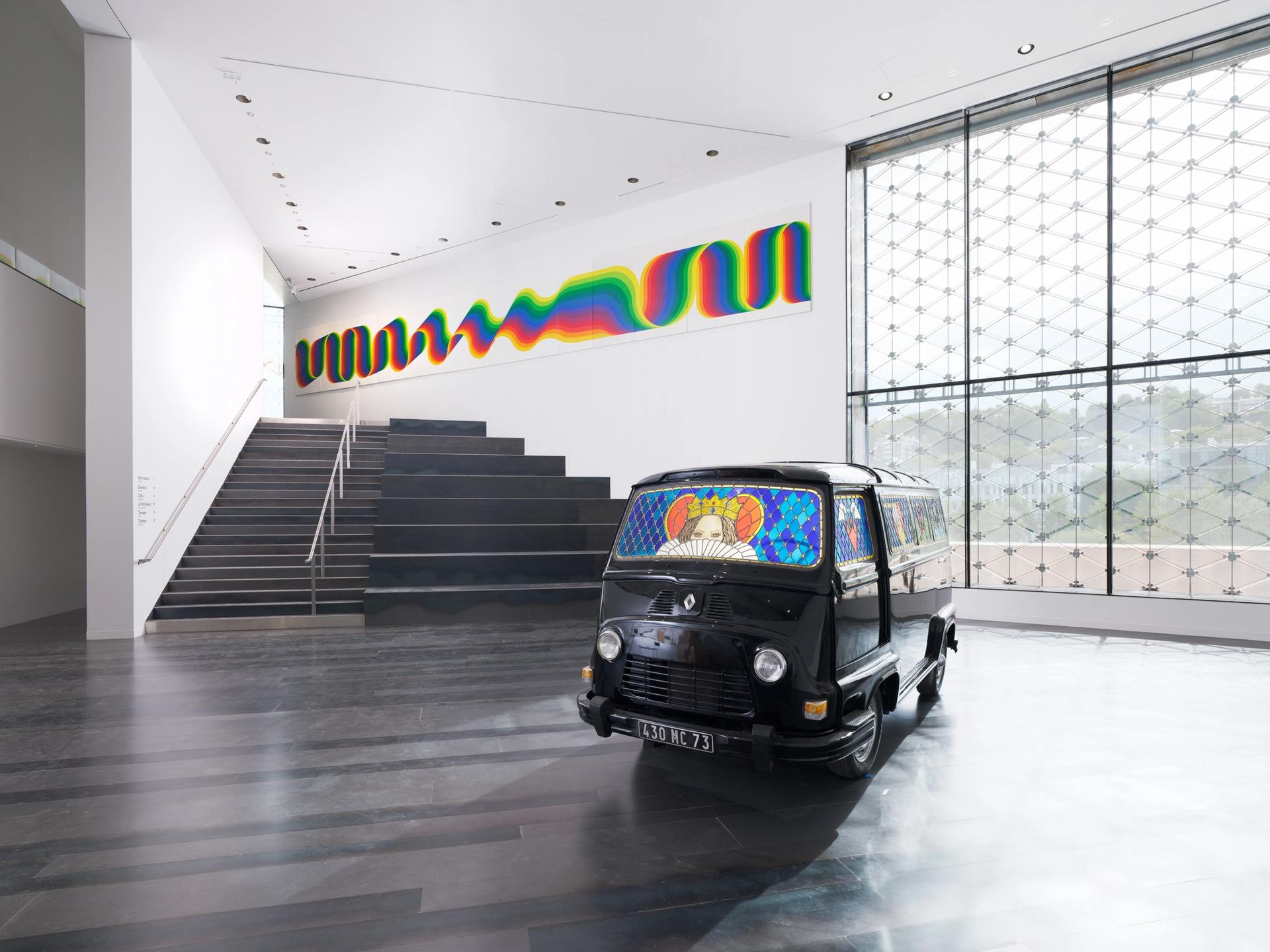
Exhibition view of Imaginary Engine at Large. In the foreground: Romuald Jandolo, Estafard (2026). In the background: Julio Le Parc, Peintures en frise (1971-74)
© Adagp, Paris, 2026. Photo: Aurélien Mole
Since the turn of the century the founding president of the Emerige Group Laurent Dumas has been working to foster connections with the national art scene, through commissions, acquisitions for his private collection and the annual Révélations Emerige prize, which he founded in 2014, for young, unrepresented artists under 35.
Aisemberg emphasises that this focus on artists living and working in the country, regardless of their nationality, is what will set Large apart too: “The French art scene is particularly riveting. We want to support it, promote it and make it accessible to the wider public, be that the international art crowd that doesn't necessarily know it that well, or the local public that doesn't always have access to it.”
The île Séguin sits between the Porte de Saint-Cloud and the Pont de Sèvres, at the point where the Seine river exits central Paris to the south-west and, looping back on itself, flows towards the Bois de Boulogne and St Denis beyond. For the best part of the 20th century, from 1919 to 1992, the island was owned by Renault. From the moment that historic plant shuttered, the Hauts-de-Seine department trained its sights on transforming the island into a cultural destination. Several false starts ensued. The collector François Pinault’s plans for a museum were thwarted by red tape. The subsequent R4 art city project—which Jean Nouvel was supposed to design—was sold by its embattled backer, the Swiss art dealer Yves Bouvier, before it could be built.
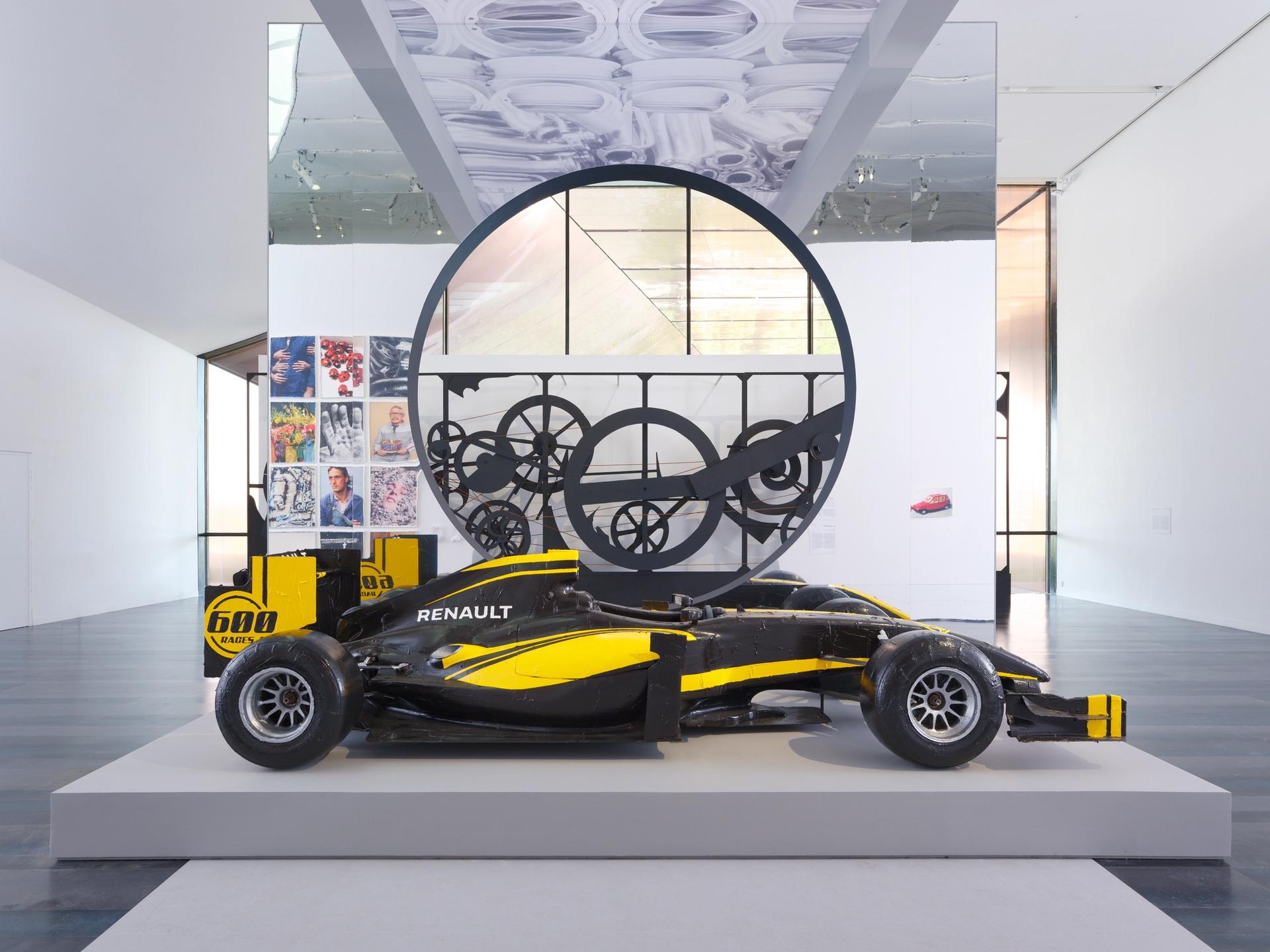
Installation view of Imaginary Engine at Large. In the foreground: Bertrand Lavier, R23-F1 (2026). At the back: Jean Tinguely, Requiem pour une feuille morte (1967).
© Adagp, Paris, 2026. Photo: Aurélien Mole
Dumas, by contrast, has brought his plans to fruition. Speaking to the Fondation du Collège de France in 2018, two years into the Pointe des Arts project, he said that as a developer, the île Séguin was “a dream becoming reality” and one of his most beautiful challenges.
He has long spoken of dreaming up and building the city of tomorrow, which, in this instance, is quite literally the plan. Boulogne-Billancourt mayor Pierre-Christophe Baguet has described the island’s redevelopment the “jewel in the crown” of the Vallée de la Culture initiative the Hauts-de-Seine department launched in 2008. As Baguet noted, the Pointe des Arts complements a string of local institutions, from Jean Dubuffet’s 1988 Tour aux Figures on the Île Saint-Germain just upstream from the île Séguin to the Cité de la Céramique in Sèvres, the Manufacture Nationale, the Musée des Années 30, the Albert Kahn Museum and Gardens, and the Musée Belmondo in Boulogne-Billancourt. And it sets the scene for the forthcoming Musée du Grand Siècle in the Caserne Sully, in Saint-Cloud.
This departmental cultural strategy is part of the wider metropolitan Grand Paris plan for 2050. Combining urban renewal with significant infrastructure and transport investment, the idea is to make the suburbs of the capital more accessible and more attractive, thereby easing congestion on every level. One of the new metro stations of the forthcoming Grand Paris express network, scheduled to open in 2027, will be at Pont de Sèvres, putting the island just minutes from La Défense and half an hour from Orly airport. Other ideas about river and cable-car access are floating around in a way that chimes quite beautifully with Large's name, as well as the very Modernist ideals of speed and mechanical beauty that suffuse its first exhibition.