

The once-in-a-lifetime loan of the Bayeux Tapestry to the British Museum might prove highly frustrating in 40 for years for those wanting to celebrate the millennium of the Norman invasion. The timing is, on the face of it, quite arbitrary, down to the determination of certain individuals—including, laudably, Emmanuel Macron—but also more prosaically because the museum in Bayeux is closed for renovation.
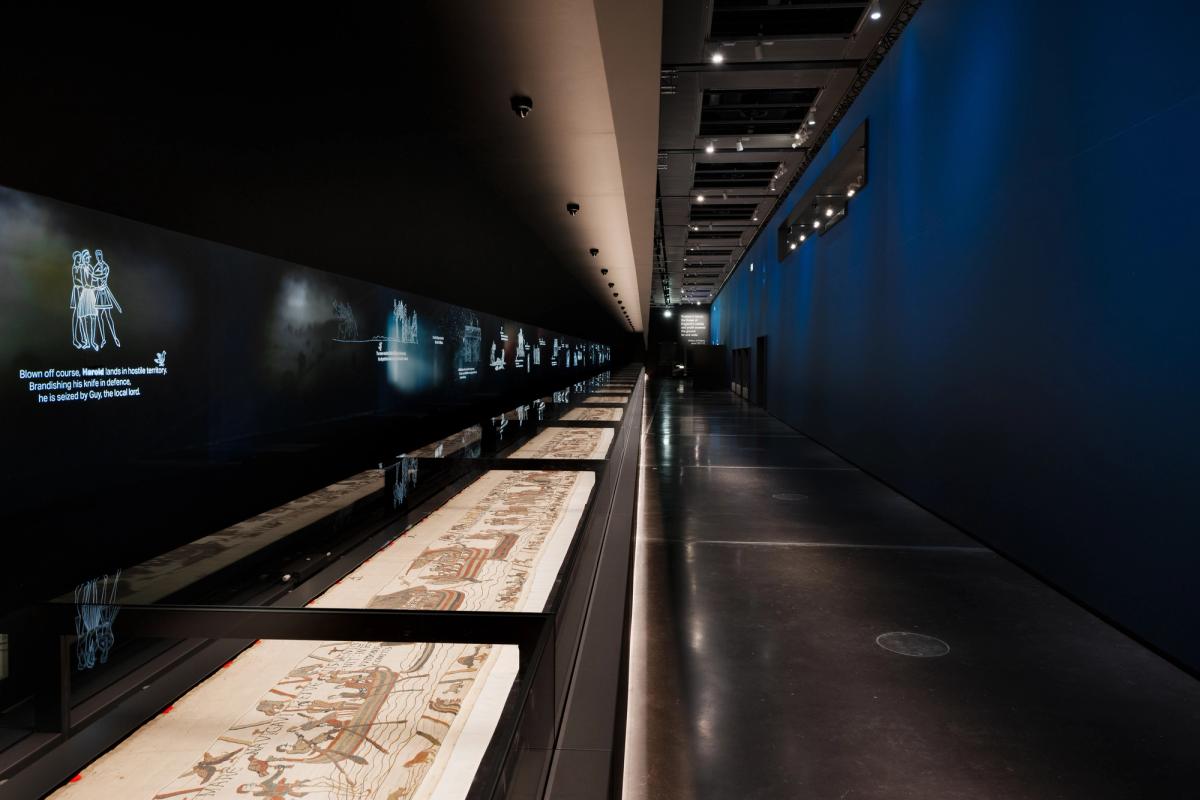
Perhaps this is all the better. The return of the object itself to England at any time is an event worth celebrating, unencumbered by meaningless anniversaries or cultural diplomacy. Shuffling down the 70m-long display case, it is impossible not to become absorbed by the story that the embroidery tells, but also the often-bizarre way that it is told. The shapes and colours of trees, horses, waves, architecture, the famous comet and a whole bestiary of animals, real and imaginary, braided in wool died with woad and madder on bleached linen, are often so strange that the world described seems far more exotic than 11th-century France and Britain.
Part of this absorption is the way that the story unfolds with such narrative brilliance. The premises are laid out by Harold's ill-fated envoy to France, then his duplicity on return, unleashing the second chapter, the building up of French forces and the invasion. The culmination of the action is in truth not the grisly death of Harold, but rather the great scene of tumbling horses, in which the spinning, helpless horses symbolise the utter defeat of the English and the world turned upside down.
It is this scene that sticks most in my mind. The horses become the symbol for the bouleversement, as the French might say, of the invasion, the feeling of time itself coming out of joint, of catastrophic upheaval. And it is this upheaval and change, bringing with it a flavour of the apocalypse, that lends the Bayeux exhibition significance at this juncture in history.
Grave climate warnings
The week that the exhibition opened, the United Nations made the grave announcement from Nairobi that we have failed the limit of 1.5ºC of warming, the figure set by the Paris Agreement in 2015, and which now looks to be surpassed by some margin. The government report from earlier this year, Global Biodiversity Loss, Ecosystem Collapse and UK National Security, warned that the collapse of ecosystems around the world would have a catastrophic effect on life on Britain, let alone those far more vulnerable nations around the world—food shortages, mass migration, the collapse of civil society and devastating war. So stark are the findings from the joint intelligence committee that only a heavily redacted version of the report has been published to date. It seems highly likely that the world of 2066 will be entirely different from the one that we currently inhabit, far more so than ours is from the world of 1066, when the Normans conquered England.

The Bayeux Tapestry, damaged heritage in Iran, Tschabalala Self’s Trafalgar Square sculpture—podcast
As guardian spaces of human culture, museums should be planning for this future and at the very least commissioning resilience plans. Three years ago, a report was written in the wake of a climate conference at Tate Modern, which laid out much important groundwork. And yet the situation has deteriorated more rapidly than any could have imagined, as the recent UN announcement makes clear. Beyond the basic need to decarbonise and be sustainable, there are the security and civil society impacts laid out in the joint intelligence committee report, from which no institution—especially museums whose revenue is based on mass tourism and who care for objects in climate-controlled conditions—can afford to disregard.
The British Museum itself might consider commissioning a ‘Bayeux Report’ to commemorate the historic loan and project the role of the museum in a changing world over the next 40 years—especially now we know that decarbonising and achieving net zero by 2050 is unlikely to be enough to stop passing into the ‘catastrophic’ realms of warming above 1.5ºC. On a practical level, such a report would offer steering for how museums can physically cope with climate extremes—not just of fire and flood, but also of the likely end of mass tourism, or its replacement with mass climate migration, the breakdown of civil society, economic insecurity, and the need to foster cooperation and mutual support in such a catastrophically upturned world. It would, in short, be a report on museums as beacons of human endeavour and hope during wartime.
Embracing difficult conversations
There is also an ethical obligation for such strategic projection. Earlier this year, in response to criticism of the postponement of a planned lecture due to possible protest and disruption, the British Museum published its first coherent statement of moral positioning on current debates. The director, Nicholas Cullinan, wrote: “Museums exist to facilitate learning, inquiry and debate. They are not merely buildings that house objects; they are civic spaces where histories can be examined and contested through evidence, scholarship and discussion.” Difficult times require difficult conversations, Cullinan stated, and it is the task of the museum to enable those conversations without fear of “cancellation” or physical intimidation. These words signal a dramatic policy change. Rather than doing all it can to keep out of the newspapers, as past institutional leaders have urged, the museum has entered a new era of direct public statement and engagement.
By initiating a “difficult conversation” on the subject of climate change now, in this pivotal Bayeux year, the British Museum could create bridges that in the future will prove of vital importance, especially in light of its highly damaging sponsorship deal with BP—reputation enhancement in return for a sum of money that amounts to around three hours of corporate profit during the bombing of Iran earlier this year.
Commissioning a ‘Bayeux Report’ would be just one aspect of such a conversation. A more immediate opportunity exists in the form of the People’s Emergency Briefing, the powerfully effective and entertaining documentary film that is currently being screened in venues around the UK (although has yet to be shown in any museum). The genius of the film is that it records ‘ordinary’ people’s responses to the sober laying-out of the facts on climate change and nature loss by eight experts, including the Lancaster University professor Mike Berners-Lee. The film gives viewers a language for discussing an otherwise extremely worrying and difficult topic.
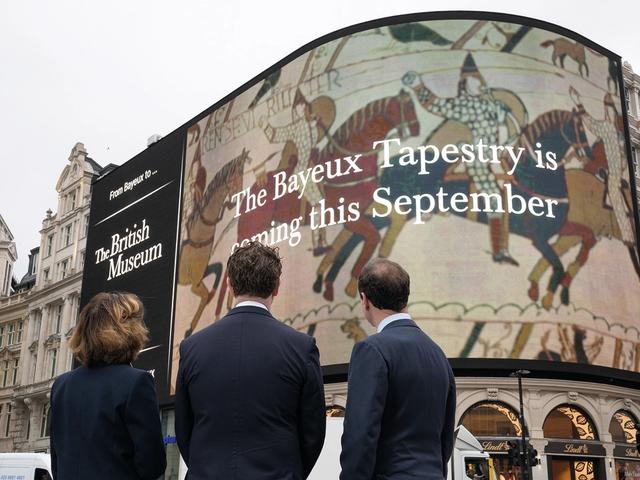
Few other museums could mount an exhibition as stunning as that of the Bayeux Tapestry at the British Museum. Those lucky enough to visit the exhibition will experience world heritage at its most important, brilliantly and powerfully displayed.
The British Museum, along with the Musée du Louvre in Paris and the Metropolitan Museum of Art in New York, the Berlin museums, and institutions such as the Iraq Museum in Baghdad, which has been so well supported by the British Museum, are the institutions that preserve and interpret this world heritage. The British Museum has taken a leading role in many international initiatives in response to war and disaster. The commissioning of a ‘Bayeux Report’, alongside screenings of the People’s Emergency Briefing and other climate events, could connect this engagement to the environmental war that is now raging around our shared planet, and create a powerful legacy for a remarkable exhibition.
- The Bayeux Tapestry, British Museum, London, until 11 July 2027
- John-Paul Stonard is an author and art historian