

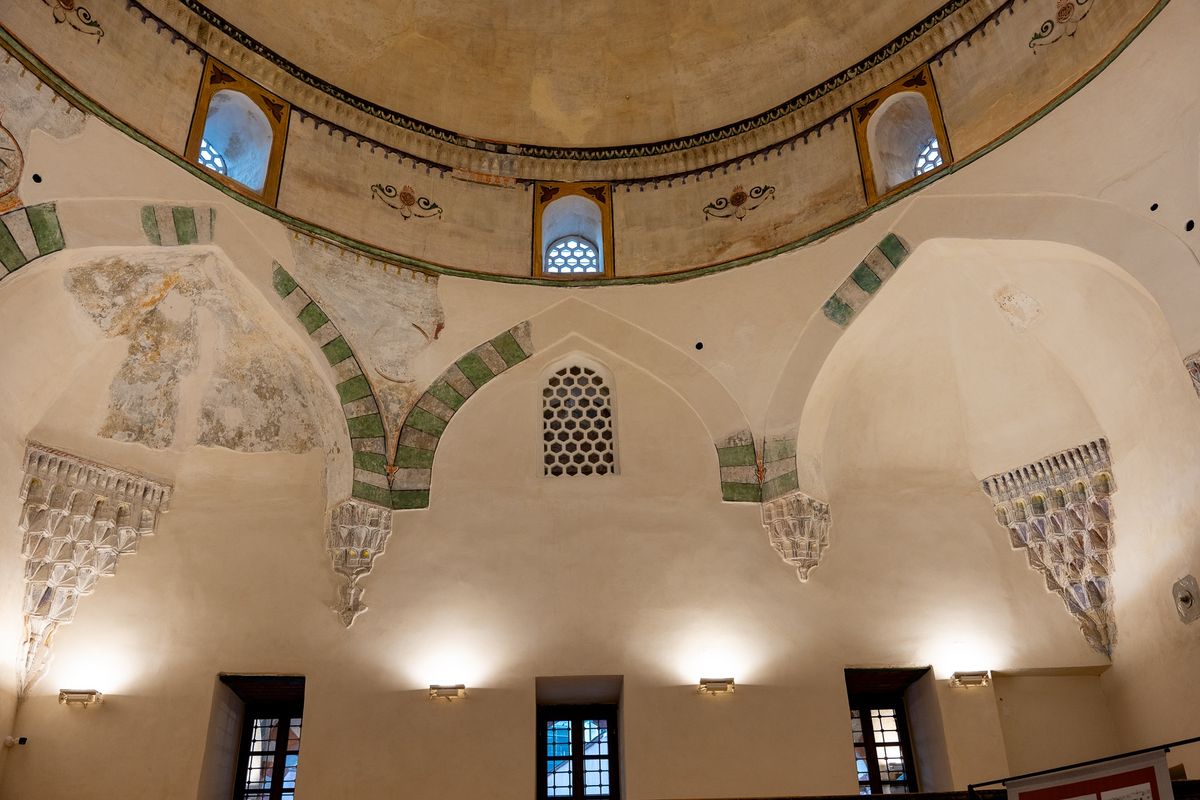
Thessaloniki’s 15th-century Hamza Bey Mosque, widely known as Alacazar, reopened last weekend as an exhibition space after nearly two decades of conservation and restoration work.
The mosque was commissioned by the daughter of the Ottoman admiral Hamza Bey in 1467. It was expanded a century later, to include a portico, minaret and quadrilateral courtyard, making the building architecturally exceptional for a mosque in the wider Balkan region.
It was later damaged by fires and earthquakes and rebuilt in 1620, when a madrasa was added. Following the population exchange between Greece and Turkey in 1923—during which two million people faced compulsory transfer based on religious affiliation—the building ceased functioning as a mosque, becoming the property of the National Bank of Greece. It briefly housed a military barracks before being declared a protected monument in 1926. The building was subsequently used as a cinema, called Alacazar, for several decades and was subjected to a number of modifications. When Thessaloniki was under Nazi occupation during the Second World War, the building’s Jewish owner was sent to an SS camp on the outskirts of the city and the movie theatres were leased to a Greek refugee from Serres. The Jewish businessman’s heirs donated the site to the Red Cross in 1977.
The former mosque, located at the junction of Egnatia and Venizelou streets in the centre of the city, came under the protection of the Greek ministry of culture in 2006. Structural work and stabilisation began in 2007. The most recent leg of work, supported by the European Recovery Fund, took place between 2024-26 and involved the completion of all interior and exterior conservation required to facilitate its new function.
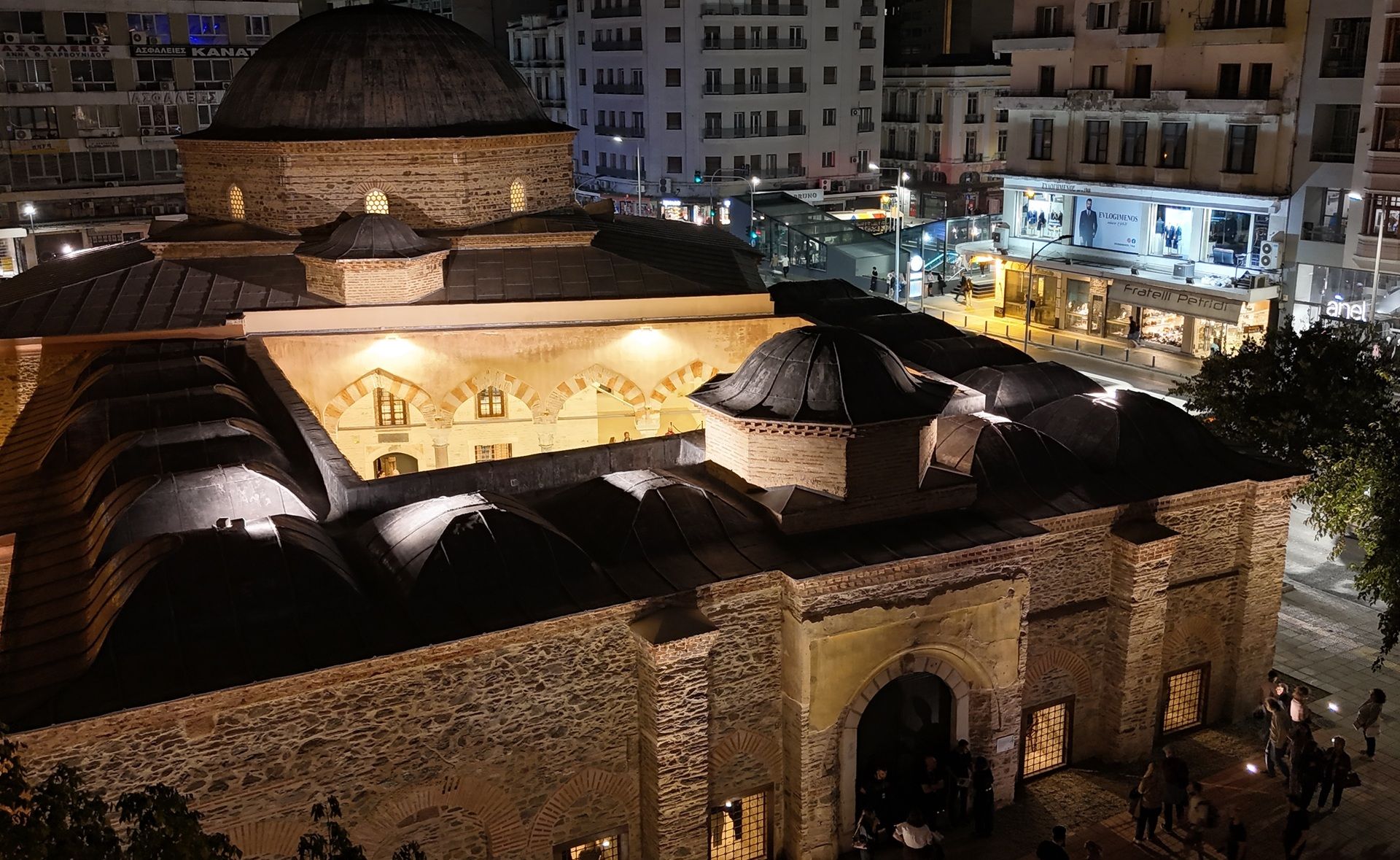
The restored mosque was originally commissioned by the daughter of the Ottoman admiral Hamza Bey in 1467
Courtesy of MOMus
The historic site will now be run by the Metropolitan Organisation of Museums of Visual Arts of Thessaloniki (MOMus), with some decisions taken in collaboration with the Ephorate of Antiquities of Thessaloniki City. It will operate as an exhibition space as well as a cultural centre, which will host heritage themed events and activities.
Fittingly, the opening exhibition Thessaloniki: The Footprint of Transition (1960-1980). Through the photographs of Pete Marifoglou offers a visual journey through two decades of rapid modernisation in Thessaloniki. In it the city, according to a statement, “is revealed as a living organism in transition, where tradition coexists and clashes with the new.” Some of the black-and-white works by Thessaloniki-native Marifoglou are on public view for the first time.
The exhibition is comprised of three thematic sections that represent parts of the mosaic of the city, the main cultural and economic hub of Greek Macedonia. The first, translated as The Commercial Character and the Market focuses on the economic heart of the city centre: Thessaloniki’s still-thriving historic markets.
The second, called People's Everyday Life,focuses on what the gallery calls the “human rhythm of the city.” The last part of the exhibition documents theencircling of the city’s Roman, Byzantine, and Ottoman heritage by a wave of antiparochi (a land-for-apartment exchange system) development, and the struggle for heritage preservation.
Epaminondas Christophilopoulos, the chairman of the management board of MOMus, said in a statement sent to The Art Newspaper: “The Hamza Bey Mosque, known to most people as ‘Alcázar’, is a building that bears witness to the city’s modern history—a history marked by the profound transformations of the Balkans. It has endured the Ottoman heyday, the Young Turks movement, the Population Exchange, and the Holocaust, and it still stands at the corner of Egnatia and Venizelou streets, in Thessaloniki. Its restoration demonstrates that Thessaloniki is now ready to showcase its Ottoman period as an integral part of its multicultural history.”
The restoration takes place within a broader programme of urban interventions initiated by Greece’s culture minister Lina Mendoni, which includes plans to link archaeological sites and illuminate the city walls—bringing to life Thessaloniki’s evolving cultural infrastructure. Another project of this kind is the ongoing conversion of the former Fix brewery into a cultural centre, which will also feature spaces dedicated or run by MOMus, as well as institutions such as the Thessaloniki State Conservatory.