

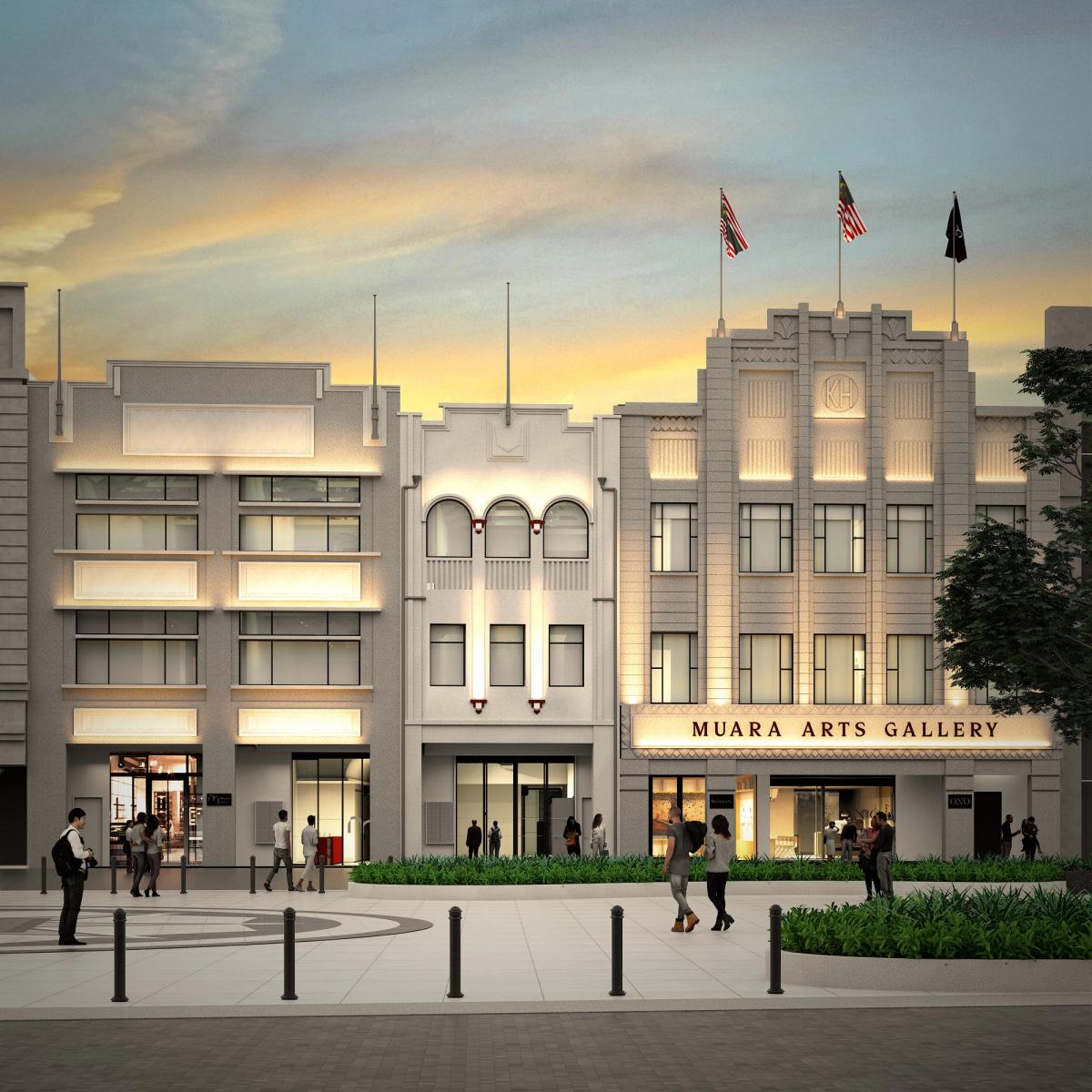
The Malaysian capital steps into the spotlight this autumn as it unveils a new art fair and a new nonprofit space, part of a larger proliferation of cultural projects. Boutique fair Art KL will debut in October (15-18) at the repurposed heritage printing factory A Place Where (APW) with ten regional galleries presenting Southeast Asian artists born after 1990. Then, in November, the nonprofit Muara Arts opens in a renovated shophouse.
'Organically driven'
“There are a lot of art-related happenings in Kuala Lumpur at the moment, and it’s all very organically driven by the private sector,” says the gallerist Richard Koh, who through his eponymous advisory is cofounding Art KL with APW and young artists platform Art Anonymous. “In recent years we have had Ur-Mu Gallery, a private collector’s art space open to the public, Muara in coming months, and also numerous events like the Access KL Art Fair, organised by G13 Gallery, and the CIMB bank-sponsored Artober.”
“The contemporary art scene in Kuala Lumpur, and more broadly across Malaysia, is at a very interesting juncture,” says Lydia Yee, Muara Arts’s artistic director. Malaysian newspaper The Star has “aptly described this as Kuala Lumpur’s ‘museum moment’,” with landmarks like Seri Negara [the former Government House] and the Sultan Abdul Samad Building reopened to the public, and the soon-to-open new Merdeka Textile Museum and Peranakan and Straits Chinese Museum due to open later in the year. Apart from institutions like the National Art Gallery, established 1958, and the Islamic Arts Museum, founded in 1998, the pace of new projects has until now been slow.
“Besides museums, I hope to see more public and private art spaces opening across Malaysia, from small artist-run initiatives to private galleries,” Yee says. She previously has held senior curatorial roles at London’s Whitechapel and Barbican galleries, and at The Bronx Museum of the Arts in New York. “A vibrant art scene needs spaces at every level to enable artists to thrive.”
Muara Arts, which in Malay references the nearby confluence of the Gombak and Klang rivers, will in 2029 also open an adjacent theatre. Both are part of the private capital backer Creador Group’s 50-plus-shoplot property redevelopment in downtown Kuala Lumpur’s heritage Medan Pasar market neighbourhood, beloved for its Art Deco architecture and traditional kopitiam cafés.
The space will open with a survey of Southeast Asian art featuring more than 40 artists, including Pacita Abad and Marcos Kueh. Two shows per year subsequently will feature “both established and emerging artists” from Southeast Asia, says Yee.
Encouraging emerging artists
Art KL aims to address the sparse opportunities at the emerging level. Along with its ten regional dealers, a curated section will highlight eight Malaysian artists including Farhan Rizuwan, Lee Mok Yee, Najib Ahmad Bamadhaj and Samantha Lee. Proceeds will go to The Lighthouse Children’s Welfare Home.
Koh says that regional galleries mostly work with much older artists, “and these younger artists have a tougher time getting any form of proper visibility”. Galleries find it economically challenging to promote emerging artists, and young artists need the exposure and experience of attending fairs. “It is also for connecting some of these regional galleries to each other, for the possibility of their collaborating with each other.”
Malaysia has long been rich in artists but short in cultural infrastructure. An initial generation from the “post-independence era, including Nirmala Dutt, Ibrahim Hussein and Latiff Mohidin, studied abroad and emerged in the 1960s and 1970s”, Yee says. “Of subsequent generations—such as Noor Mahnun Mohamed (Anum), Nadiah Bamadhaj, Simryn Gill, Pangrok Sulap, Wong Hoy Cheong and Yee I-Lann—many of them had significant exhibitions with the late gallerist Valentine Willie,” who supported Southeast Asian artists through his galleries in Kuala Lumpur, Singapore, Yogyakarta and Manila.
More recently, she says, there has been a unidirectional flow of Malaysian artists exhibiting in Singapore, “which has a particularly strong institutional and commercial infrastructure for art. While Singaporean artists have had fewer opportunities to exhibit in Malaysia, there is strong interest among them in doing so.”