

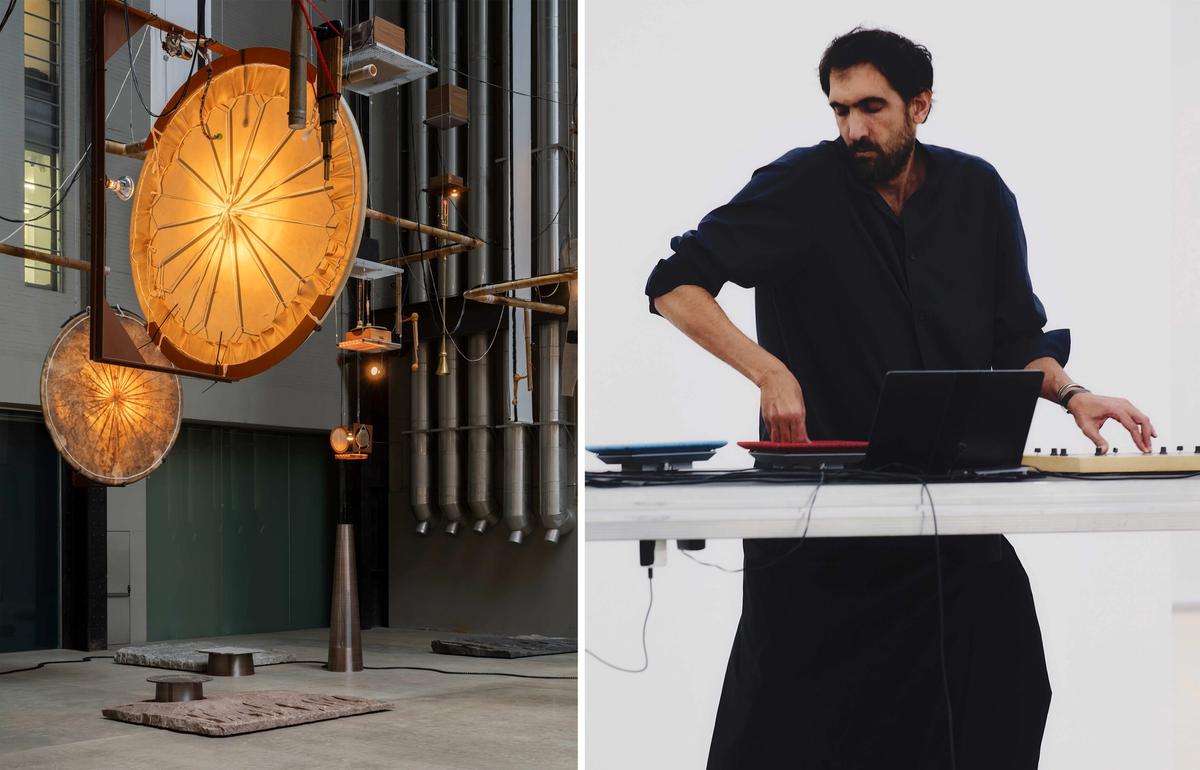
Tarek Atoui’s Hold, this year’s Turbine Hall commission at Tate Modern, is the most sound-focused work for the space since Bruce Nauman’s Raw Materials in 2004. Atoui is a composer in sculpture as well as sound, with the three-dimensional elements often possessing sonic properties that are central to the enveloping effect of his installations.
Atoui’s works are informed by various interactions, whether with communities and their musical and aural traditions, which inform the bespoke instruments he often creates; with other artists and musicians, through collaborative artworks and performances; or with his audience, who are active participants in these environments. The audience’s participation is key to the development of the work, whether directly in the forms of workshops and public events, or indirectly through their movement and the sounds they make being recorded or monitored through complex embedded electronic systems.
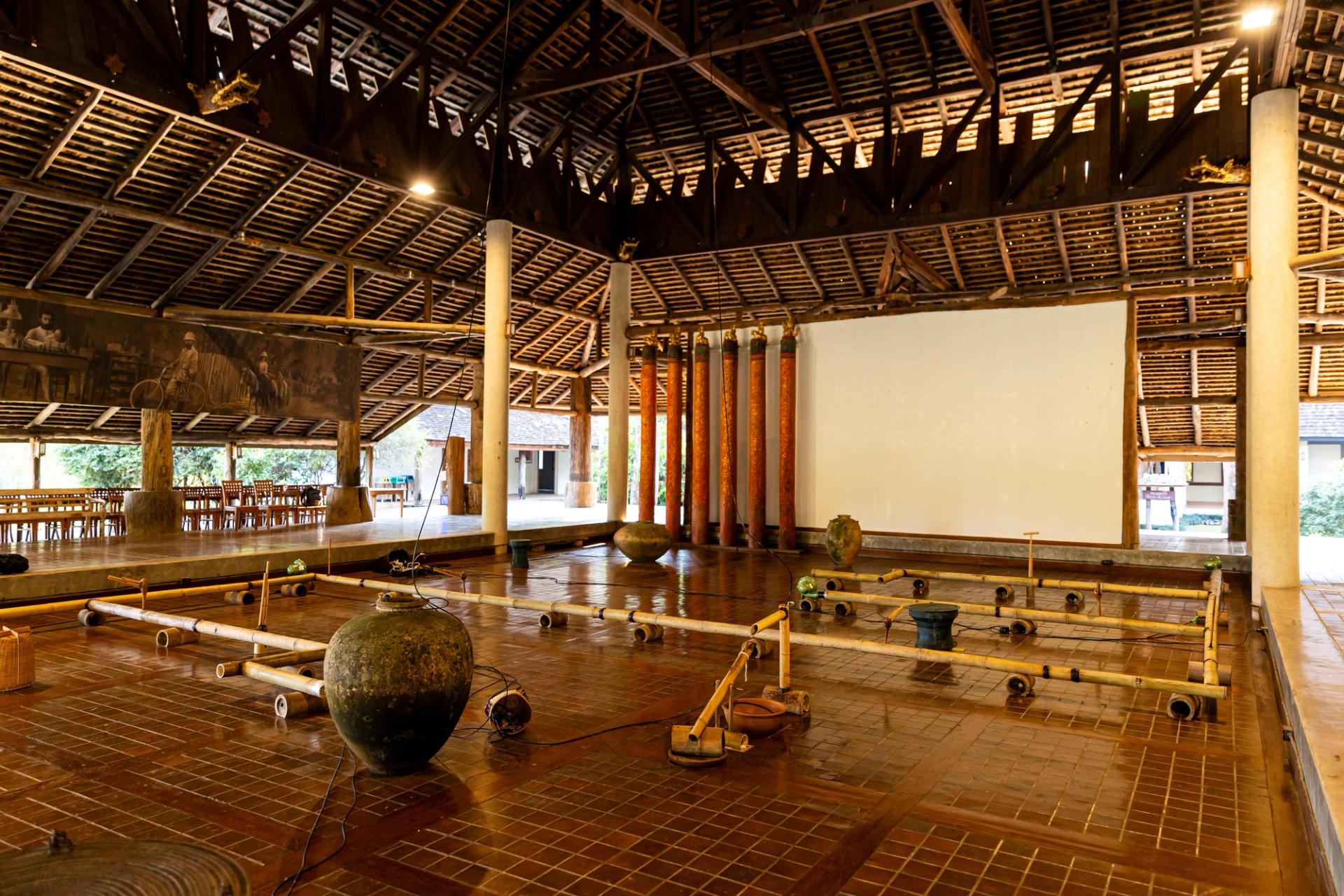
Installation view of Tarek Atoui’s The Wind Harvesters at the 2023 Thailand Biennale
Photo: Wanchai Phutthawarin
“[My work is] definitely connected to human presence in so many ways,” Atoui says, “whether you are … a kid on a school trip, a family having a picnic on the weekend, or a musician coming to play. All these dimensions are thought about in the work.”
The Art Newspaper: Acoustically, the Turbine Hall is an enormously complex space. Is that both a challenge and something to enjoy?
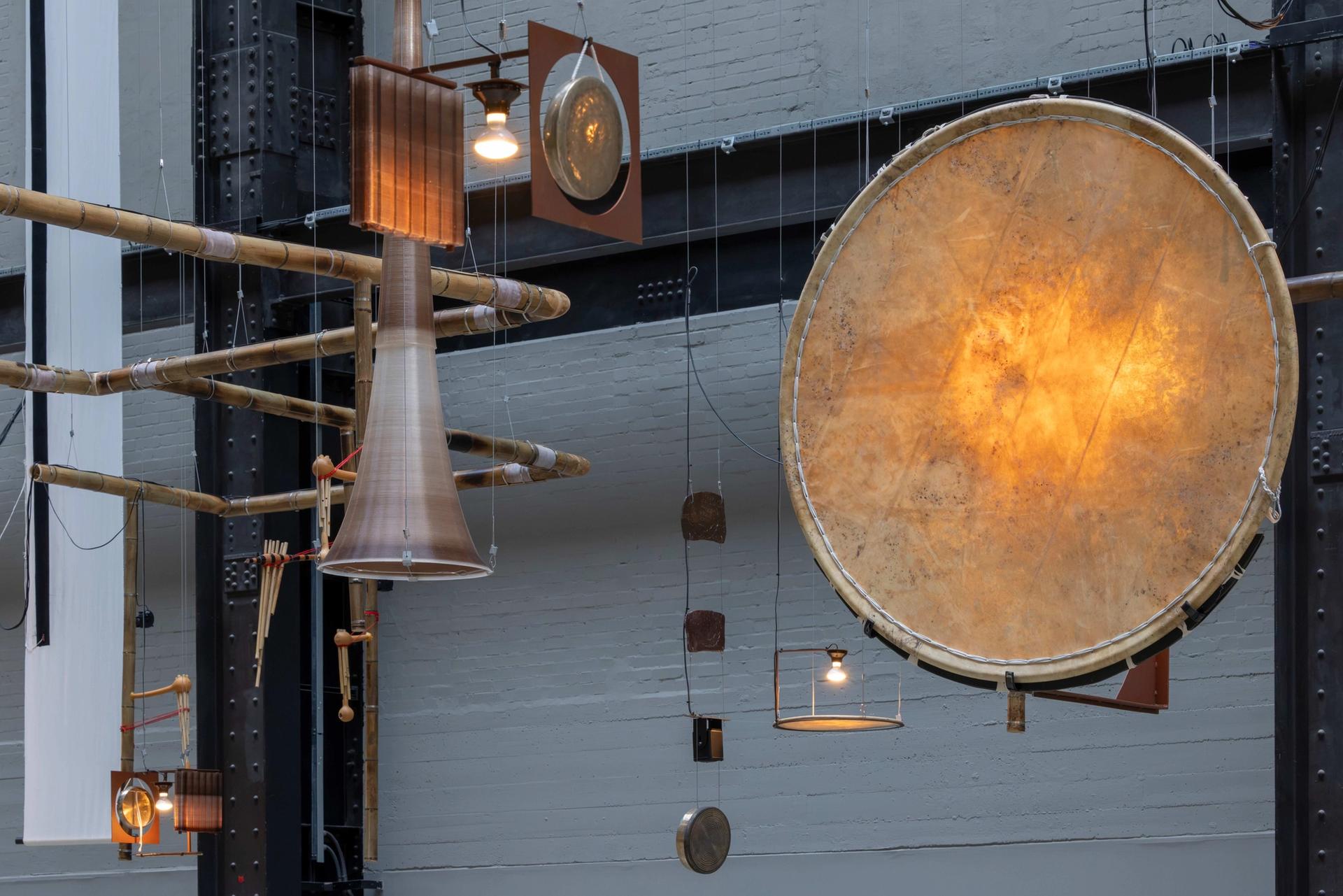
Tarek Atoui: Yes, it’s a challenge, of course, and there are lots of variables and uncertainties in it, but it’s an improvisation with the space, as well. It’s taking what it offers and its characteristics. Then my attitude and approach towards it was to think of instruments, think of a palette of sounds and materials to bring into that space that worked with this type of acoustic. So big drum skins that are struck in a simple direct way with a sound that would benefit from the echo of the space, horns that would fill the sound of the space because the echo would benefit them as well, and other types of instruments that I chose precisely to converse and be in dialogue with this acoustic and this identity.
Frequently the Turbine Hall is referred to as a “cathedral”. Have you responded to these cathedral-like qualities?
I saw it not necessarily as a cathedral or a type of religious monument. Of course, it has this quality, but at the same time it doesn’t have the reverberation or the acoustics of a cathedral. For me, it reminded me of a silo or of a big industrial space rather than a cathedral, per se.
If people come into Tate Modern from the west and walk down the ramp, the first thing that they will see is a karnai horn, isn’t it?
Yes, they will see these three horns that are announcing what is to come and punctuating [the space] with a very special sound and intertwined composition for three horns. They will be resonating throughout the whole Turbine Hall and connecting the two parts, left and right of the bridge.
I have revisited the karnai horn from Uzbekistan [that I used in my work for the] Bukhara Biennial a year ago. Then other horns were created specifically for the Turbine Hall commission. These are born from a conversation and a collaboration with the Arthur Mamou-Mani architecture office in London. Arthur and his colleagues have been exploring different ways of 3D printing, using recycled or resin-like organic materials. We had a previous collaboration where we started exploring sugar and I wanted to stay with this idea of working with sugar, its transparency—and also sugar made sense in the case of the Turbine Hall, in regards to its past [Tate was founded by Henry Tate, the sugar baron]. But this time we introduced another variable: we mixed bamboo dust with the sugar, to create a very specific and special material we will see a lot throughout the project. The bamboo dust was something we thought about, to be recycled and recuperated to make this material that would help us 3D print things. Then came the idea, inspired by the karnai: “why not print a horn?”
You are also collaborating with the Issey Miyake fashion company
Yes. We had worked together before but then in this chapter I wanted to push things further. Issey Miyake are fantastic in terms of research on textiles, their components, the way they work with airflows and natural elements. I asked Satoshi Kondo, who is their artistic director, as well as the fabric developers, to continue working on a textile they have that is a mixture of traditional Japanese washi paper and cotton.
So there is this fabric that is stretchable, that absorbs ink like a piece of paper, but at the same time is a textile. This was for me the start of something very poetic: of saying, well, if I paint it with a special charcoal paint, and if I use it as a cable to conduct electricity at very low voltage, and then use this electricity to generate bass sounds through synthesisers I had built, I would be creating big sails.
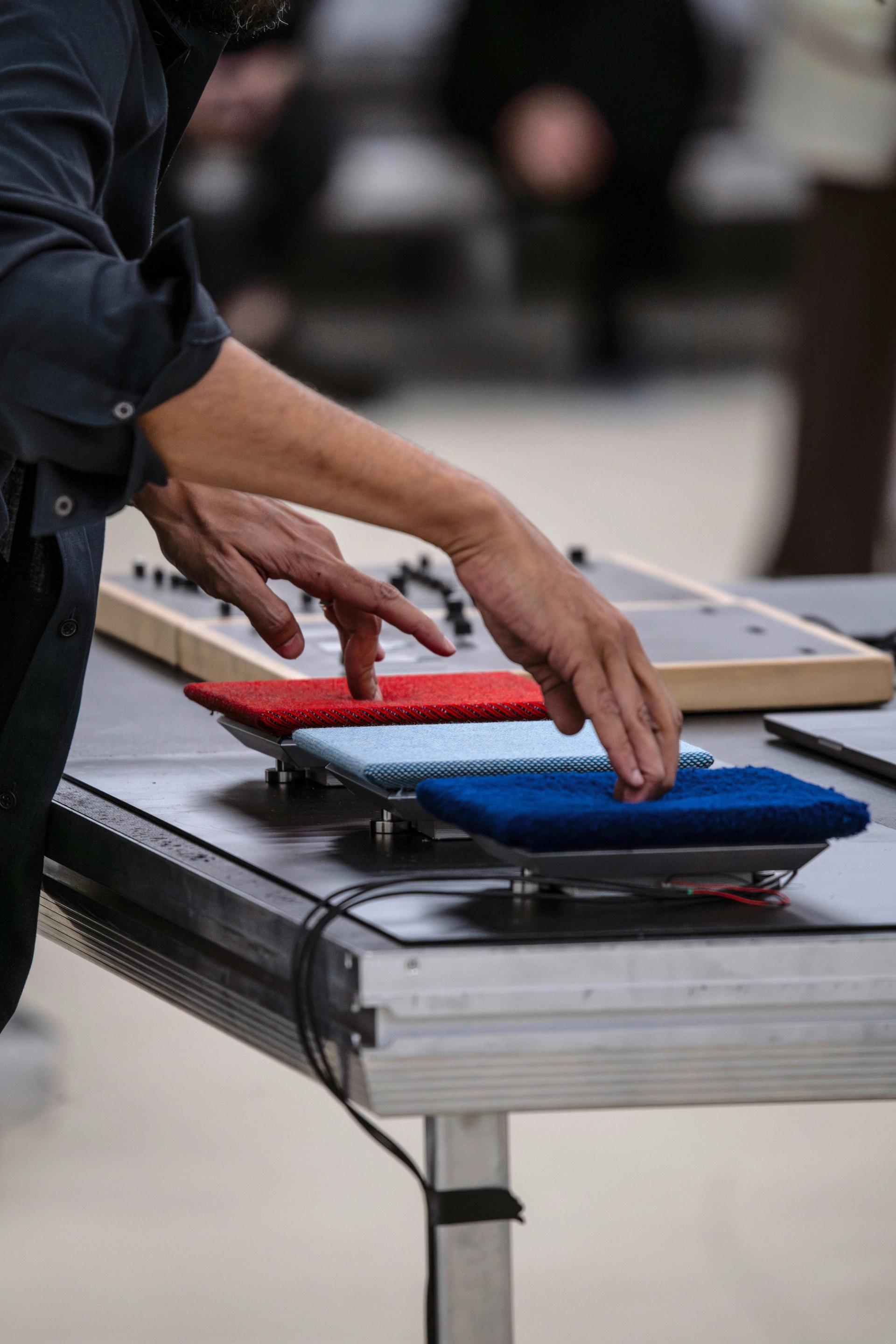
Atoui performing at an Issey Miyake show at Centre Pompidou, Paris, in 2025
Photo: Luna Conte
[The textiles] fall from the ceiling of the Turbine Hall down to the floor, and they act like an organic type of sensor—like a leather drum skin can absorb humidity—fluctuating because of their length with the air currents inside the Turbine Hall. And the sensitivity that these textiles have makes them amazing bass generators and power generators inside the space. Maybe you can start to see in this answer what I’m trying to get to with this idea of a silo or industrial space: I see the Turbine Hall as a vessel somehow; as a sound vessel or as a space that is meant to take us somewhere else.
You also create bespoke software. There are microphones within the installation that feed into the custom software and then generate music, which accompanies the natural sounds that are occurring through the space, right?
Totally. The modules and instruments that create this are called the Sunflowers in the case of the Turbine Hall piece. The Sunflowers are made out of percussion elements that are made from ceramics, from clay, from drum skins, from brass, and made in different parts of the world. But these materials are coupled with microphones. So the Sunflower in our case is something that listens to the space and what’s in it—not just the instruments that are around it, but sometimes it can also capture the voices of people, distinctive sounds that happen in the space. The Sunflowers catch the sound and inject it in a whole chain of processing events from strange looping mechanisms to complex sound effects. [The lines of software code I developed personally] make it very distinct [and] specific in terms of the sound and the timbres I’m looking for.
You have said the work relates to “current social and political realities”. Is it the human interactions, the communities that engage with the work, that manifest this social-political dimension?
Absolutely. In the case of sound- and music-making, you are not necessarily addressing the political in a direct or frontal way. On the contrary, you are letting it manifest, to see a complexity that is very personal and that is very open to discussion and dialogue. There is this dimension in sound and music that is political as well, of opening hearts, of opening minds, and paving the way for spoken dialogue, because to dialogue through sound is a totally different form of communication.
And also a more universal form of communication.
It allows political realities to manifest in a way that is much more subtle and that is much more connected and rooted in personal and intimate experiences and stories. So that’s maybe what I’m more interested in, in relation to the political: the part of the intimate and the personal that leads to the collective.
Many memorable projects have appeared in the Turbine Hall, including a sound piece by Bruce Nauman. To what extent have you engaged with that history and addressed the “ghosts” of the space?
It’s always nice to acknowledge and be aware of ghosts, what came before and even what is coming after. If you respect traditions and if you like working with tribes and people all across the world, I don’t know why you would not want to know what happened before. It seems like a very awkward, selfish attitude. Of course, I’m aware and I enjoyed looking at this history a lot. If you look in my installation, you will find a lot of shapes and a lot of things that are acknowledging it: the drums will remind us maybe of the sun of Olafur Eliasson, but these look like moons and not necessarily like suns or shining with the same brightness. There are pipes that remind us of Carsten Höller’s piece, there are cracks like in Doris Salcedo’s piece. I sometimes have fun trying to see samples or traces of previous Turbine Hall pieces in this work. But in a very playful and candid way also. It’s fun; you’ll see.
• Hyundai Commission: Tarek Atoui: Hold, Tate Modern, London, Until 11 April 2027