

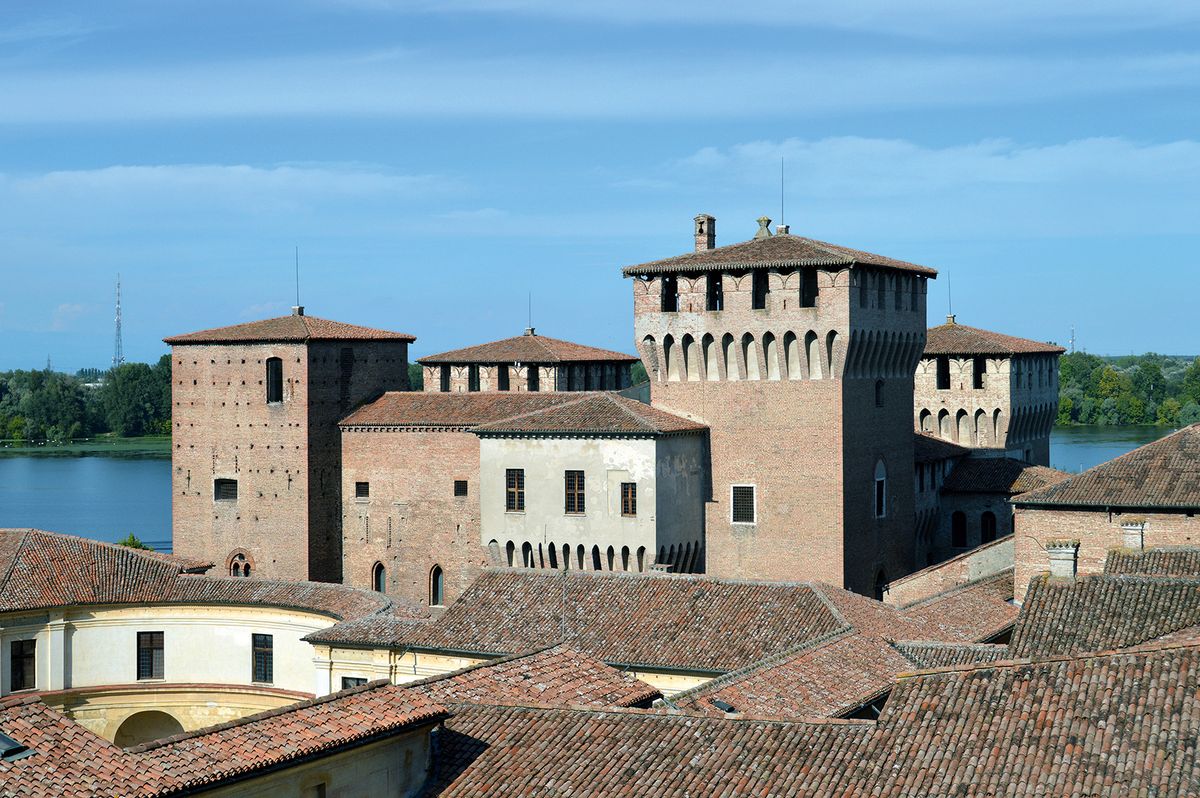
In spring 2012 two strong earthquakes centred in northern Italy’s Emilia-Romagna region caused significant damage to one of the country’s most important cultural sites: Mantua’s massive Palazzo Ducale.
Dating from the 13th century and extended over the centuries by the Gonzaga dynasty, the 35,000 sq. m complex has been under restoration for 14 years. This autumn, the ambitious project, comprising everything from anti-seismic interventions to the sprucing up of elaborate finishes, is set to cross a threshold. “About 99% of the work has been done,” says Stefano L’Occaso, the Palazzo Ducale’s director.
The 1,000-room complex, home to one of Italy’s leading Renaissance courts, has special status among the country’s grand residences, says Stephen J. Campbell, a professor of art history at Maryland’s Johns Hopkins University and the author of a monograph on Andrea Mantegna (1431-1506), court painter to the Gonzagas.
Eradicated or mutilated
Similar residences in Milan, Ferrara, Bologna and Naples, he says, “are lost altogether or survive in reduced and mutilated form.” Mantua’s Palazzo Ducale, by comparison, has seen “the survival of several phases of its building”, and in that sense “can best be compared to the Vatican Palace”.
The vicissitudes of Italian history certainly have left a mark here. Starting in the late 1620s, the legendary Gonzaga art collection was sold off and scattered, and the bulk of the Palazzo Ducale’s furnishings over time were looted or displaced. But the structure itself, and many original finishes, remain.
After the demise of Gonzaga rule in the early 18th century, the complex served as everything from a Habsburg residence to a political prison. It finally opened as a museum in the late 19th century, but only really came into its own as a modern cultural destination in the 1960s, earning Unesco World Heritage status, along with the rest of historic Mantua, in 2008.
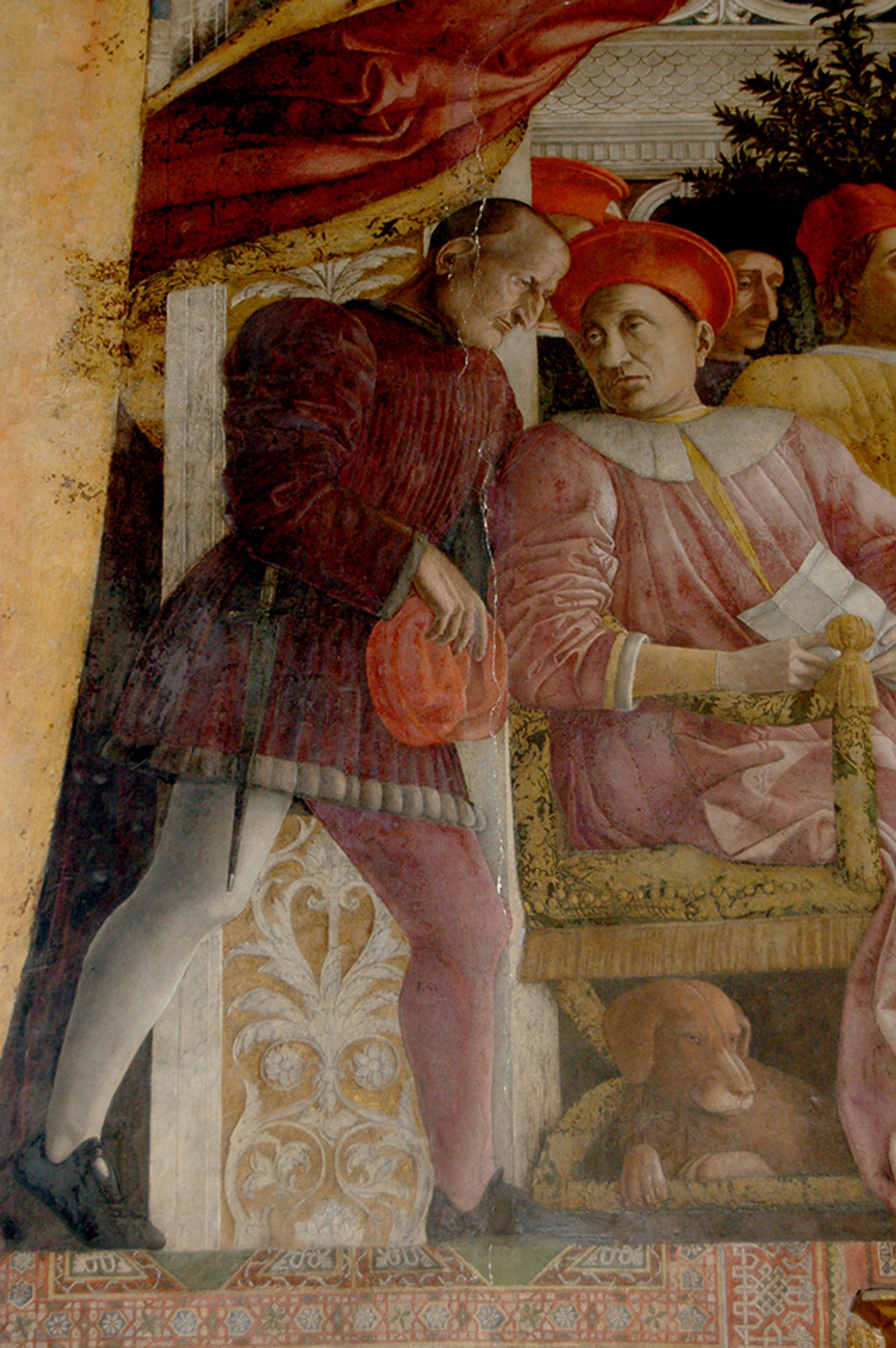
A wall of Andrea Mantegna’s 15th-century Camera Picta suffered damage, shown here, in the 2012 earthquake
Su concessione del Ministero della Cultura – Palazzo Ducale di Mantova
Near collapse
Then came the 2012 earthquakes. The bell tower of the Basilica Palatina di Santa Barbara, the complex’s royal chapel, almost collapsed. Mantegna’s Camera Picta (1465-74), a richly muraled chamber depicting quattrocento court life that is the city’s signature artistic treasure, suffered a crack right through one of its key scenes. Following the earthquakes, the complex reopened in fits and starts; both the bell tower and the Camera Picta were repaired by the end of 2016.
But some work was stalled until the arrival of L’Occaso, who has taken the opportunity not only to restore but to reinvigorate the site. Earlier this year, the complex’s southwest tower, a Medieval structure open to the elements long before the earthquake, was cleaned of bird droppings (some 200 bags’ worth, L’Occaso says). It was given a new earthquake-proof floor and is now, for the first time, routinely open to visitors. The Appartamento Grande di Castello, a palace-sized suite of rooms commissioned by Duke Guglielmo Gonzaga (1538-87) to celebrate his family’s military exploits, had been seldom shown to the public before 2012; it reopened in July, with restored ceilings and reinforced walls and floors.
In September a stabilised portico bordering the complex’s 17th-century garden, the Giardino dei Semplici, was reopened. For the first time, L’Occaso says, the public can access an upper floor corridor that provides a privileged view of the celebrated green space.
Revisiting Renaissance history
By the end of this year, the palace will reopen the Sala delle Sigle (hall of initials), associated with Francesco II Gonzaga (1466-1519) and his wife Isabella d’Este (1474-1539). The Ferrara-born Marchioness of Mantua is a subject of renewed interest among Renaissance scholars, who now view her as a canny stateswoman and supreme art collector. The space, with frescoes showing the intertwined initials of the pair, has been out of public view since the earthquake. Featuring a new floor decorated with vintage Majolica tiles, the reopened room will be finished off with a brand-new installation of ceramics and Renaissance glass.
L’Occaso has revisited another underappreciated member of the Gonzaga clan—Ferdinando, whose story combines extravagant patronage with a streak of bad luck and fits of bad judgment that culminated in the notorious 1627-28 sale of the dynasty’s major works of art.
The sale sent dozens of masterpieces into Europe’s other great dynastic collections, but L’Occaso will bring back several for a special palace exhibition, A Sun that Shines with its Own Light: Ferdinando Gonzaga, Patron and Duke (1587-1626), this month (10 October-10 January 2027), featuring loans from the Musée du Louvre and Vienna’s Kunsthistorisches Museum.
Too many doors to open?
L’Occaso estimates that around €15m has been spent on repairing earthquake-related damage and installing new anti-seismic measures, and he is hopeful that an increase in visitor numbers can offset the costs. But he also concedes that Palazzo Ducale’s emergence from its post-earthquake cocoon could have an unintended downside. The new network of reopened spaces means that there may now be “too many doors to open” and he is concerned that people will have a harder time deciding where to go and what to do.
The immense size has yet to become a personal challenge. “I have never got lost,” he says, but concedes that, when taking on the whole of the Palazzo Ducale, he always brings water and even a sandwich, just in case.