

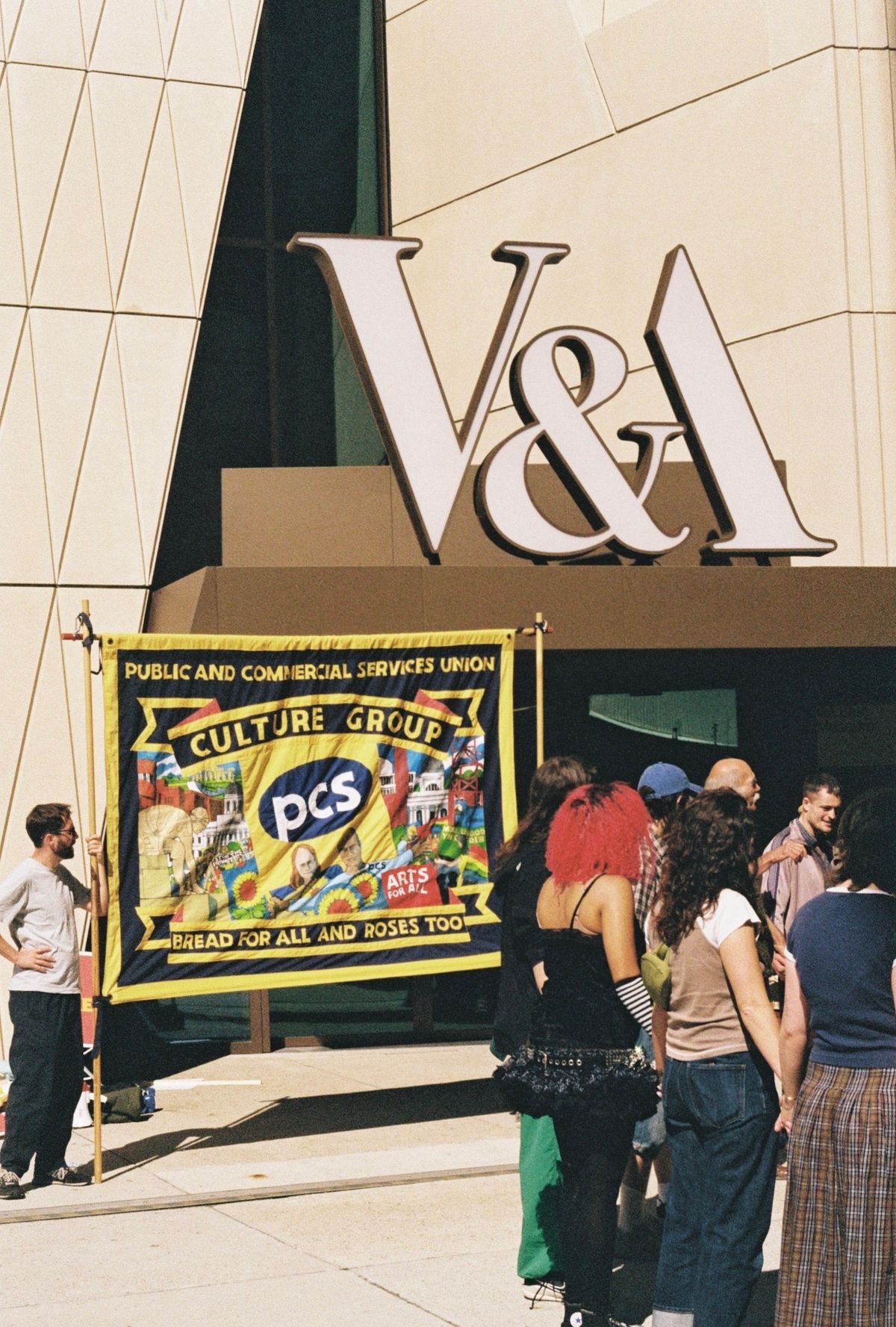
The Victoria and Albert Museum (V&A) in London is planning to launch a voluntary exit scheme for all staff following a series of strikes over pay and working conditions.
The unions PCS and Prospect held strike action at the V&A’s South Kensington site on 25 and 26 September. The strike action came after union members at three V&A sites (East Storehouse, East Museum and Young V&A) walked out on 4 and 5 September after raising concerns about renumeration and working conditions, especially at the V&A East Storehouse in Stratford, which opened last spring.
According to a report by Arts Professional, the “PCS union claimed the institution is projecting operational deficits amounting to a cumulative total of £19m by 2030”; this was not confirmed by the V&A.
“Like many organisations, the V&A is facing rising operating costs, driven by inflation, economic uncertainty, and reduced visitor spending. While we continue to receive government support, below-inflation settlements mean a real-terms reduction in funding over the coming years,” a V&A spokesperson told The Art Newspaper.
The V&A received grant-in-aid from the UK government totalling £59.9m from 2025-26 according to its annual report, an increase of £3.7m on the previous year. In addition to this core funding, there was also a £5.2m award for the museum from the Public Bodies Infrastructure Fund to help protect the V&A’s buildings at South Kensington and Young V&A.
The V&A spokesperson highlights the museum’s organisational strategy for 2026-30 which “is underpinned by a cautious approach to financial planning and we’re exploring a wide range of measures to reduce costs, including launching a Voluntary Exit scheme.” The scheme is open to staff across the museum.
One element of the organisational strategy objectives on “streamlining operations” addresses staffing: “We will simplify our operations and enhance our output through the effective deployment of our people, processes and technology, including AI; reducing costs while increasing impact.” The strategy also includes “develop[ing] confident, skilled teams and an inclusive culture” as one of the museum's foundations.
In a statement dated 22 September, PCS disputed some claims made by the V&A director, Tristram Hunt. “Hunt alleged that V&A staff would receive an average pay rise of 4.18%. Yet the vast majority of staff, aside from the lowest paid, are being offered 3.25%,” said PCS. The statement also disputes the claim that the museum directorate has had “regular contact” with the trade unions.
The spokesperson adds: “We deeply regret that the trade unions voted for strike action. We have been negotiating with them in good faith since February and have met the majority of their demands with a significantly improved offer, which we believe is fair, competitive and affordable.”
The spokesperson says that the latest pay offer delivers a pay rise “well above inflation for all staff, with an average 4.18% pay rise and a 6.9% increase for our lowest-paid colleagues; a bank holiday pay rate increase to 1.5, alongside a sector-leading bonus scheme and a subsidised food offer at all of our sites”.
According to the spokesperson, all V&A staff are paid the London Living Wage (LLW) and have been for many years; they also note that the “majority” of contracted roles are paid the LLW. “The vast majority of contracted roles are also paid the London Living Wage. The V&A has already made a commitment to the trade unions that we will review LLW accreditation by December this year.” The museum remains available for negotiations with the trade unions, the spokesperson adds. No further strike action has been announced at time of publication.