

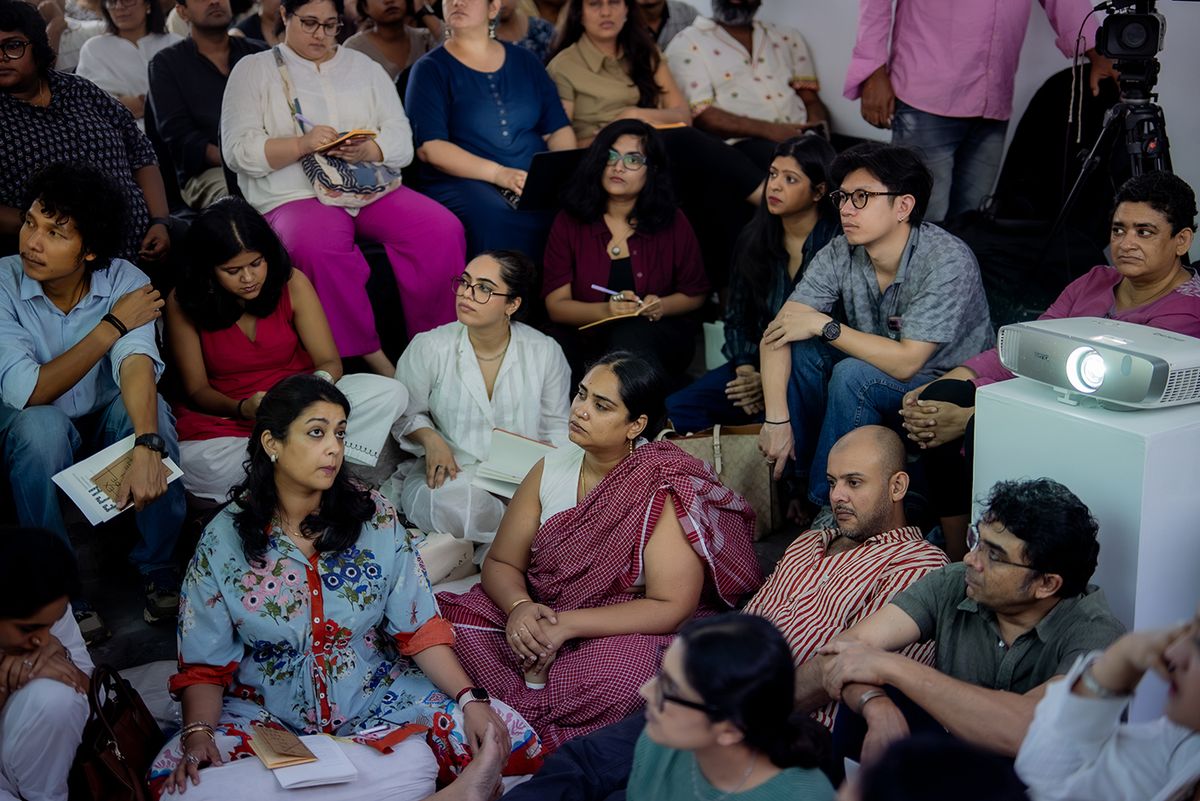
For an art industry disoriented by speed and unsure of its future, crystal ball gazing feels increasingly futile. Accordingly, this year’s edition of the Experimenter Curator’s Hub (ECH), an annual, open-to-the-public conference for curatorial practice, focused less on speculation than “present concerns”, said the hub’s convener, Rattanmol Singh Johal.
Organised every July by the prominent Indian gallery Experimenter, ECH invites a group of leading curators to present on a topic of their choice in the gallery’s Hindustan Road location (one of two spaces it maintains in Kolkata, where it was founded in 2009).
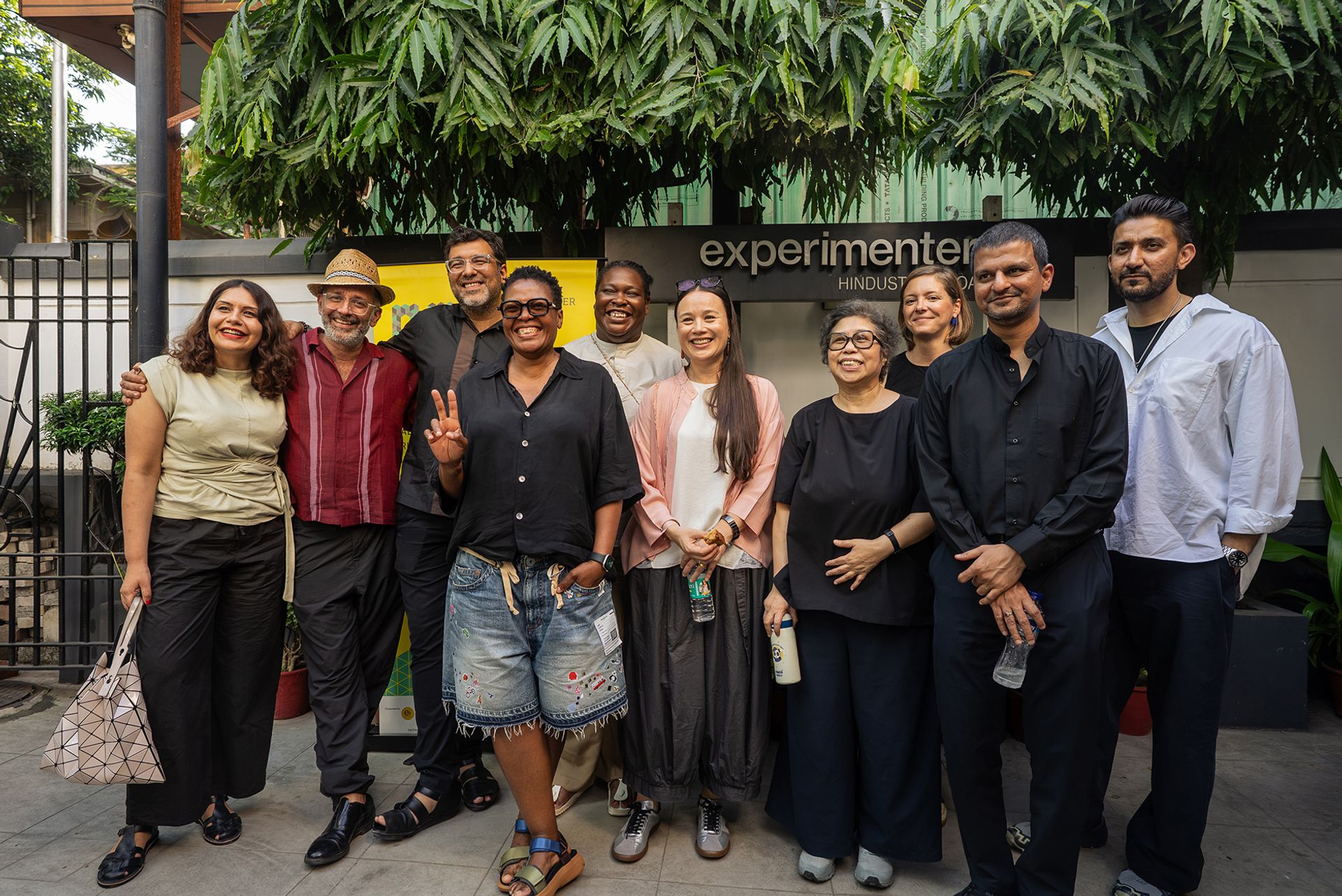
The invited speakers at Experimenter Curators' Hub 2026
Courtesy of Experimenter
The 2026 speakers were: Sabih Ahmed, the co-curator of the 2026 Diriyah Biennale; the Chiang Mai-based Zoe Butt, the founder of in-tangible institute and the artistic director of the forthcoming Decentral in Thailand; Arnika Ahldag, the director of Museum of Art & Photography (MAP) in Bengaluru; Gabi Ngcobo, the director of Kunstinstituut Melly in Rotterdam; Tarini Malik, an independent curator whose recent projects have included A Story of South Asian Art (Royal Academy of Arts; Hepworth Wakefield) and John Akomfrah’s commission for the British Pavilon at the 2024 Venice Biennale; Nikhil Chopra, a performance artist who curated the sixth Kochi Biennale; Sepake Angiama, the director of Iniva in London; Shabbir Hussain Mustafa, the chief curator of Singapore Art Museum; and Gridthiya Gaweewong, the co-founder of Project 304 and the artistic director of Jim Thompson Art Center, Bangkok.
The practicalities and precarities of curating
Several speakers took the opportunity to address the precarious—and often unsustainable—material conditions of curating and working with institutions. Butt attempted to "map relations to power and agency" throughout her career, from working under heavy censorship in Vietnam to the importance of "inserting oneself into boardrooms".
Butt, who declared herself "at a crisis point with the arts", will serve at the artistic director of the forthcoming Decentral in Thailand, an art centre and social enterprise launched by the conglomerate Central Group. Addressing her choice to work with the "the highly visible face of a corporation" Butt spoke about eschewing "leftist purity politics" to reach wider non-art audiences. In an era of dwindling public arts funding she suggested strategic measures for attracting new patrons, concluding that art must support a culture of "irreverence" in order to do so.
Also commenting on the hidden practicalities and problems of curating, Gaweewong put paid to the notion of collectivism as a panacea for curators. "How many of these people do I still have dinner with?", she said in jocular fashion of many of her past collaborators.
Resisting the romanticisation of curatorial practice, Malik addressed the fallacy of "care" being as a buzzword by an industry that ignores its abusive and exploitative systems. "What does it mean to talk about care in an artist’s work when the industry feels bereft of care?" she asked. "What does it mean to speak about collectivism, when the industry privileges certain voices and leaves others behind.”
"Our entire industry is fuelled on emotional labour," Malik concluded. "We are not paid enough."
The role of artists during fascism
Opening the edition, Experimenter’s co-founder Prateek Raja eulogised Hind Rajab, the five-year-old Palestinian child who was killed in January 2024 in Gaza by the Israeli military. He called for “hyper empathy” in the face of a “progressive desensitisation” taking place across the world. Raja’s concerns are not just global but local, too. This was the first Curators’ Hub to be held since West Bengal (of which Kolkata is the capital), fell to the Bharatiya Janata party (BJP) in state elections, having long stood as a stronghold against prime minister Narendra Modi’s right-wing Hindu nationalist party, whose use of “violence against dissent, unfair detention and aggressive targeting of minorities” was called out by the hub’s moderator, Rattanamol Singh Johal.
One audience member asked Nikhil Chopra, the curator of the last Kochi Biennale, what the biennial would do if Kerala—one of India’s few remaining left-leaning states—was taken by the BJP. Chopra acknowledged that Kochi is a “rare corner where conversations can still be had” and that “it has always withstood a certain power”. Chopra added: “Kerala has always had a self-intelligence beyond swings to the right or left.”
The subject took a more concrete turn at the hub's close—during its open discussion portion—when an audience member, the independent curator Shaleen Wadhwana, drew attention to the detention of artist Srishti Gupta, who is facing charges of inciting violence at a workers’ protest in Noida, near Delhi.
Yet Gupta’s occupation as an artist is not incidental to her arrest; another audience member, the Raqs Media Collective co-founder Shuddhabrata Sengupta, said that Gupta was detained in part as a result. Quoting her judicial report, Sengupta noted that the judge questioned “why would an artist be present at a construction site protest?”.
It drives home that in India, and indeed in much of the world, artists—and by extension cultural professionals—are considered separate to most workers. As the hub drew to a close, Johal concluded that this troubling verdict should only compel art workers to “continue to show up in places we might not be considered to be a part of”.