

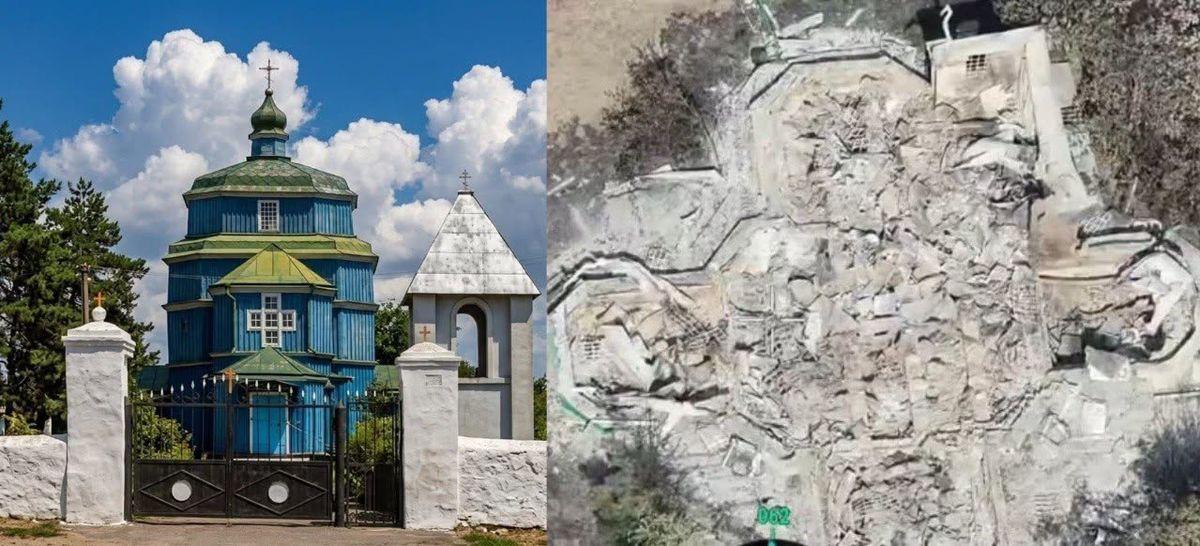
An 18th-century church in southern Ukraine, which officials say was the country’s last remaining example of wooden Cossack architecture from that time, was destroyed by a Russian drone strike over the weekend (1-2 August). Photos from the site in Beryslav, a historic settlement in the Kherson region, show the burnt remains of the Holy Vvedenska (Presentation) Church.
Oleksandr Alchiev, the head of the Beryslav City Military Administration, wrote in a Facebook post on the morning of 3 August that the church “was a unique architectural monument of national significance that had been an integral part of the history of our city for almost three centuries”. He wrote that it was built in 1725 of oak from the Perevolochna fortress of the Zaporizhzhian Cossacks, without a single nail being used, before it was transported along the Dnipro to Beryslav in 1784.
Most, a Kherson news site, reported after the attack that the church is still under the jurisdiction of the Ukrainian Orthodox Church, which has historically been affiliated with the Moscow Patriarchate. A separate entity called the Orthodox Church of Ukraine was established in 2018 with the aim of achieving a full break with Moscow’s ecclesiastical authority.
At the beginning of its full-scale invasion of Ukraine in 2022, Russia occupied most of the Kherson region—which is strategically located on the route to Crimea. Parts of the region, including Beryslav, have been liberated, but it is under constant bombardment and its cultural and religious sites are at risk as a result of the conflict.
Skeiron, a Lviv-based cultural heritage organisation that creates 3D scans of monuments, appealed on Facebook and Instagram for images of the church so it could create a digital version of it.
In April, a Russian drone strike in the Kharkiv region destroyed the historic Dontsiv-Zakharzhevsky Manor, which had been the estate of a prominent Cossack family.