

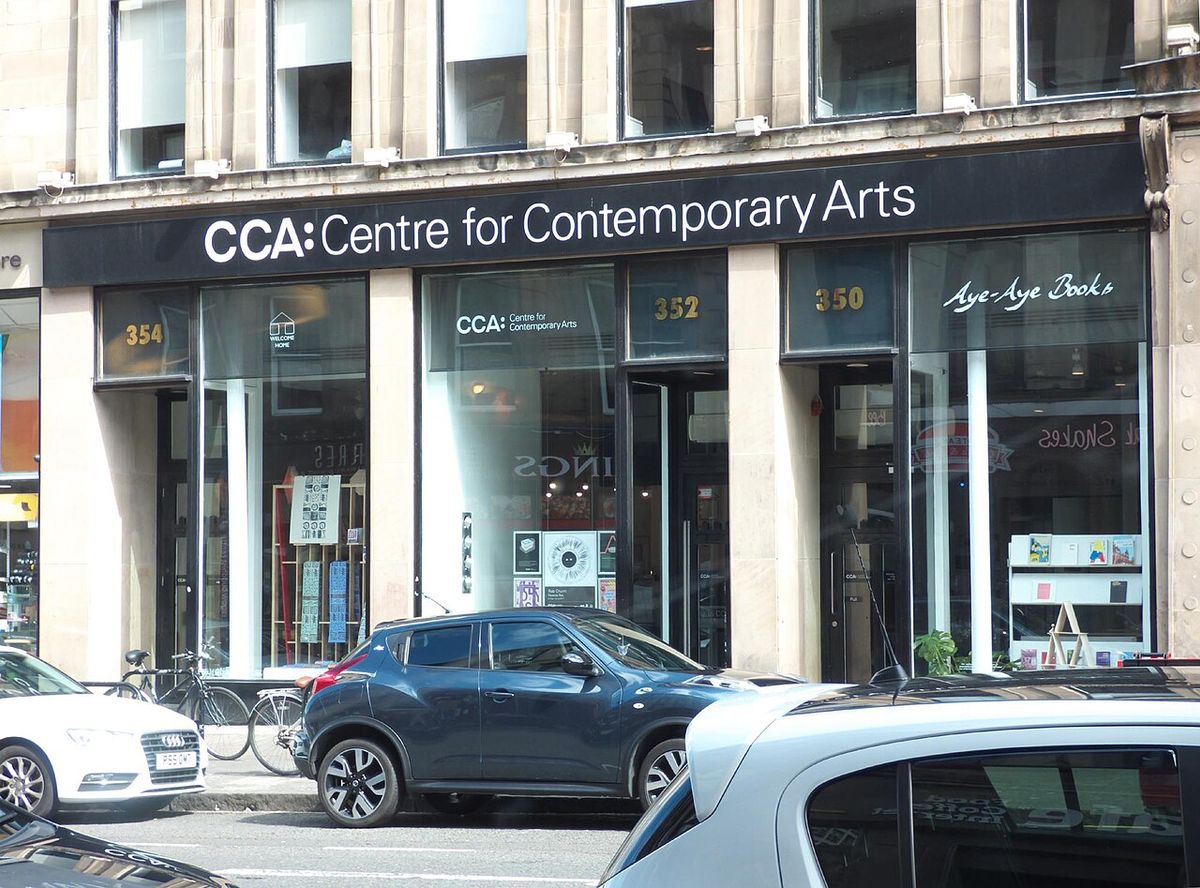
Campaigners, politicians and arts figures have called on the Scottish government to intervene after the archive of Glasgow's Centre for Contemporary Arts (CCA)—which documents more than 50 years of Scotland's contemporary cultural history—was listed among the assets of the insolvent organisation, prompting fears that that the collection could be broken up or sold as part of liquidation proceedings. A "Stop the Sale" demonstration took place outside the building on Friday.
The archive of the CCA and its predecessor, the Third Eye Centre, contains exhibition records, photographs, posters, film, flyers and other ephemera documenting five decades of artistic activity in Glasgow.
Creative Scotland, which owns the CCA building on Sauchiehall Street, has confirmed it is working with Glasgow Life and the Ballast Trust, an archives charity, to explore ways of preserving the collection and keeping it publicly accessible in Glasgow.
Amanda Catto, a former portfolio manager at Creative Scotland, warned in an Instagram post that "the archive at risk today encompasses more than 50 years of Scotland's contemporary cultural history", featuring the work of generations of artists, writers, filmmakers, musicians, performers, designers and activists.
Describing the collection as "part of Scotland's cultural memory", Catto argued that allowing it to be broken up or sold would represent "an irreversible loss to Scotland's cultural record". She also questioned what protections exist for the archives of other nationally significant cultural organisations if they too were to become insolvent.
MB Valuations, the firm instructed by the liquidators to dispose of the CCA's assets, has indicated it is seeking advice on the future of the archive and is inviting expressions of interest, rather than including the collection in the wider auction of furniture and equipment. According to Scottish media reports, the company hopes the archive can remain together under institutional ownership.
David Green MSP, the Scottish Liberal Democrats' culture spokesperson, however tells The Art Newspaper: "The public will rightly be asking questions. It's important that steps are now taken to preserve the centre's valuable archive."
He added: "This government often talks a good game on culture but now is the moment they must put in the hard yards of delivery. That means nurturing creative talent in every corner of the country and protecting our treasured cultural assets."
The concerns have also been echoed by the campaign group Save Our CCA, which has launched a petition calling for the archive to remain intact and for the former arts centre building to remain in public ownership as a cultural asset.
The controversy follows the closure of the CCA earlier this year after prolonged financial difficulties. The institution entered liquidation in January, with the loss of all staff, and Creative Scotland subsequently announced plans to sell the building, ending more than two decades in which it served as one of Scotland's leading centres for contemporary art. The Office of the Scottish Charity Regulator launched an inquiry into the charity's financial governance after it folded, and last week concluded that investigation without taking further action.
Catto argued that the fate of the CCA archive would have implications far beyond a single institution. She says: "If an archive of this importance can be treated simply as an asset to be realised during administration, what protection exists for the documentary history of other nationally significant cultural organisations should they face similar circumstances?"