

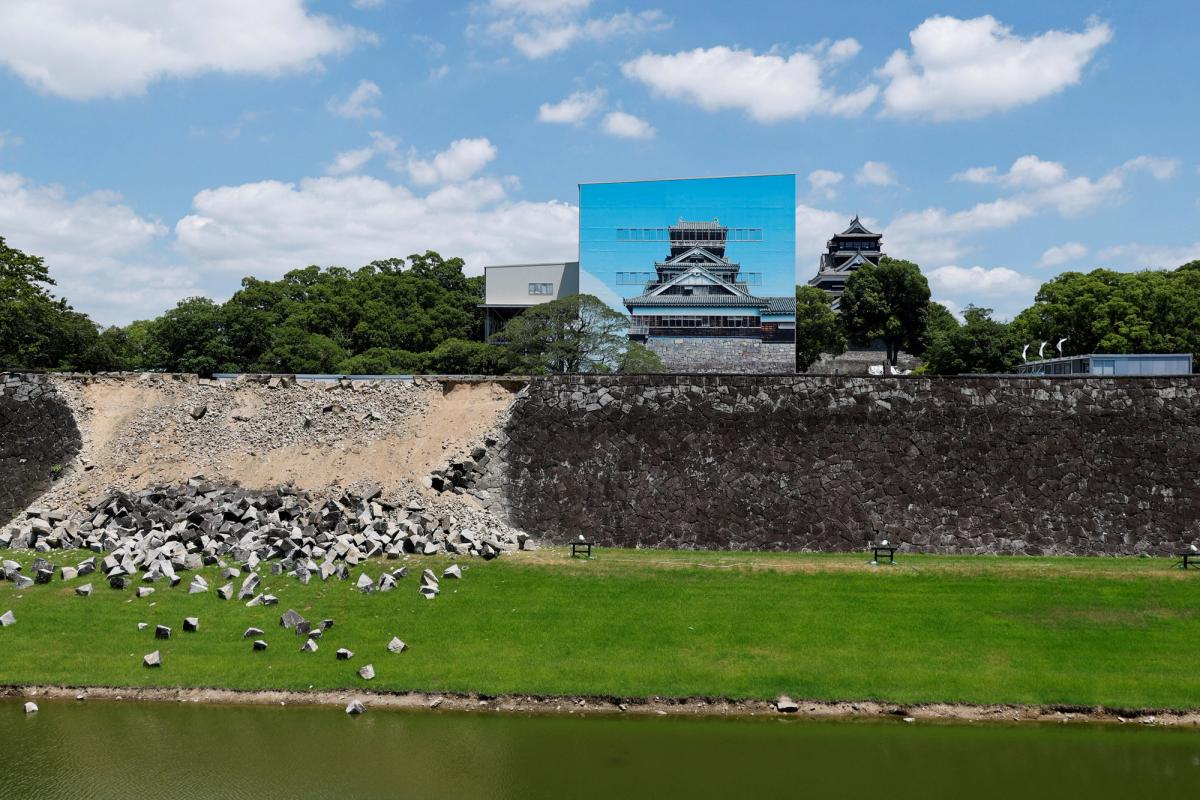
Kumamoto Castle, a celebrated Japanese landmark which has been undergoing restoration after devastating earthquakes in 2016, has suffered fresh damage following a magnitude 7.1 earthquake that struck the southern Kyushu island on 28 July.
This week’s earthquake, which registered the maximum intensity of 7 on Japan’s seismic scale in the cities of Uki and Hikawa, has led to the deaths of 36 people as of 31 July, forced thousands to evacuate amid extreme summer heat, and caused widespread damage to infrastructure across the island’s Kumamoto Prefecture.
Kumamoto Castle, completed in 1607 by the feudal lord Kato Kiyomasa on the site of earlier fortifications dating back to the 15th century, is widely regarded as one of Japan’s finest castles. It has become a symbol of the city’s long recovery since the devastating twin Kumamoto earthquakes of 2016, which killed more than 275 people. Two of the castle’s walls collapsed at that time.
According to Kumamoto Castle officials, newly confirmed damage at the site includes collapsed sections of stone walls and minor damage to buildings within the castle complex. The castle remains closed while engineers assess structural safety. The new damage comes as restoration work following the 2016 earthquakes was expected to continue until 2052.
“We are still investigating the extent of the damage, so it is too early to know how the restoration schedule will be affected,” Rintaro Mitsuyasu of the Kumamoto Castle General Office tells The Art Newspaper. “There is certainly a possibility that the completion date could be delayed, but at this stage we cannot estimate by how much.”
The latest earthquake has also damaged cultural heritage sites elsewhere in Kumamoto Prefecture. Footage published by Japan Broadcasting Corporation (NHK), for example, shows a collapsed gate at Yatsushiro Shrine, the venue for the Yatsushiro Myoken Festival, which is registered as Unesco Intangible Heritage.
Meanwhile, according to the Japanese art magazine Bijutsu Techo, at least 16 museums, galleries and cultural facilities temporarily closed to inspect buildings and collections following the earthquake. The Art Newspaper confirmed these closures through statements published on the websites of these institutions. Among them are the Contemporary Art Museum Kumamoto, Kumamoto Prefectural Museum of Art, Kumamoto City Museum and Tsunagi Art Museum.
The Contemporary Art Museum Kumamoto reported no serious damage to its collection. While movable exhibition walls shifted during the earthquake, causing dust and paint particles to fall onto some works, museum staff say that all affected works can be cleaned and restored.
“There has been no major damage to either exhibited or collection works,” Akiko Sakamoto, the museum’s deputy director, tells The Art Newspaper. “At this point, we are optimistic that conservation treatment such as cleaning will be sufficient.”
Rather than waiting for every inspection to be completed, the museum plans to reopen its free public spaces next week before gradually reopening its exhibition galleries, including the current exhibition about the Japanese fashion brand minä perhonen.
Sakamoto says the institution’s response has been shaped by lessons learned from the 2016 disaster.
“Ten years ago, we hesitated before reopening,” she says. “This time we realised that creating a place for people to gather is just as important. Instead of keeping the museum closed, we want to reopen as quickly as it is safe to do so and provide a space for the community.”
Officials expect museums in Kumamoto City to reopen relatively quickly, while institutions in harder-hit southern municipalities such as Uki and Yatsushiro may face longer closures.
For Kumamoto Castle, however, the immediate priority remains assessing the latest damage before restoration work can resume.
“We hope visitors from Japan and overseas will come back once the castle reopens,” Mitsuyasu says. “We hope they will return to experience Kumamoto Castle’s history and culture again.”