

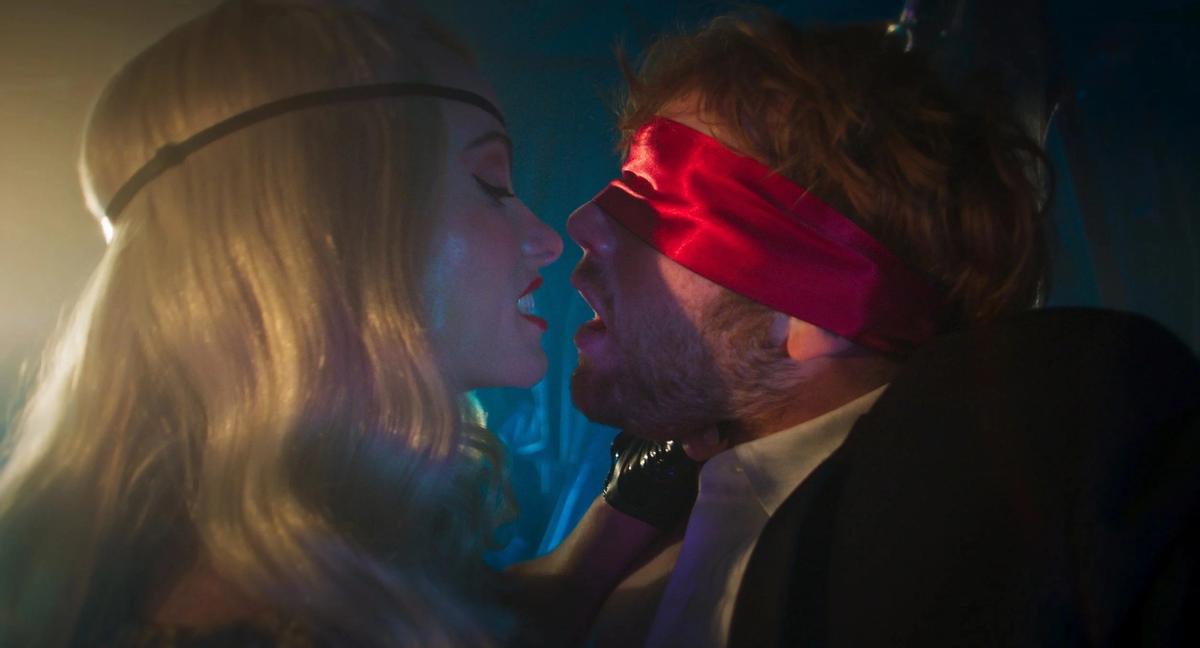
“I’m a slave to this vagina.” So says Elliot (Cooper Hoffman), an assistant in the studio of Erika Tracy (Olivia Wilde), an Erika Lust-like multidisciplinary artist. He is referring to one of Erika’s works-in-progress: an outline of female genitalia on canvas, to which he and his fellow-toilers in this “hipster sweatshop” affix wad after wad of chewing gum, which they masticate piece by piece. As studio-assistant gigs go, it’s a step down from stretching canvasses (or, as in this spring’s The Christophers, forging the master’s work). But just after this remark, Elliot is called into Erika’s office, asked if he signed the standard non-disclosure agreement, told to shut the door and recruited for another, more sexual sort of servitude, in the form of a BDSM relationship.
Gregg Araki’s new film I Want Your Sex opens with a flash-forward to Erika face-down and unresponsive in her swimming pool, an homage to the opening of Sunset Boulevard (1950), another film about the complicated age-gap romance between a fragile, egotistical artist and her boytoy. But things are fun at first: with his typical Pop Art colour palette and himbo playfulness, Araki shows the unfolding of a mutually liberatory relationship.
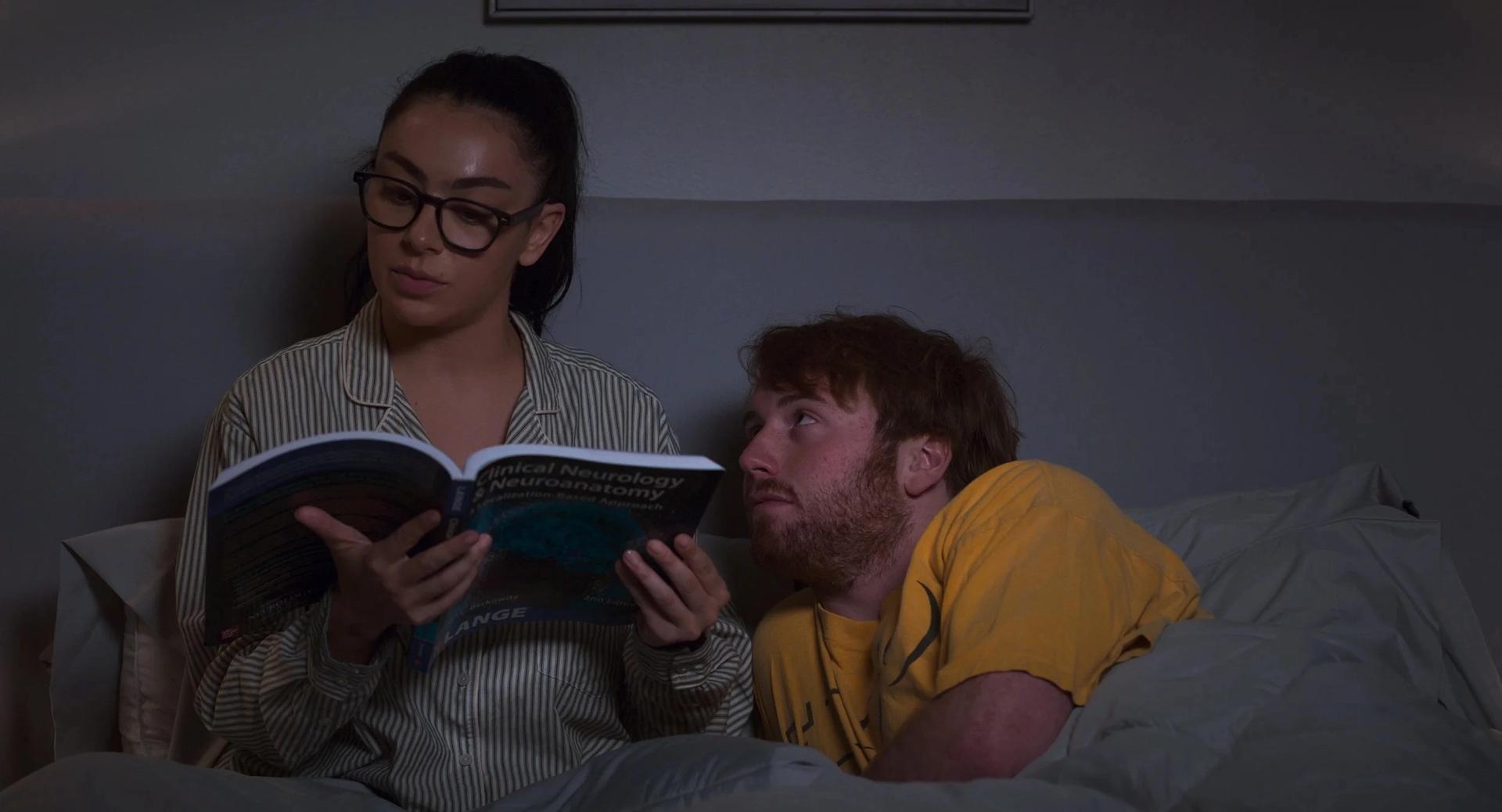
Charli xcx and Cooper Hoffman in I Want Your Sex Photo courtesy of Magnolia Pictures
Erika, compulsive and in need of adoration—she becomes visibly aroused when Elliot writes a press release that is worshipful even by PR standards—pushes her sub past his comfort zone with a try-it-you’ll-love-it casualness. Elliot is incompatible with his girlfriend (Charli xcx) and bottling up things he’d been unable to articulate or recognise on his own, so it is easy for him to surrender to being paddled and penetrated, to the latex mask on his face and the scissors tracing patterns on his chest, even as his boss demands ever more trust and vulnerability. Elliot recounts all this in a police interrogation room, to square cops who relitigate his sexual relationship like HR managers while also raising eyebrows at Erika’s work. (In an inside-joke casting choice, the cops are played by Margaret Cho and Johnny Knoxville, that great mainstream ambassador for the type of transgressive body art pioneered by artists such as Chris Burden.)
Characters in Araki’s films often indulge in id-freeing sprees only to face consequences: witness the triad-on-the-run of The Doom Generation (1995), brutalised in the film’s climactic hate crime; or the arrest that harshes the vibe at the end of the classic stoner comedy Smiley Face (2007). A flag-bearer for the confrontational New Queer Cinema that emerged in the wake of the Aids crisis, Araki has always taken pleasure seriously and understood that the world will punish him for it. In the early 1990s, his peers, such as the National Endowment for the Arts-supported Todd Haynes and Marlon Riggs, were tarred by right-wing politicians as taxpayer-subsidised degenerate art—caught up in the same culture wars that also made a weapon out of Andres Serrano’s Piss Christ (1987), an evocation of fetishistic ecstasy that is rather weightier than an Erika Tracy. Erika’s attention-getting work, which exposes both herself (as in an audio loop of her own unsimulated orgasmic moaning) and her sexual partners, also continues the autobiographical mode of another object of 1990s controversy, Tracey Emin’s Everyone I Have Ever Slept With 1963–1995 (1995).
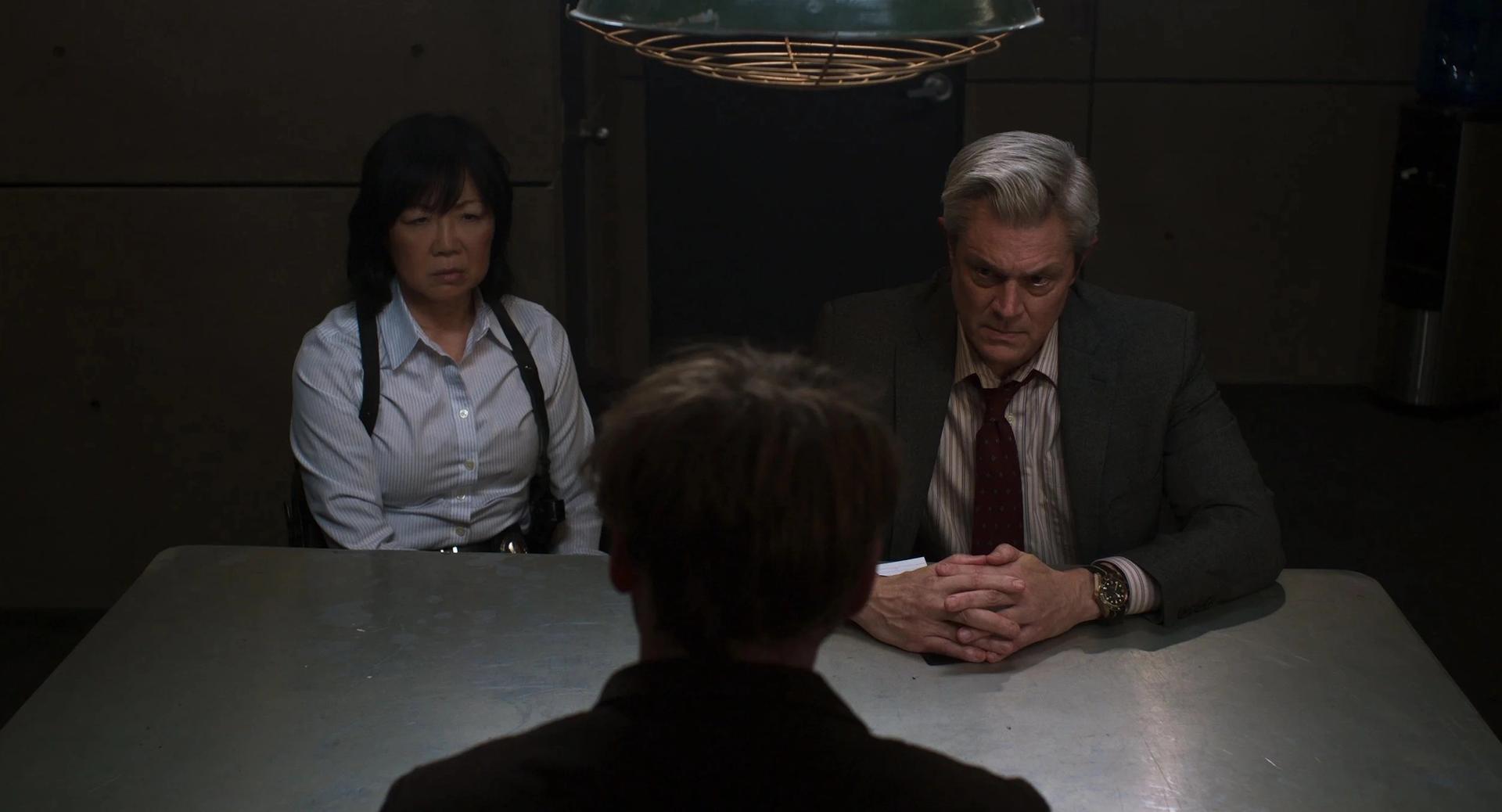
Margaret Cho and Johnny Knoxville in I Want Your Sex Photo courtesy of Magnolia Pictures
The scars of the 1990s may explain why Araki insists on interrogating what the film sees as Gen Z’s fear of sex. Erika says she “read an article” about Elliot’s generation’s prudery and implores him, in both word and deed, to loosen up and embrace his desires, however problematic. One suspects the words coming out of Erika’s mouth may be Araki’s own, a queer elder insisting the youth not surrender his generation’s hard-won victories.
There is something self-serving about this insistence; Erika’s sex-positivity is shown to be its own form of addiction. Like Jeff Koons in the era of his Made in Heaven series, Erika is both a despot lording over an atelier of fabricators and an exhibitionistic celebrity. The film’s explorations of power imbalances in studios and in sex eventually converge at a disastrous opening, during which Elliot and Erika are forced to confront the blurry line separating mentorship from exploitation.

Olivia Wilde in I Want Your Sex Photo courtesy of Magnolia Pictures
I Want Your Sex is deft in showing how interiority bleeds into role-play, particularly through Wilde’s swaggering yet high-strung performance. But it is glib rather than heady about the buzz-driven art market, which Erika dismisses as a “scam”. Still, the art in the film is mostly good. David LaChapelle’s studio is among those who contributed pieces, which tend to the maximalist and garish, including brightly coloured sculptures in the shape of sex toys looming around Erika’s studio. If some of Erika’s black-and-white photographs—which include depictions of rope bondage, Gregg’s possible homage to another Araki—are more like Madonna’s Sex than Mapplethorpe, the Claes Oldenburg-sized fiberglass ball gag is a nice touch, and the “pornographic blog” made, by one of Elliot’s fellow-assistants, with real GChat logs is a compelling concept, raising thorny issues of subject consent similar to those broached by Erika’s video installations.
Since at least the my-kid-could-paint-that era of Abstract Expressionism, Hollywood spoofs have often depicted modern art with such contemptuous incredulity as to be unconvincing. The art in I Want Your Sex is absurd, but not condescending: knowledgeable enough to be satire, but also not without merit. The finished chewing-gum vagina composition could be a fine addition to a mid-tier museum.
Watch the trailer for I Want Your Sex:
- I Want Your Sexopens in US cinemas on 31 July