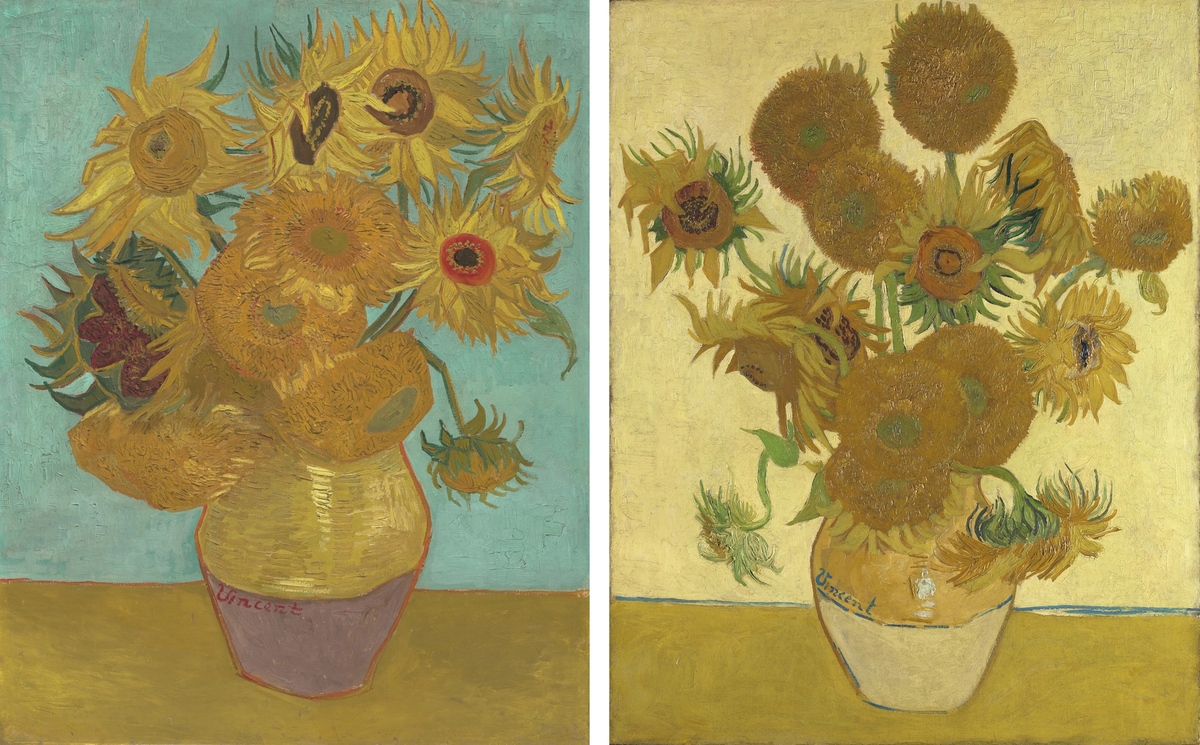

Two of Van Gogh’s Sunflowers have recently been brought together for an unusual reunion at the Philadelphia Museum of Art. Van Gogh’s Sunflowers: A Symphony in Blue and Yellow (until 11 October) raises questions about how the artist planned to present his dramatic flower still lifes.
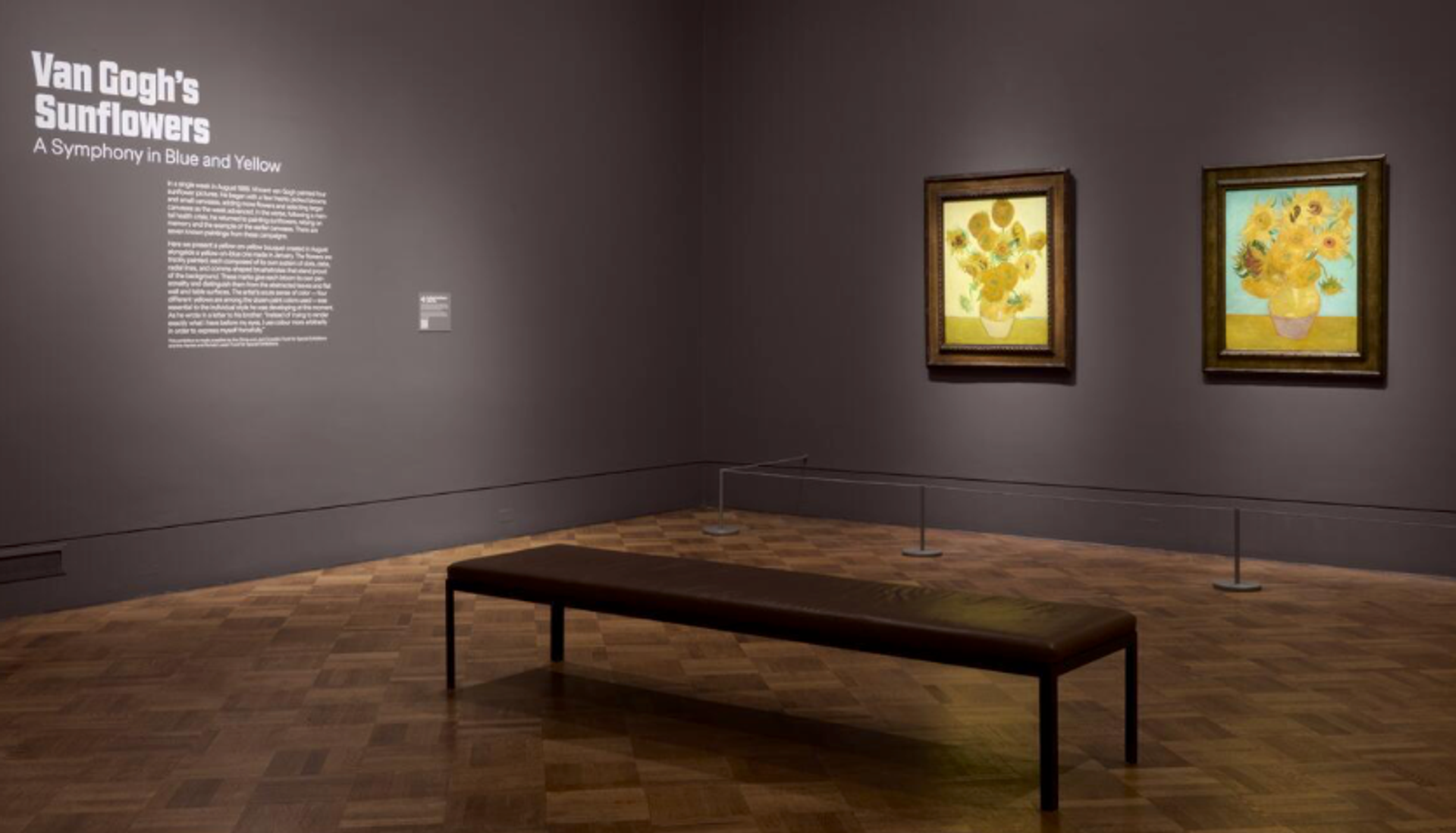
Installation photograph in the Philadelphia Museum of Art’s exhibition of the London yellow Sunflowers (left) and the museum’s own blue Sunflowers (right)
Philadelphia Museum of Art (photograph Sarah Croop)
London’s National Gallery owns the finest of the Sunflowers series, the painting with a yellow background (August 1888). It is the first time the picture has ever crossed the Atlantic. The London painting has only been lent abroad four times since its acquisition in 1924: to Paris (1955), Amsterdam (2002 and 2013) and Japan/Australia (2020-21). Van Gogh’s Sunflowers pictures are so important that museums are very reluctant to lend them.
Why then is the London painting travelling again? In 2024, the Philadelphia Museum of Art lent their Sunflowers (January 1889) to the National Gallery’s show Van Gogh: Poets & Lovers. This was the first time that the Philadelphia painting had been loaned since the museum acquired it in 1963. As part of the 2024 arrangement, London is reciprocating.
Sunflowers in the Yellow House
Bringing together the London and Philadelphia Sunflowers highlights Van Gogh’s changing ideas of how they were to be displayed. The two original versions of the still lifes of 14 flowers (turquoise-blue background) and 15 flowers (yellow background) were painted in mid-August 1888.
At this stage Van Gogh had an ambitious scheme for his Sunflowers. As Vincent told his brother Theo: “If I carry out this plan there’ll be a dozen or so panels. The whole thing will therefore be a symphony in blue and yellow.” This evocative phrase forms the subtitle for the Philadelphia museum’s current display.
The planned dozen or so paintings sadly never materialised. Van Gogh actually completed four versions of Sunflowers in August 1888, beginning with two depicting smaller bunches of flowers and then the Philadelphia and London versions, with 14 and 15 flowers respectively. He hung the last two in the spare bedroom of the Yellow House in Arles. This was when Van Gogh was anticipating the imminent arrival of his colleague Paul Gauguin.
Gauguin eventually arrived in October. Their ten-week collaboration was tragically brought to an abrupt end with the incident just before Christmas, when Van Gogh suffered a mental crisis and cut off most of his left ear.
In January 1889, Van Gogh made copies of the “bedroom” Sunflowers, probably with a view to sending them to Gauguin, following the French artist’s departure for Paris. The turquoise painting now in Philadelphia was one of these copies.
Van Gogh never actually sent the Sunflowers copies to Gauguin, but instead he had another idea: to display the yellow and turquoise Sunflowers as the wings of a “triptych” with his portrait of Augustine Roulin, the wife of his postman friend, as the centrepiece. She was portrayed as a mother holding the rope of a cradle, hence his title for the painting, La Berceuse (The Lullaby).
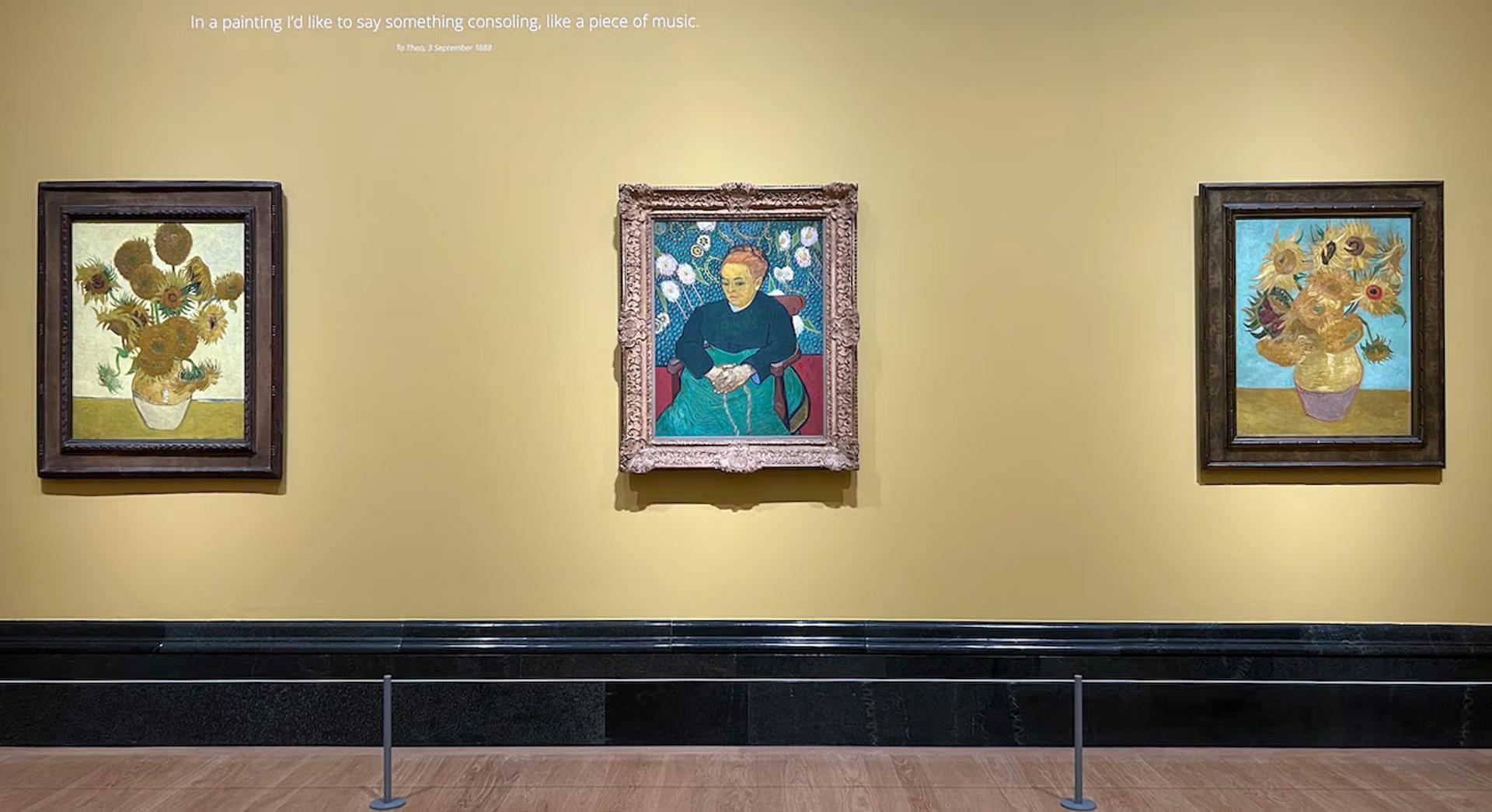
Installation photograph in the National Gallery’s exhibition Van Gogh: Poets & Lovers (2024), with the London and Philadelphia Sunflowers, on either side of La Berceuse (January 1889, Museum of Fine Arts Boston)
The Art Newspaper
The above image shows how the London and Philadelphia paintings were displayed in the National Gallery’s 2024 exhibition. In the middle was the La Berceuse (January 1889) portrait, a version on loan from the Museum of Fine Arts Boston.
The new Philadelphia exhibition includes the two Sunflowers, but without La Berceuse. However, the catalogue does feature an image which suggests how the triptych might have worked, with narrow coloured frames that abut each other.

Digitally reassembled triptych with dark and reddish brown abutting frames, as proposed in the Philadelphia Museum of Art catalogue: the yellow London Sunflowers on the left and the original turquoise Sunflowers (August 1888, now at the Alte Pinakothek, Munich) on the right, with a version of La Berceuse (December 1888-January 1889, now at the Kröller-Müller Museum, Otterlo) in the centre
Van Gogh’s Sunflowers catalogue (fig. 38), Philadelphia Museum of Art
Minute traces of yellow-orange paint have just been found along the edges of the Philadelphia Sunflowers. These only became visible when conservator Teresa Lignelli removed tape from the edge of the canvas, in preparation for the display. The catalogue suggests that this may be evidence of “a colourful original frame”.
Arles to Philadelphia
Four months after Vincent finished his copy of the Sunflowers with the turquoise background, he sent it to his brother Theo in Paris. After Theo's death, his widow Jo Bonger sold the still life to the Paris writer and amateur artist Antoine de La Rochefoucauld in 1896, for the equivalent of $80.
La Rochefoucauld so admired the Van Gogh that he made a watercolour copy of it. His original watercolour has been lost; only a little-known black-and-white photograph survives. In 1902, La Rochefoucauld’s wife Eugénie wrote a novel, L’Initiée (The Initiated), which was centred around an artist with a passion for sunflowers.
When La Rochefoucauld sold the painting in 1928, it was bought by the Philadelphia businessman and artist Carroll Tyson for $45,000.
Tyson’s son-in-law, Louis Madeira IV, once recalled that his father-in-law carefully positioned the Sunflowers behind his dining chair, so that he did not have to see the Van Gogh while eating “because he thought the painting crude and untutored”. This unlikely anecdote may well have been a family joke.
Tyson only lent the painting to exhibitions in nearby New York three times, in 1935, 1943 and 1954, and never sent it abroad. After the death of Tyson’s widow Helen in 1963, their Sunflowers was bequeathed to the Philadelphia Museum of Art.
This year’s Philadelphia show, curated by Jennifer Thompson, is the first to spotlight the museum’s greatest treasure. News of the planned display was broken by The Art Newspaper in November. The one-room presentation simply comprises the two Sunflowers masterpieces (there are no other loans), with the accompanying catalogue examining the pair in fascinating detail.
For visitors in Philadelphia, don’t miss the collection of seven Van Gogh paintings almost next door to the art museum, at the Barnes Foundation. These include a slightly earlier depiction of flowers in a jug, Still Life (May 1888).