

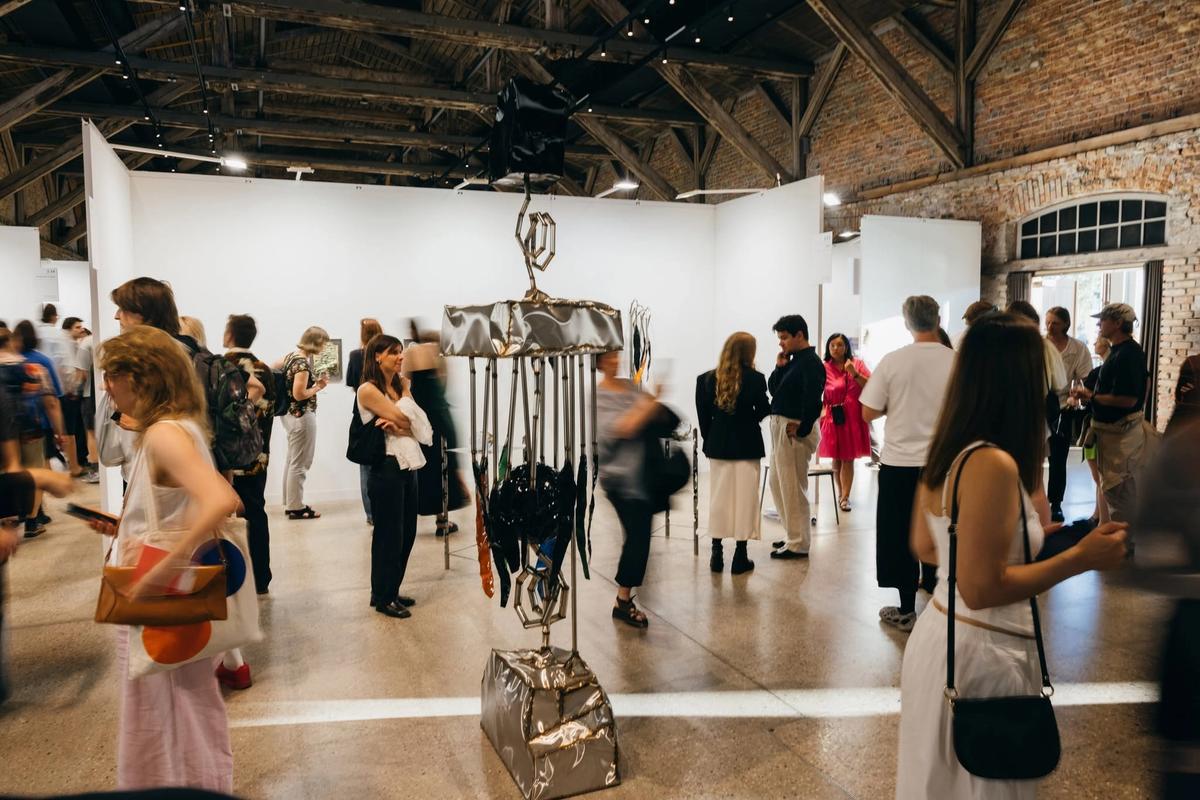
“Nascent” might be the best description of the art market in the Latvian capital of Riga, where the second edition of Riga Contemporary art fair was held from 2-5 July. It was sited in a repurposed train warehouse close to Riga’s Old Town, a Unesco world heritage site.
Once a major trading city in the Hanseatic League, the Baltic port of Riga was founded in 1201, and has long been a centre for culture, notably because of its architectural heritage. But while the art market in Latvia remains nascent, even “embryonic” as one dealer described it, it certainly has a little more wind in its sails today.
The city funds the fair, which this year brought together 41 dealers from around the world, including some as far afield as Chicago and Tokyo. More than a dozen exhibitors hailed from the Baltic states.
A local foundation, VV, established by collectors Vita Liberte and Vilnis Štrams (the title comes from their first names) is aiming to become a leading patron of contemporary art in the region. It offers artists’ residencies in the seaside resort of Pāvilosta, and as well as organising exhibitions and workshops. Vita Liberte sits on Tate’s Central and Eastern Europe Plus Acquisitions Committee as well as working with the Delfina Foundation in London.
“For the moment Tate has just one Latvian artist, and I want to change that!” she says. She and her husband’s foundation collect mainly Latvian artists, some of them displayed at the newly built offices of her company right beside the fair.
The fair was free to enter (one only has to register in advance) and the opening night attracted a lively, chattering and young crowd, who mobbed the “speakeasy” booth set up by the Paris-based, nomad New Garden Gallery which is run by the MaybeMaybe artistic duo of Rūdolfs Štamers and Eliza Ramza, both initially from Latvia. Cocktails were priced at €9, including Kiss of the Gallerist, a concoction of syrup, vodka, citrus and fizzy water, with hand-decorated grapes from a small window in the fair. “We are selling experiences,” said Eliza: “It’s all about the viewers—what they feel, what they think, and even the area around our little window is lined with mirrors, to reflect back towards the viewer.”
It was extremely cheap to participate in Riga Contemporary: booth stands cost just €500, and for that exhibitors could choose small, medium or large, all for the same price.
Tokyo-based Misako & Rosen was sharing a stand with The Green Gallery of Milwaukee. According to Jeffrey Rosen, who is also co-president of Nada (New Art Dealers’ Alliance), and is one of the advisors to the fair: “This is an attempt to get Riga on the map internationally as a cultural destination, and an art fair is an element of that. Because of the city’s support, galleries can do the fair with essentially zero risk,” he said. And for him it paid off—rather to his surprise, he sold four works of art on the first night.
“I think there is misconception that the art from the Baltic region began after the dissolution of the Soviet Union,” said the Estonian-born exhibitor Micha Lustin of London’s Galerina: “But during the Soviet period a lot of the artists were Estonian, Latvian or Lithuanian, and very successful, but they worked under a false flag so to speak. The dissolution of the Soviet Union brought some instability but now, 30 years on, things have stabilised. There is a new generation of collectors, patrons, artists: the region has been quite prolific on the international and European art scene, possibly even before the local art market catches up.”
Lustin cited the London-based Upé Foundation, created by the Lithuanian-born tech entrepreneur Justas Janauskas, the co-founder of second-hand clothing sales platform Vinted, which aims to build bridges between the Baltics and the global contemporary art world.
Latvia is a small country, with just 1.8 million inhabitants, and its population is shrinking; the combined population of all three Baltic states is only about 6.1 million people. Much of the art on show at the fair was under €5,000 and a natty little QR code, linked to “buymyart.lv” gave prices and availability for many of the pieces on offer. “Lots of people here don’t realise what an art fair is, they think it is a display, not art for sale,” lamented Eliza Ramza. If they did realise the art was for sale, they could buy very reasonably priced ceramics—for instance €390 for Ceramic Glasses by Marleen Suvi at Artrovert, or spend €4,000 on a wall-based sculpture Lash Lure II, by Indriķis Ģelzis at the organiser of the fair, Kim?Contemporary Art Centre.
So there is a way to go for this nascent fair, but there are some encouraging signs: the involvement of the city, a municipally-funded contemporary art space and the mission of VV Foundation to push forward collecting in the region. And perhaps, soon, Tate will add more Latvian artists to its programme…