

New York’s affordability crisis mimics its punishing summer heat. Increasingly, it feels like the city’s artists and art professionals can only escape either with an exceptional amount of money.
Yet no single cost has absorbed more of the conversation over the past year than rent. From Zohran Mamdani’s victorious campaign in last autumn’s mayoral election to Josh Kline’s discourse-dominating essay, New York Real Estate and the Ruin of American Art in the periodical October this spring, the anxious prospect of being priced out of a home, a studio or both has been pressing in from all sides.
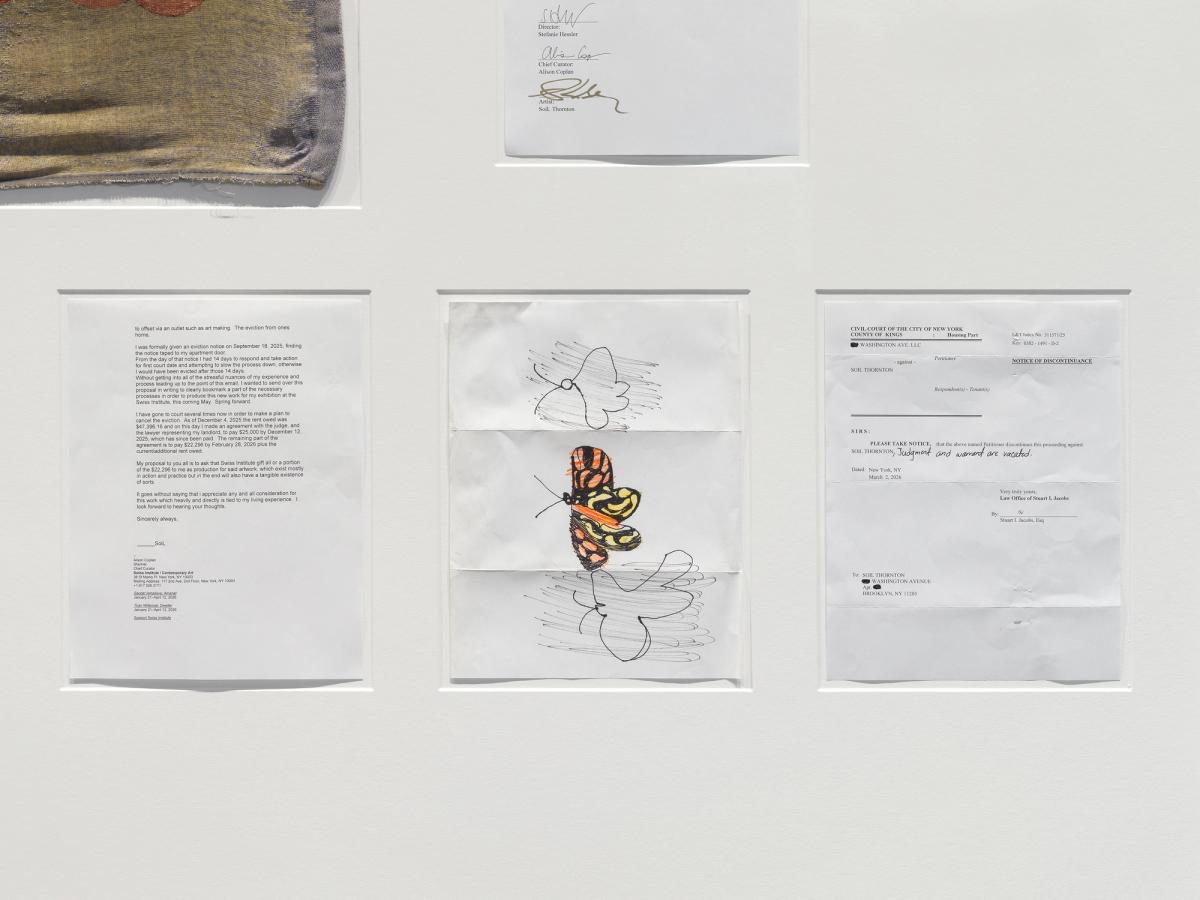
It also acts as the gravitational centre of Metabolizing eviction try, work_mp3 and other games of topping (until 5 July), the Brooklyn-based artist SoiL Thornton’s exhibition at the Swiss Institute (SI). Although the works on view examine numerous power relationships between Thornton and other people, institutions or entities, the SI’s chief curator, Alison Coplan, identifies one piece as “the heart of the show”: evict relief, a 2026 work of institutional critique that was also pivotal in keeping the artist housed.
Thornton (who uses they/them pronouns and declines interview requests) was served an eviction notice on 18 September 2025. The order gave them 14 days to either vacate their home of the past decade or secure a temporary stay from the Kings County civil court while they pursued settlement negotiations with their landlord. Resolving the dispute required Thornton to pay $53,014.33 to their landlord, on a court-ordered schedule of less than three months.
I know all this because evict relief’s physical components include hard copies of the eviction notice, several subsequent legal filings and an artist’s statement summarising the saga. Alongside these pages are sketches of butterflies, a dish towel given to Thornton as a housewarming gift and printed email correspondence between the artist, Coplan and SI director Stefanie Hessler.
But the subject of the emails is the true nucleus of evict relief. The exchange covers the artist’s early February proposal to create a work that involves SI gifting the artist the remaining $22,296 needed to clear their housing debt. The proposed piece raises fundamental questions about what qualifies as a work of art and what the role of an art institution is in a city where so many artists are struggling to keep a roof over their heads.
Art making as an outlet
“I can’t help but think about this work’s relation to a very common and unfortunate experience here in New York due to its costs of living, an experience that many do not have the privilege to process and attempt to offset via an outlet such as art making,” Thornton wrote in the initial message included in the framed work.
Coplan tells The Art Newspaper that she was “immediately convinced” that Thornton’s conceptual proposal “was a really essential work and direction for the show” they were planning. “The question wasn’t really whether [the contribution] was possible,” she adds. “The conversation was more, what amount could that be and, as you see in the correspondence, how to classify the funds.”
A “gift” was a nonstarter, owing to that word’s specific legal meaning within the context of a 501(c)(3) non-profit. Instead, Thornton and Coplan agreed that evict relief would funnel $5,700 of the exhibition’s $10,000 production budget to the artist’s tenancy settlement, leaving $4,300 to fund the rest of the show. Thornton was also free to use some or all of the $9,544 honorarium that SI is making to all artists in its solo exhibitions this year to resolve their housing dispute.
“What is an art institution? Where does this money come from? Why can it be used for this [purpose]?” Coplan says of the questions raised by evict relief. “This kind of investigation is part and parcel of the artwork, just like any work of institutional critique.”
It has won over at least one other key figure in the affordability debate. Kline not only visited Thornton’s show but also thanked SI for presenting it, according to Coplan. (Kline was not available for comment.)
More importantly, evict relief was instrumental in keeping Thornton in their home. The conclusion of their odyssey is on view in the piece’s physical, framed component: a filing, dated 2 March 2026, confirming that Thornton’s landlord had discontinued eviction proceedings against them.
All of this makes Thornton the exception that proves the rule: for artists and so many other workers, one of the only ways to survive New York’s real estate market is with creativity—and even then, you still may need a helping hand.
• SoiL Thornton: Metabolizing eviction try, work_mp3 and other games of topping, Swiss Institute, New York, until 5 July