

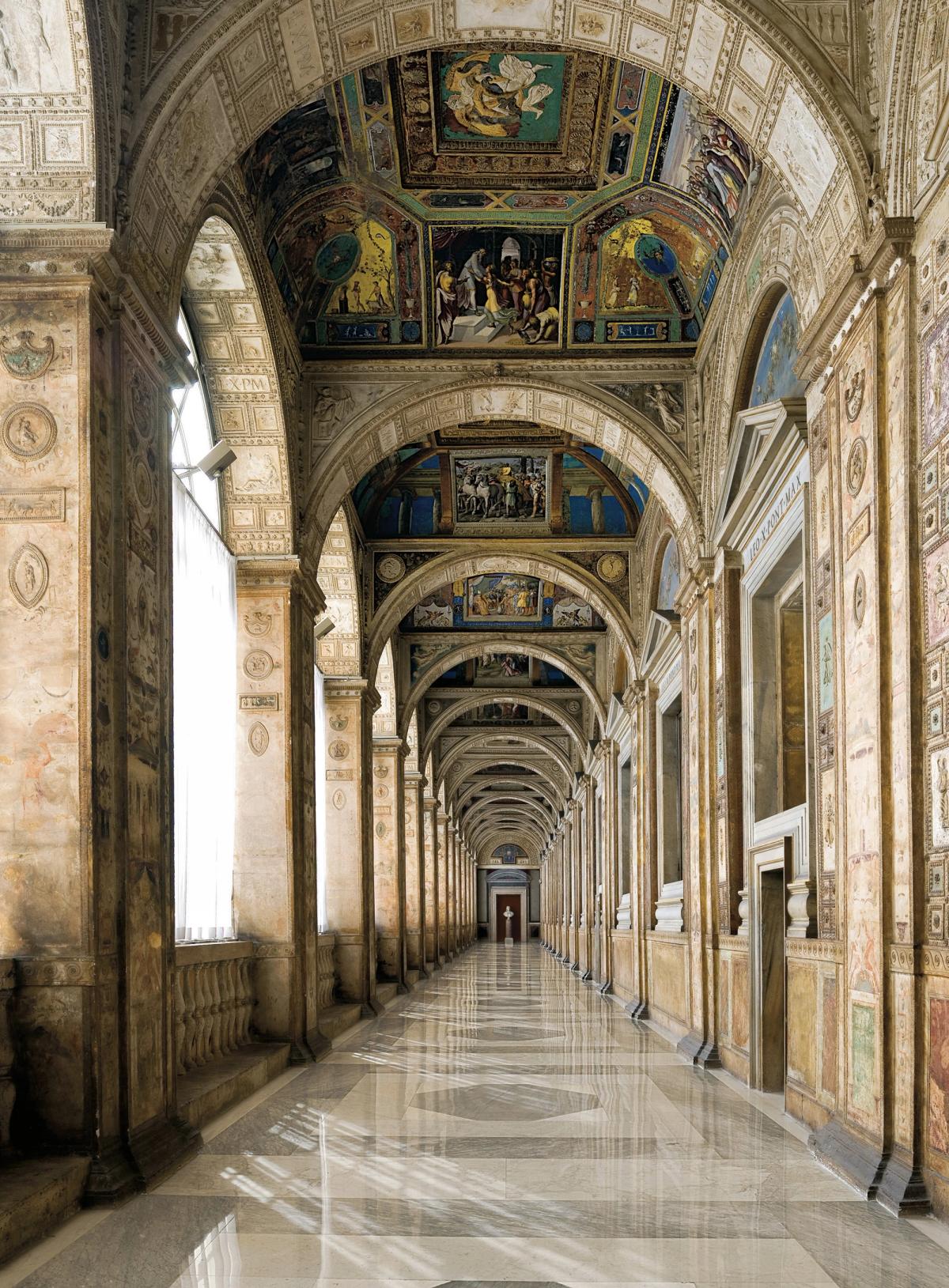
The Vatican Museums has launched the most ambitious restoration ever undertaken of the Raphael Loggias, a 65m-long corridor featuring one of the Renaissance master’s most spectacular fresco cycles.
A team of more than 20 experts from the Vatican Museums will restore the loggias—located in the Apostolic Palace, where the pope resides—using state-of-the-art technology. Windows will also be installed to create stable climatic conditions for Raphael's frescoes, which depict scenes from the Old and New Testaments. The project is expected to take five years.
Museum officials say the project will secure the future of the relatively little-known decorative cycle, which is nevertheless widely regarded as one of the greatest achievements of Renaissance art.
“The Loggias represent a revival of the style and techniques of antiquity,” Barbara Jatta, director of the Vatican Museums, tells The Art Newspaper. “They were the destination of choice for generations of clergymen, diplomats, but above all Grand Tourists and artists who came specifically to draw inspiration from antiquity.”
Divided into 13 bays on the second floor of the Apostolic Palace, and overlooking a central courtyard, the covered promenade is crossed daily by Vatican officials and are not part of the Vatican Museums' public exhibition route, although they can sometimes be visited on request.
Raphael and his workshop decorated the space between 1517 and 1519 for Pope Leo X de’ Medici. They created 50 scenes, surrounded by ornamental panels, drawing inspiration from ancient Roman mural painting.
The space was initially exposed to the elements, with a first set of windows inserted between the gallery’s columns in 1813 and 1814 under the supervision of sculptor Antonio Canova. Conservators applied glue over the centuries to secure flaking paint, subsequently accelerating deterioration.
“These adhesives shrink and peel off the paint,” says Angela Cerreta, the Vatican Museums’ deputy head restorer for paintings and wooden materials. “If you don’t remove these adhesives and protective films, they’ll keep stripping the colour.”
Restorers will first consolidate unstable paint before cleaning the frescoes with fibre lasers, Cerreta says, adding that areas requiring retouching will be colour-matched using techniques that allow visitors to distinguish original passages from restored ones. Work is currently under way on four bays before expanding to other parts of the gallery.
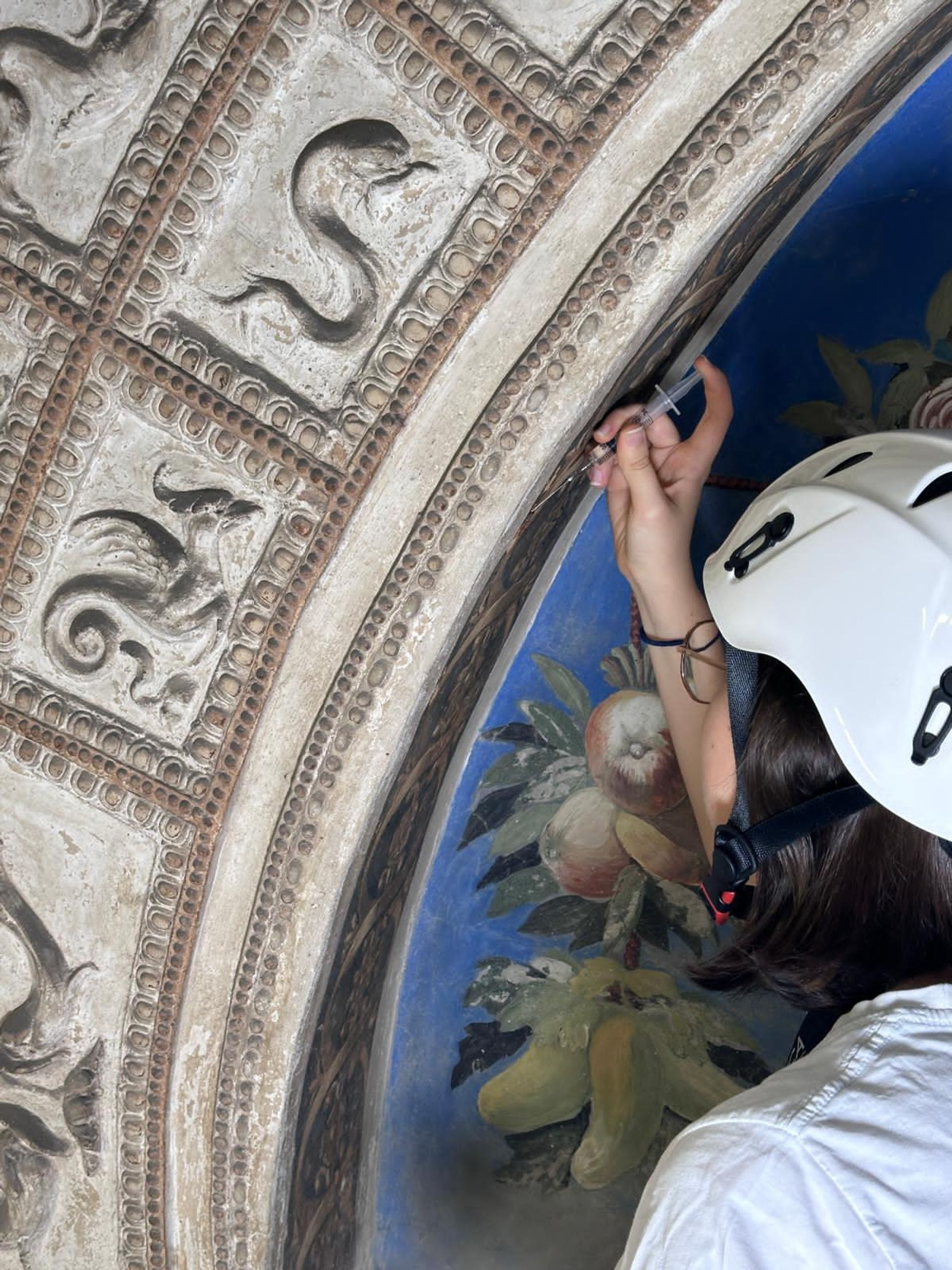
A conservator stabilisating the paint film on part of the loggias with adhesive injections
Photo: the Painting and Wood Materials Restoration Laboratory of the Vatican Museums, June 2026. © Governatorato SCV – Direzione dei Musei. Tutti i diritti riservati
The restoration follows two pilot projects carried out between 2019 and 2024, in which experts tested the technology that will be applied to the entire cycle.
The restoration is supported by $5.5m from the Legacy of Raphael: The Vatican and Beyond initiative, a World Monuments Fund project for restoration, training, digital documentation and dissemination. That initiative was itself funded with a $14.3m donation by the Stephen A. Schwarzman Foundation, a New York-based philanthropic organisation. The work on the loggias has also been supported by the group Patrons of the Arts in the Vatican Museums.
Jatta adds that the installation of the new windows had been made possible with a donation by The Patrons of the Arts in the Vatican Museums, which also financed the pilot projects.
“The new windows are absolutely essential,” Jatta says. “If the right microclimatic conditions aren’t created in that space, there’s no point in carrying out the restoration, as those areas and the frescoes would certainly deteriorate again.”