

In the third and final version of The Stones of Venice, published in 1853, John Ruskin included a guide to seeing Jacopo Tintoretto paintings. He provided these “somewhat copious notices of the pictures of Tintoret” because, he wrote, “they are much injured, difficult to read, and entirely neglected by other writers on art”.
Like so many of us since then, Ruskin first understood the majesty of the Venetian master in the Scuola di San Rocco, where more than 60 of Tintoretto’s paintings fill the walls and ceilings. Few epiphanies have been better expressed: “I never was so utterly crushed to the earth before any human intellect as I was today, before Tintoret,” he wrote to his father, in September 1845. He immediately put Tintoretto “in the school of Art at the top, top, top of everything”.
I remember feeling a similar crush on my first trip to Venice. I was fortunate in that this was 1994, the 400th anniversary of Tintoretto’s death, and so he was more ubiquitous than ever; his St George and the Dragon even appeared on a 1,000 lire coin. Ruskin eloquently describes the Scuola experience, where, having already viewed dozens of paintings, we turn to see the Crucifixion (1565) in the Sala dell’Albergo: Ruskin and the watercolourist James Duffield Harding sat down and looked at each other, “literally the strength so taken out of us that we couldn’t stand!”
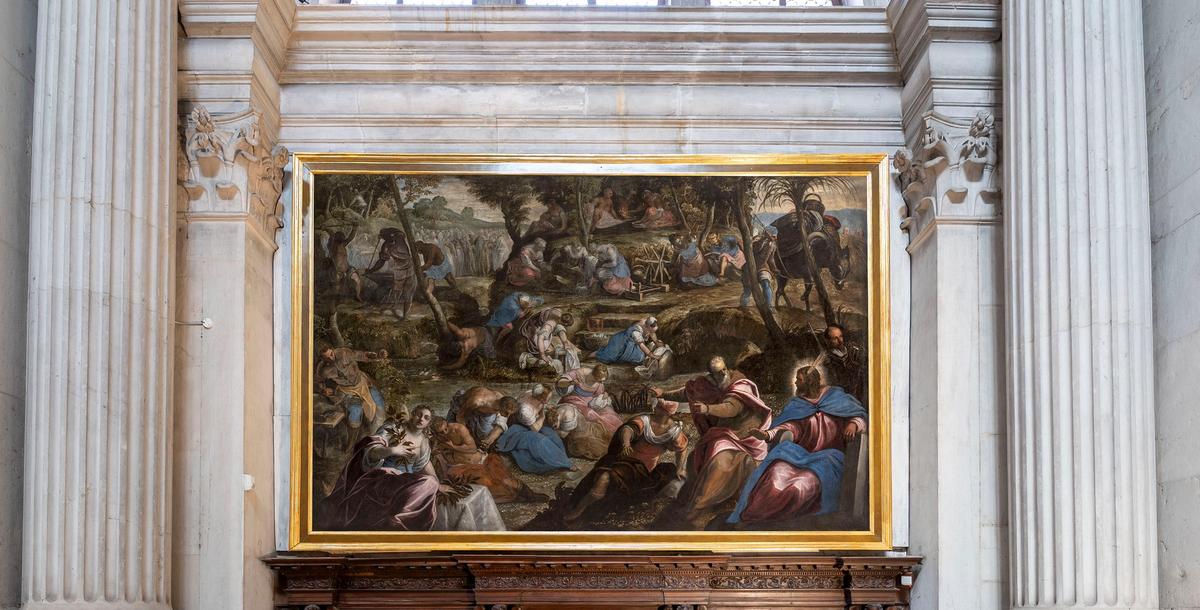
I was equally moved back then by Tintoretto’s The Last Supper (1591-92), one of his two vast paintings in the presbytery of the Basilica di San Giorgio Maggiore. Ruskin did not esteem this as among the artist’s highest achievements, but wrote beautifully of its ethereal presences: “the smoke of the lamp which hangs over the table turns, as it rises, into a multitude of angels, all painted in grey, the colour of the smoke; and so writhed and twisted together that the eye hardly at first distinguishes them from the vapour out of which they are formed”. The painting and its pair, The Israelites in the Desert (1591-92), have been conserved by Save Venice, which went back on display during the Biennale opening week, looking fresher than ever.
Viewing these paintings, their sensitive reading of biblical texts, their brilliant engagement with the architecture of the church and the people who inhabited it, and their radical approach while still adhering to Counter Reformation instruction, I thought again about Ruskin’s comment on Tintoretto’s intellect (only Michelangelo bettered him on this score, he wrote). This, surely, is what sets apart great from good painters, throughout history.
And I thought again about contemporary art, and particularly painting, and what separates its most successful forms amid a surfeit of mediocrity. Skill is not enough; intellect is the key. I don’t mean that it wears its references on its sleeve or is performatively learned; more that its materiality, possibly including technical prowess, and its image-making are employed with judicious intelligence.
Wit and imagination
Another stunning group of pictures in Venice this year embodies this thought. Sanya Kantarovsky’s exhibition Basic Failure at the Palazzo Loredan includes several new paintings of searing power, wit and imagination. Many of his paintings are haunted by half-skeletal figures, often very much alive, despite their flesh having fallen—or been severed—away. Kantarovsky intended this motif as a statement about our contemporary condition: “a cheap trick to describe a simultaneity of external opulence and internal poverty”.
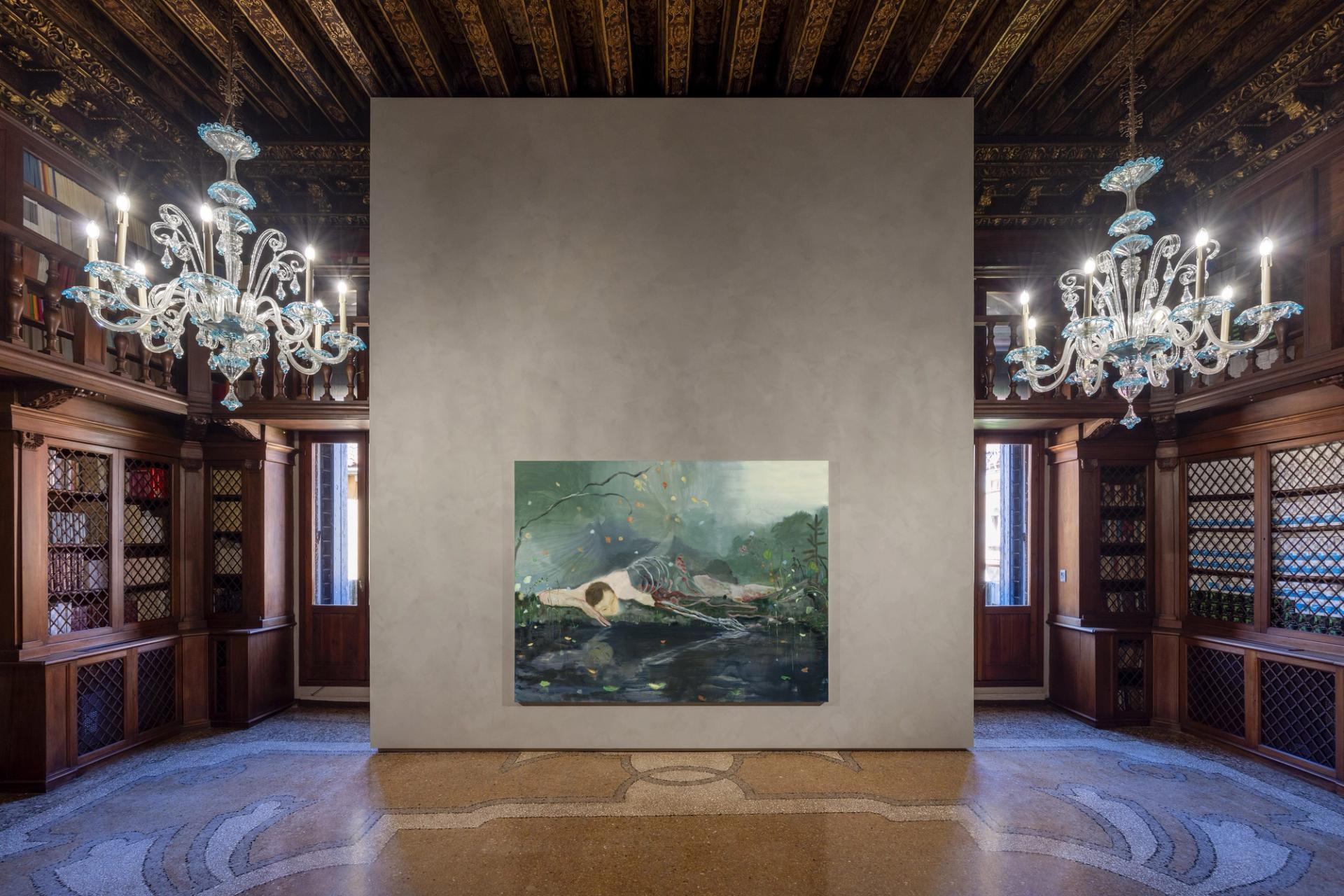
Sanya Kantarovsky’s Reenactment (2026) in his Venice exhibition Basic Failure
Courtesy the artist, Capitain Petzel; Modern Art and VeneKlasen, © Sanya Kantarovsky, Photo: Pierre Le Hors
He goes even further in Reenactment (2026), which evokes the Narcissus myth. It features a prostrate figure lying by water, with a skeletal lower arm and an abdomen that is effectively just a ribcage and slumped organs. The figure’s head appears to be dissolving. He must be dead. And yet he skims the pool’s surface with the fingers of the skeletal hand. The entrails, too, seem animated, on a serpentine journey into the deep. The head’s reflection is more precisely described than the actual matter. The landscape is blustery, the air filled with a confectionary confetti, an enchanting will-o’-the-wisp.
Of all the art in this year’s Biennale, this searching examination of matter and spirit, and of paint’s capacities to describe or evoke them, crushed me the most.
• Sanya Kantarovsky: Basic Failure, Istituto Veneto di Scienze, Lettere ed Arti, Palazzo Loredan, Venice, until 22 November