

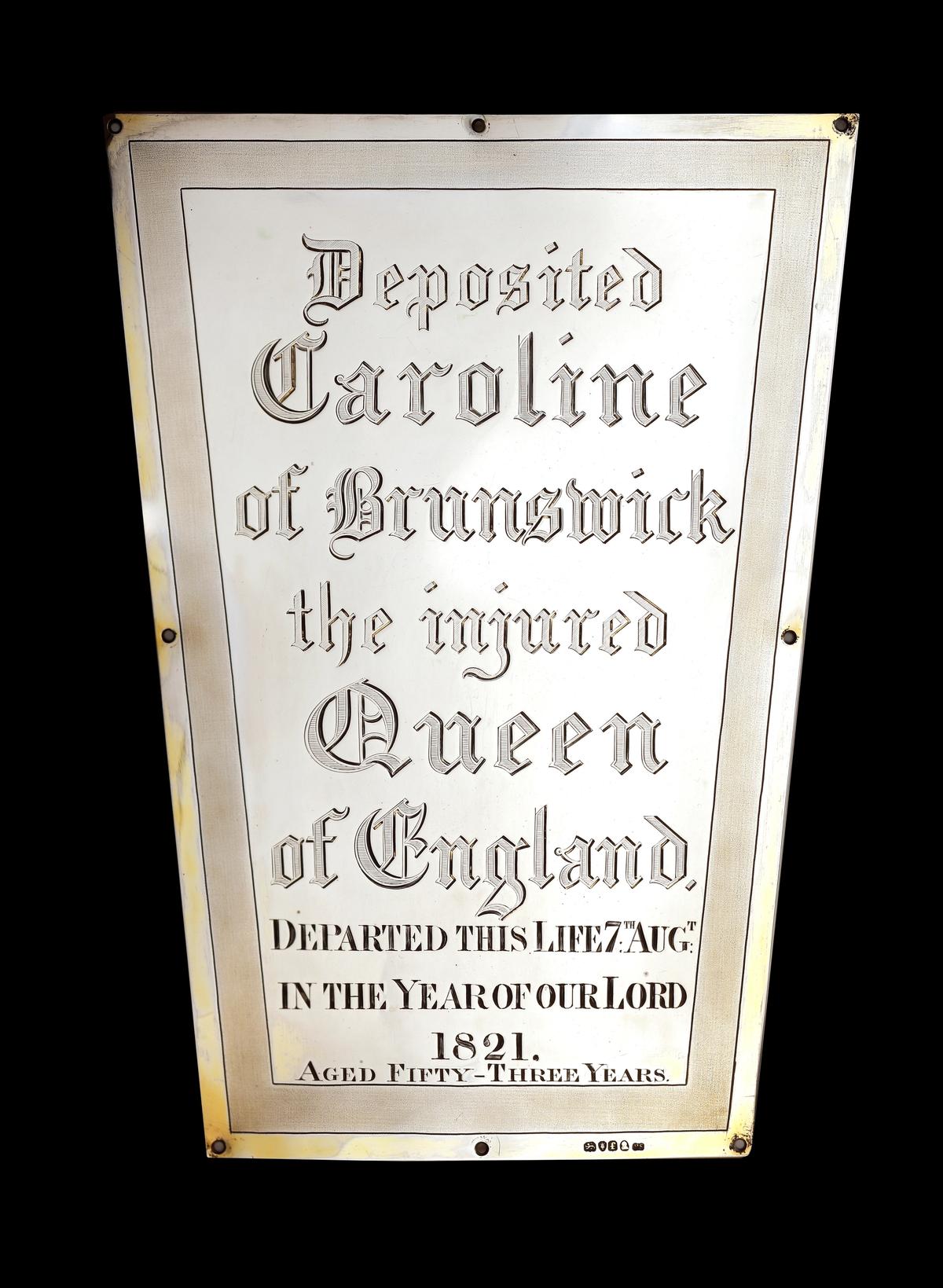
Caroline of Brunswick’s marriage to George IV was exceptionally unhappy even by the standards of royal weddings: it began in mutual loathing and ended in brawls over her coffin. The silver coffin plate which bore witness to the last farcical scenes of her time in England will be for sale this week at the Treasure House Fair, at the Chelsea Royal Hospital in London.
It is engraved with the wording Caroline requested on her death bed, describing her as “the injured Queen of England”. It was twice wrenched off her crimson velvet coffin during the funeral ceremonies, and forcibly replaced with an official version demanded by the King’s representatives. That version, in Latin, described her as Queen Consort rather than Queen, devoted most of its space to glorifying George as “the most august and powerful Monarch”, and, as the final insult, got her age wrong—she was 53, not 54 when she died, as engraved on the plate. She lies in the family vault in Brunswick cathedral in Germany, her coffin bearing the scars of its history, including the marks left by the carpenter who scrambled onto it in the dead of night to attach the proscribed plate.
In 1821, the coffin plate, engraved by the master silversmith Paul Storr, cost 25 pounds, 17 shillings and threepence. This time the price tag will be £75,000, sold by historian and specalist dealer Martyn Downer, though it does come with a replica of Caroline’s coffin.
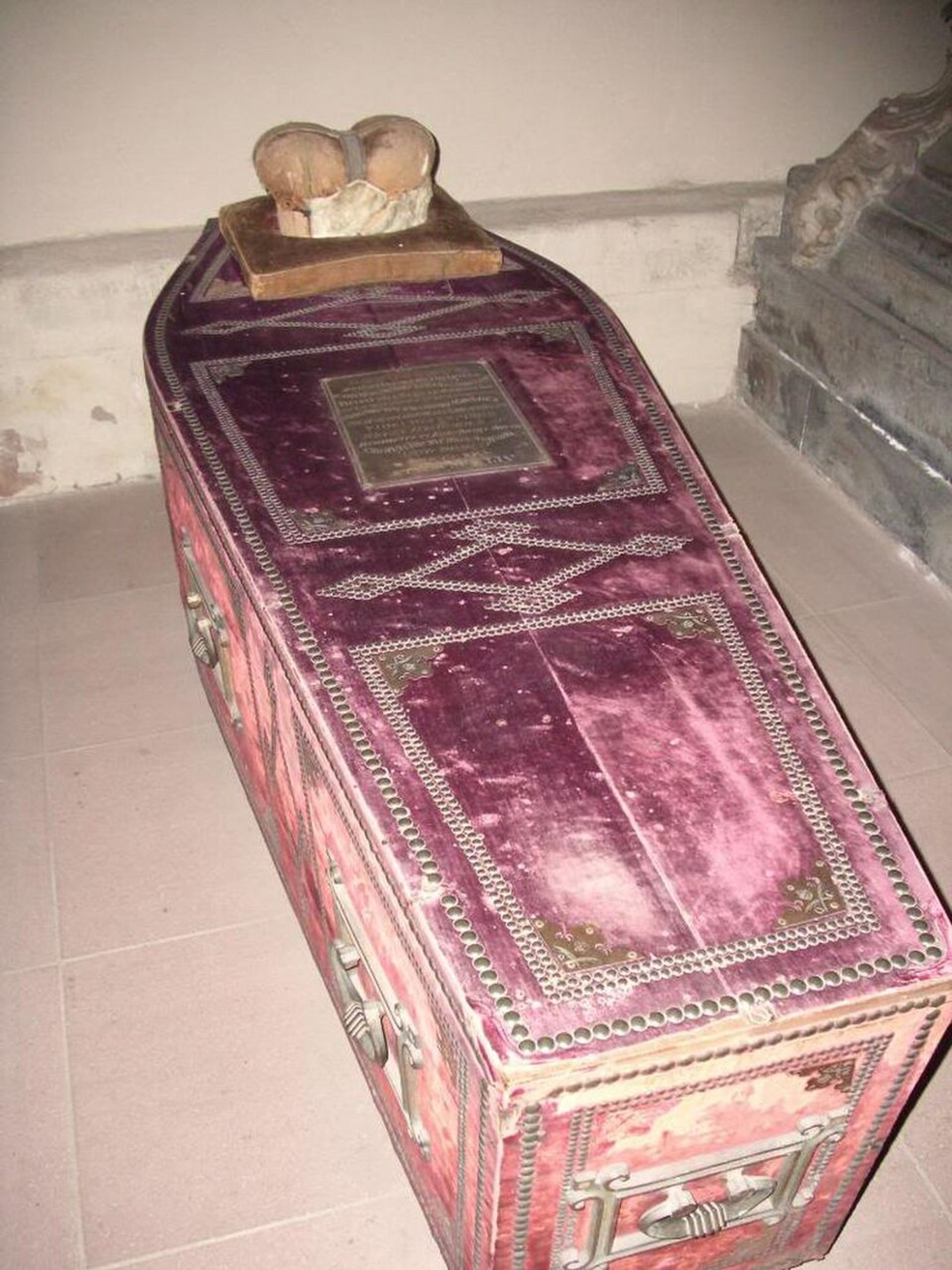
Tomb of Queen Caroline of Brunswick at Brunswick Cathedral in Lower Saxony, Germany
Courtesy Wikimedia
“It’s just a simple piece of silver, but the value lies in the extraordinary story it tells”, says Downer. “This was a massively dysfunctional abusive marriage, which blossomed into a national emergency.”
In 1795, George IV, then Prince of Wales, was already massively in debt, wreathed in scandalous affairs and in an illegal marriage to the Roman Catholic commoner Maria Fitzherbert, when he was persuaded to wed his first cousin Caroline. The couple apparently detested one another on sight, and, according to Caroline, he got so drunk on their wedding night that he passed out on the bedroom floor with his head in the fireplace. They separated for good after 10 months, but by then had already produced an heir, Charlotte, who became very popular with the public. Charlotte died in childbirth with her son in 1817, sparking a wave of national mourning compared by historians to the death of Princess Diana in 1997.
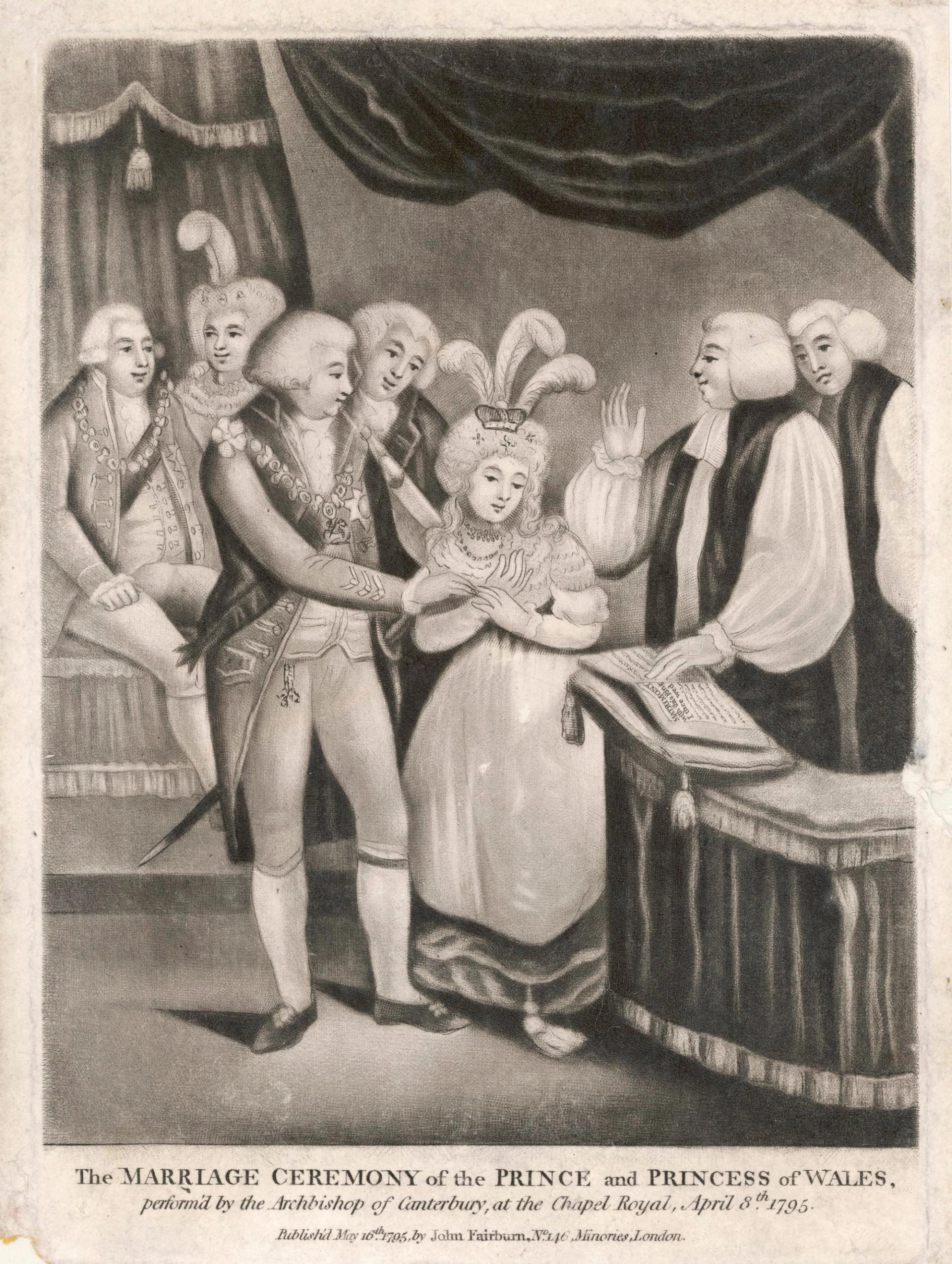
George IV and Caroline of Brunswick were married on 8 April 1975 at St. James's Palace in London
Courtesy Adobe Stock
George ultimately failed to get the marriage annulled, despite attempts to procure evidence of Caroline’s supposed adultery. In July 1821, he finally became king after the long illness of George III, but during what would have been her coronation as well, Caroline was left beating on the locked door of Westminster Abbey. She died just three weeks later. By then she had been adopted as a popular symbol of opposition to the monarchy, and despite attempts to bar the public, her funeral cortege attracted huge crowds in London.
Downer has traced the details of the extraordinary days after her death, when her own coffin plate was attached at her home in Hammersmith, then removed on the orders of the Lord Chamberlain, only for the official version to be removed in turn and thrown aside on the orders of her lawyer Stephen Lushington, a tough character who had acted for Lady Byron in her scandalous divorce of the poet.

James Lonsdale's portrait of Caroline of Brunswick, painted around 1820, the year before her death
Courtesy Wikimedia
According to Downer, the authorities wanted Caroline’s body out of the country as fast as possible, but the cortege stopped overnight in Colchester, on the way to the port at Harwich, where her coffin lay overnight in St Peter’s Church. A local carpenter duly clambered onto the table to bore holes in the coffin and re-attach her silver plate. However in the small hours another carpenter, under orders from the Lord Chamberlain, prised off Caroline’s plate and threw it on the floor. The official plate, which had been found in a pub in Hammersmith, caught up with the cortege in Harwich, and was attached once again to the coffin, where it remains. Caroline’s own silver plate was retrieved by a servant who stuffed it down the back of his trousers - and after his death, 30 years later, it was returned by his widow to Lushington. It had remained in Lushington’s family until his descendants sold it last year at a Christie’s auction.
Before bringing it to the Chelsea fair, Downer brought the coffin plate back to St Peter’s Church in Colchester, where it lay quietly in a position of honour in front of the altar. The Vicar, Mark Wallace, told The Art Newspaper that it was extraordinary to see a tangible connection with such a dramatic moment in national history return to the church after more than 200 years.
“This is the only coffin plate of a Queen of England that will ever be on the market”, Downer says. “The buyer could of course also use the coffin themself, provided they are fairly short—Caroline was only five foot four.”
- Treasure House Fair, Royal Hospital Chelsea, 24-30 June