

The Messeplatz takes on a life of its own during Art Basel, as collectors, curators, artists, locals and tourists cross paths in a grand choreography that disrupts and enhances the ordinary rhythm of the city. To this frenetic environment, Nairy Baghramian’s specially commissioned sculptural intervention introduces a pause, and a chance to look, underlined by her inclusion of a bench-sculpture. “I hope it creates a moment of slowed attention within the accelerated reality of the fair,” says the Berlin-based artist ahead of the work’s installation. Titled Modèle vivant (S’empilant), the work treats the rectangular Messeplatz fountain as a platform across which stainless steel structures support lavender and pastel-coloured cast aluminium forms, “gathered together like provisional accumulations or suspended fragments”, she says.
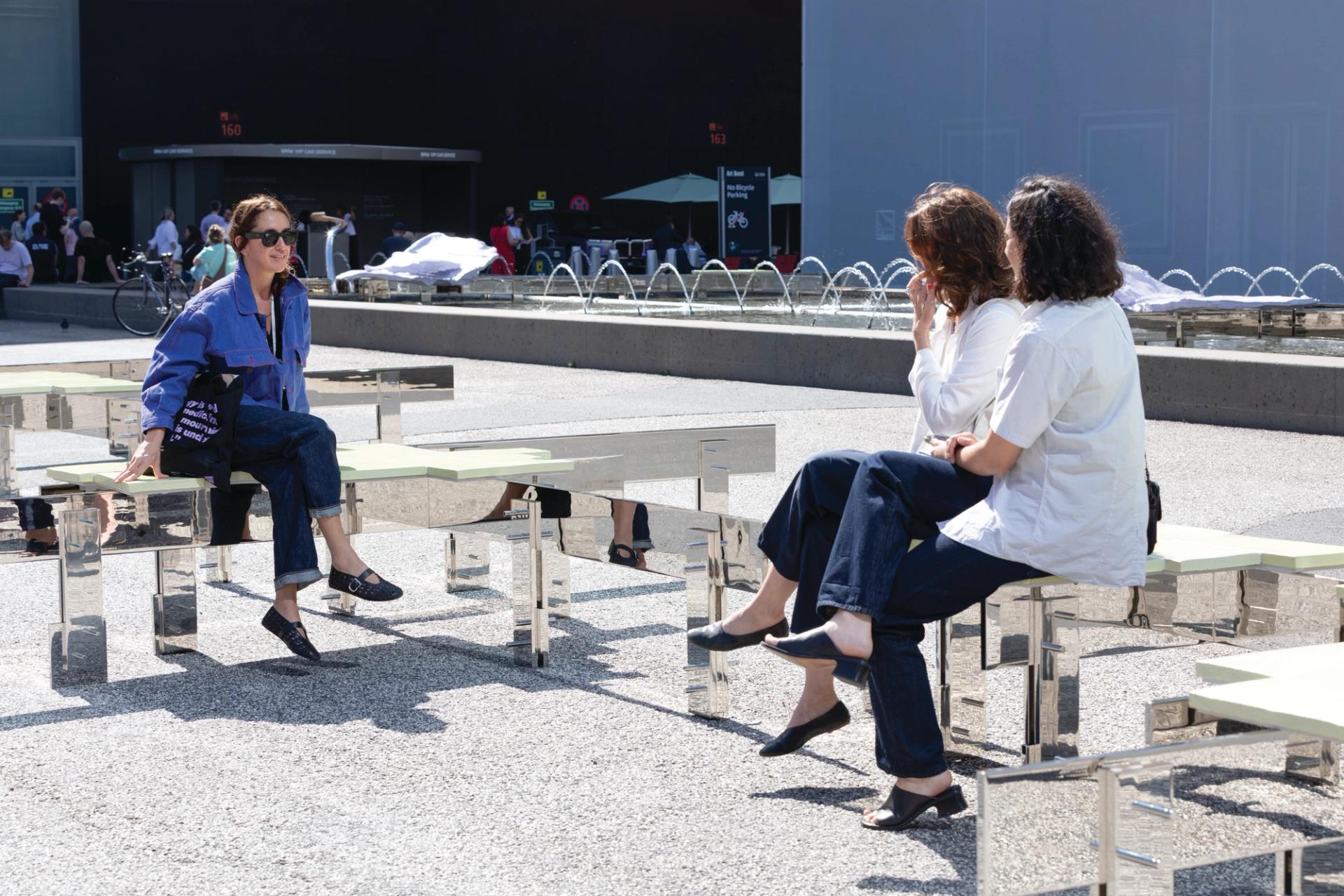
Nairy Baghramian’s Modèle vivant (S’empilant) (2026) has been installed in Basel’s Messeplatz. The commission comes off the back of the artist’s Gold Medal win at the inaugural Art Basel Awards last year David Owen
The commission comes off the back of Baghramian’s Gold Medal at the inaugural 2025 Art Basel Awards, presented in recognition of a body of work that has evolved over 25 years and continues to explore the uncategorisable zone between gesture and feeling, in which bodies respond to space and each other, often in highly specific settings. The award for an established artist brings a responsibility “to remain attentive and rigorous”, Baghramian says. “But though I am more than grateful to be called an established artist, who really wants to be established? I want to remain emerging. The work should keep emerging, always and forever.”
The Art Newspaper: How have you approached the Messeplatz commission?
Nairy Baghramian: Basel is a remarkable city, almost a conglomerate of museums, institutions and an art-interested public, a city historically shaped around the idea of civic responsibility and cultural participation. For me, it is a very particular place in which to test a new idea for a work.
The invitation was intentionally open, which I appreciated very much. The essential parameters were the site itself and the public nature of the work during Art Basel. Beyond that, I was encouraged to think about how sculpture could operate within a space that is simultaneously architectural, commercial, social and temporary.
It’s a complex space, isn’t it?
What many people do not immediately notice is that the setting unfolds within Heimo Zobernig’s permanent intervention. His inscription of “MESSE BASEL” across the asphalt in monumental black-and-white Helvetica letters subtly transforms the square itself into an activated surface almost like a performance space. Rather than competing with it, I became interested in working alongside it. Instead of occupying the centre of the square, I focused on the long rectangular fountain running alongside Zobernig’s intervention, a structure that is surprisingly overlooked despite its scale. I don’t think of the work as a fountain sculpture in the traditional sense. Rather, it could introduce a quieter sculptural presence into an already overloaded environment.
This installation, as is often the case in your practice, belongs to a series, this one called Modèle vivant. What does working in series mean to you?
I don’t think of a series as a linear progression or a sequence of resolved steps. A series is more like a conversation that keeps reopening itself. Certain questions persist, but they mutate depending on context, material or scale.
Modèle vivant is a title that already contains tension. It refers to the “life model”—something historically associated with artistic study, discipline, exposure and projection. Across the series, I’ve been interested in bodies that are fragmented, supported, interrupted or dependent on external structures. They lean, sag, brace themselves or seem temporarily assembled.
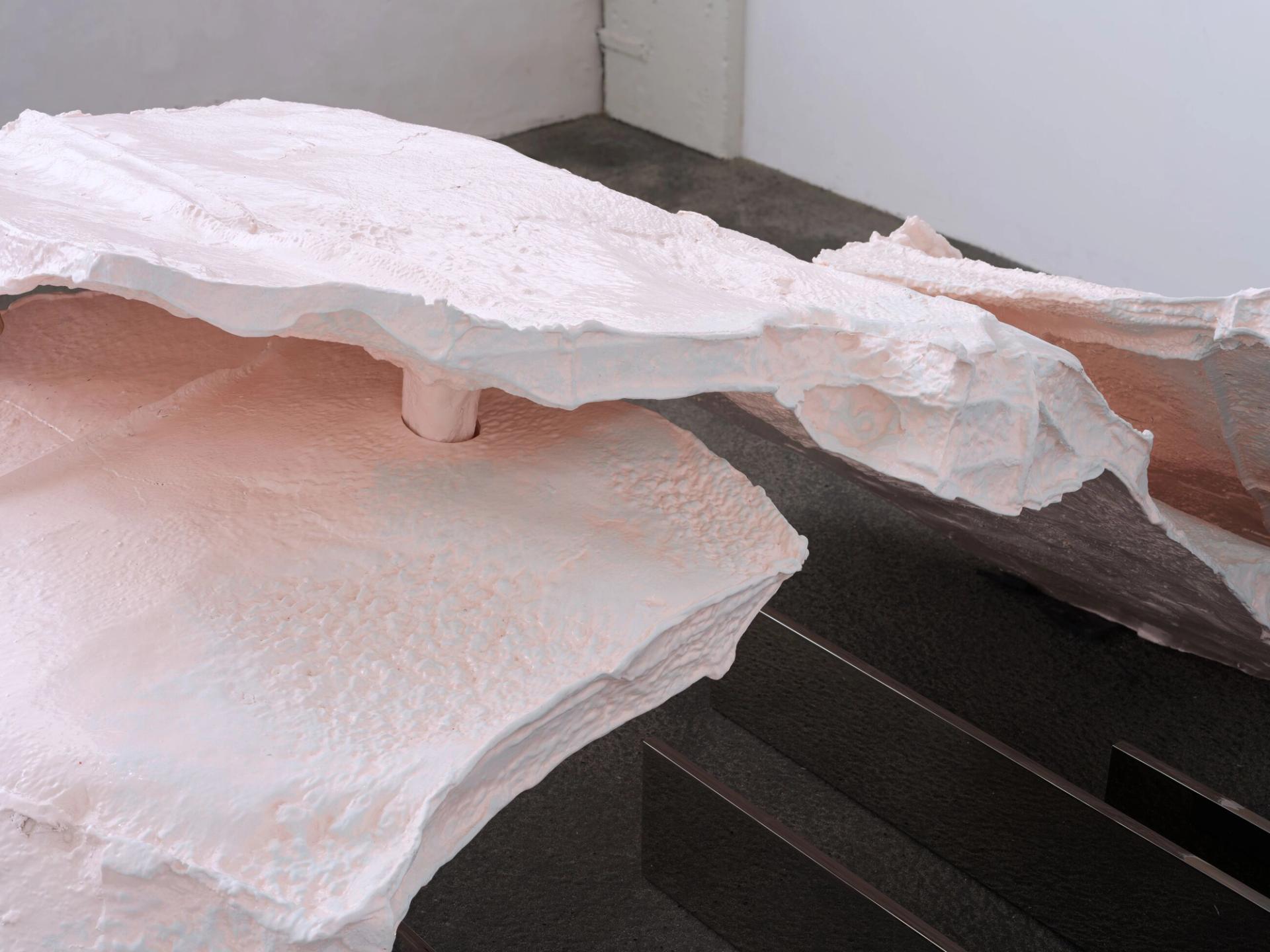
Bhaghramian’s cast aluminium, stainless steel and bronze Se ployant (givre) (2024). Like the artist’s Art Basel commission, the work is part of her Modèle vivant (life model) series, which she began in 2022 Photo: Nick Ash, © and courtesy of the artist
Here, I’m extending those sculptural steps and concerns into a public and architectural setting. The forms appear stacked or suspended, but they are also held in place by supporting armatures that become part of the work’s structure. In that sense, it connects very directly to earlier sculptures where support systems are never neutral; they are psychological and political as much as functional.
The title contains a linguistic tension too.
I think that ambiguity is a beautiful necessity. Language is never innocent, especially in French, where certain terms carry layered art-historical and bodily associations. I actually don’t speak French, and maybe that is precisely why I often use it to preserve the potential for ambiguity that language can carry.
Modèle vivant began for me as a sculptural thought: bodies transfer into bodies. Forms lean onto one another, support one another, interrupt one another or merge temporarily into composite structures. Modèle vivant invokes the live body posed for observation. S’empilant, meaning “stacking” or “piling up”, introduces another register: accumulation, compression, dependency, perhaps even exhaustion. It can be playful, but it can also suggest overcrowding. During the process, I often referred to the [sculptural elements] as bundles—like bundles of asparagus, flowers or wood—only in my case they were bundles of sculpture.
How does working on a project at this scale, which involves many people and processes, affect your practice?
The technical processes and traces of fabrication remain visible—the necessity of collaboration and mutual dependence becomes part of the work itself. I work with casters, metal workshops, installers and technicians, and I value those exchanges very much. I have continued working with a metal workshop run by two brothers, Arne and Steve Clemens, for decades, and a deep sense of trust and friendship evolved from that long-term collaboration. These kinds of sustained working relationships shape the work over time and become embedded within its production. But I definitely need most of the time to work in solitude in order to think clearly about form, proportion, detail, experiments, production and so on.
What changes is not necessarily the intimacy of the process. I try to preserve a certain immediacy, because in the process of making in the studio, and through close and intense collaboration with industrial workshops, chances and surprises arise that keep the work shifting and changing.
The installation remains in place only for the duration of Art Basel. Is that a source of regret?
Although the installation will remain there only briefly, it will carry an afterlife. Here, it proposes a sculptural experience for both the people of Basel and the international audience. In the end, it is about the essential condition of art: to be taken seriously, to carve out its own space, and to ask the viewer for time, to sit, to look and not merely to be entertained. Art can do more than that.
• Modèle vivant (S’empilant), Messeplatz, Basel, until 21 June