

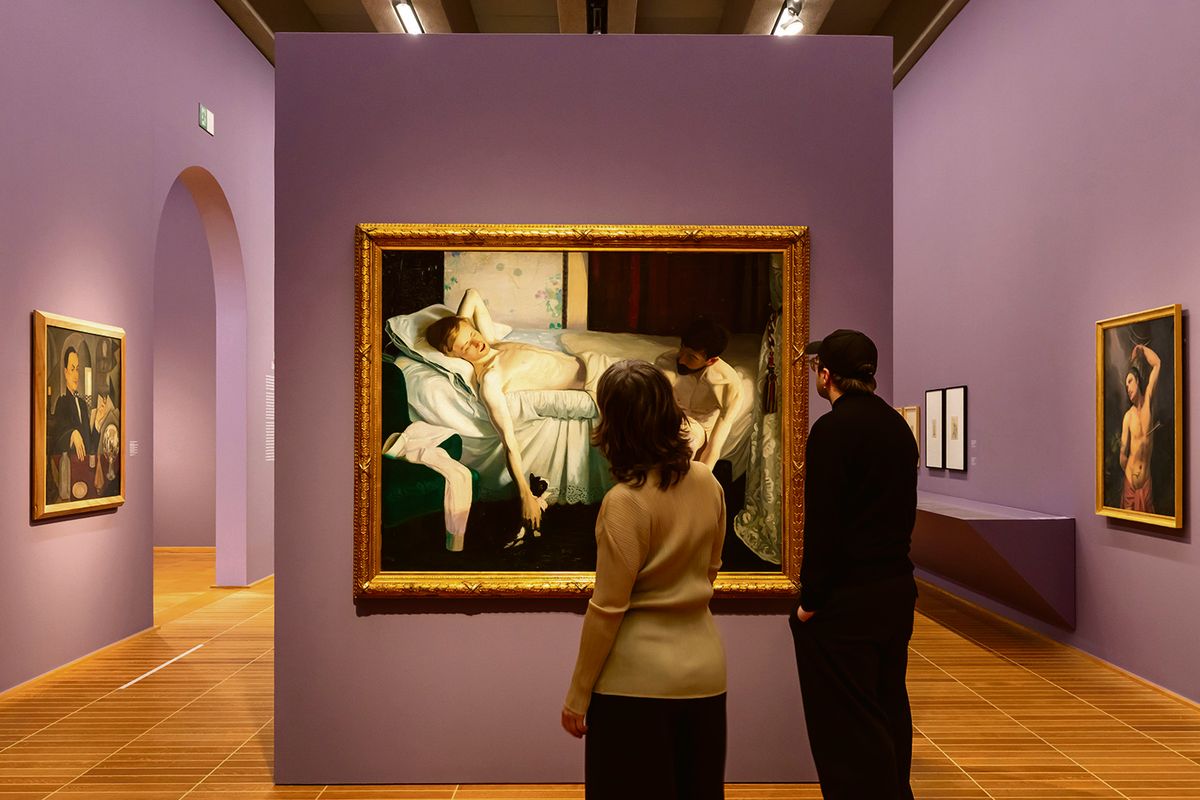
A sexual revolution quietly took place in 1869 when the word “homosexual” first appeared in print. The term, used in German by the Hungarian author Karl Maria Kertbeny in a letter to the German lawyer Karl Heinrich Ulrichs, is the starting point for The First Homosexuals: The Birth of New Identities 1869-1939 at the Kunstmuseum Basel.
Len Schaller, the co-curator, reiterates in the show guide that the term “homosexuality” emerged in a “Europe shaped by profound social and cultural upheaval”. Around 80 works made between 1869 and the outbreak of the Second World War shine a light on the early visibility of same-sex desire and gender diversity in the arts, adds Schaller, introducing visitors to artists and writers who openly grappled with homosexual and trans identities.
The show opened last year at Wrightwood 659 in Chicago but the iteration in Basel looks at Swiss artists more closely. For instance, while Naked Fishermen and Boys on the Green Shore (around 1900) by the German painter Ludwig von Hofmann or Interior with Hendrik Andersen and John Briggs Potter in Florence (1894) by the Norwegian American artist Andreas Andersen have homoerotic undertones, “around 30 years later, the Swiss painter and architect Paul Camenisch’s painting Bathers in the Breggia Gorge (1927) is more frank about the motif’s homosexual connotations,” says an exhibition statement.
• The First Homosexuals: The Birth of New Identities 1869–1939, Kunstmuseum Basel, until 2 August