

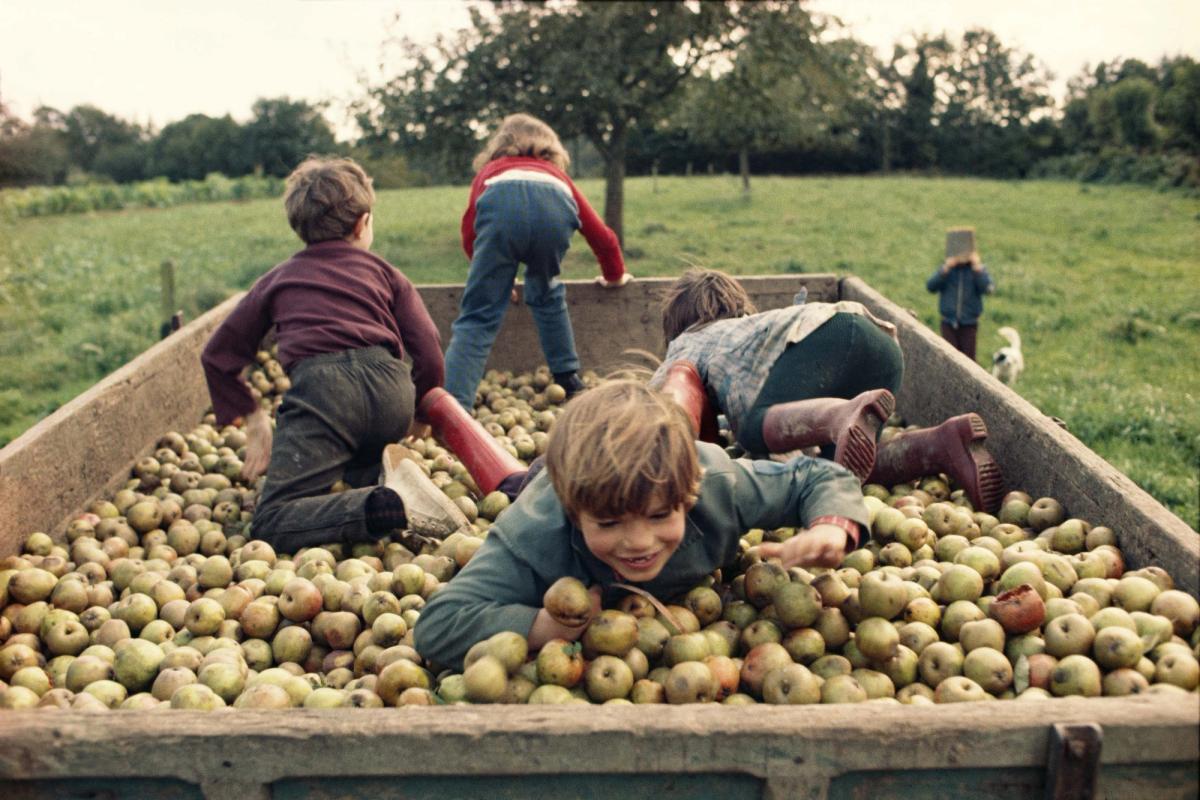
In 2020, the regional Centre d’art GwinZegal in Brittany, northwest France, put on a show dedicated to a French photographer hardly anyone had ever heard of. The centre’s artistic director, Jerôme Sother, had presented Madeleine de Sinéty’s work in startling numerical detail: 33,280 colour slides and 23,076 black-and-white negatives, taken between 1972 and 1982 in Poilley—a tiny village in northern France—by an artist who was already nearly 40, but who went on to work until her death in 2011, aged 77. That is an extraordinarily focused and prolific output by any measure. After Quentin Bajac, the director of the Jeu de Paume in Paris, saw the show, he thought: “There must be more”.
Bajac’s hunch has resulted in a chronological survey of De Sinéty’s wider oeuvre at the Jeu de Paume, which travels from the Château de Tours where it debuted in December last year. Working with De Sinéty’s son Peter, Bajac and Sother had a storage container of the photographer’s work shipped over from the US, where she lived from 1980, and got to work unpacking what they found. Most of it she had never herself had the time to go through. “Often, photographers reach a certain point in their career where, at 60, they’ll get an assistant to help them organise their work,” Sother says. “She never did. It’s as if she always felt this pressure to keep making work, not to stop to look at it.”
Focusing variously on urban gentrification (the Montparnasse neighbourhood of Paris and New York’s Meatpacking District in the 1970s), rural life (in northern France and in Maine) and labourers (steam railwaymen, farm labourers, greengrocers, butchers), De Sinéty homes in, with urgency and constancy, on things that are disappearing. At a time when black and white reigned supreme, she worked a lot in colour, the modernity of which the show duly highlights. “There is something so alive about her work,” Sother says, “which stems from her closeness to the people she was photographing: she lived with them, shared their lives, worked with them.”
Aristocratic family
De Sinéty was born in 1934, to an aristocratic family whose ancestral seat was the Chateau de Valmer in the Loire Valley. They fell on hard times and the castle burned down in 1948.
After studying applied arts in Paris in the 1950s, she embarked on what Sother describes as an “initiatory” road trip to Iraq with her first husband, the journalist François de Sainte Marie. They aimed to document the aftermath of the 1958 revolution. In travel shots, De Sinéty appears warmly wrapped in blankets in a Renault 4CV convertible amid the snow-covered mountains of central Europe. The French magazine Paris Match published several of their images.
She was trained in standard mid-century fashion illustration and only really connected with the wider photographic world, most notably Mary Ellen Mark, after moving to the US in 1980 with her second husband, the American journalist Daniel Behrman. On the occasion of one of the few exhibitions she did during her lifetime, in 2011 at the Portland Museum of Art in Maine, she said it was “people living simple lives, close to the earth” that had always drawn her in.
Jeu de Paume is showing several of her journals alongside her photographic work. She was a prolific writer with an elegant turn of phrase (always in French; her thick accent never left her either) and an almost anthropological attention to detail. Of that remarkable Poilley series, she wrote in 1996: “Through the inevitable tumult of modern life, this is the story of a relationship that has not fundamentally changed: that between the inhabitants of a small village, the land they work, and the livestock they rear.”
• Madeleine de Sinéty: A Life, Jeu de Paume, Paris, 12 June-27 September