

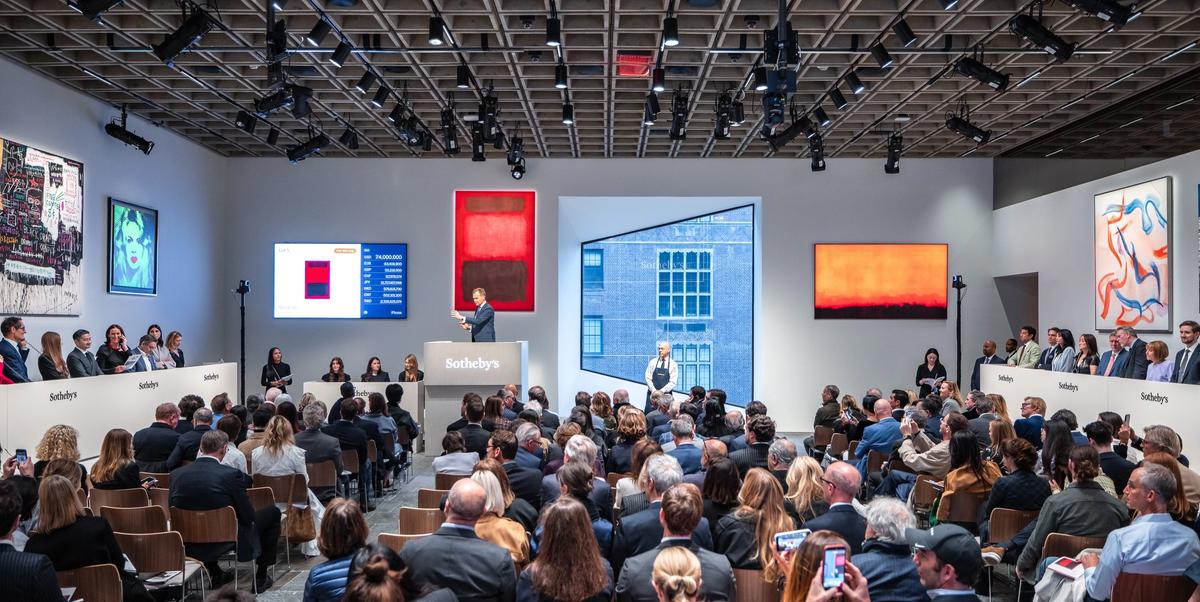
Are we entering a new, distinctive phase of the art market? After a couple of fallow years, during which wealthy collectors and their estates were reluctant to consign high-value works to auction, Sotheby’s and Christie’s offered a crop of Modern and classic contemporary trophies with prestigious provenances in their May series of marquee sales in New York.
Leading the season was Christie’s $450m consignment from the estate of the late media magnate S.I. Newhouse, from which two works were certain to sell for nine-figure prices, each backed by third-party guarantees. Jackson Pollock’s 1948 drip painting Number 7A and Constantin Brâncuși’s sculpture Danaïde (around 1913) both broke the canonised artists' auction records, with the Pollock selling for $181m (all totals include fees) and the Brâncuși for $108m.
At Sotheby's, Mark Rothko’s 1957 abstract Brown and Blacks in Reds, from the estate of the late New York dealer Robert Mnuchin, made $85.7m, again backed by a third party. At least 20 lots by big 20th-century names like Picasso, Mondrian, Twombly, De Kooning, Warhol, Lichtenstein, Basquiat and Richter were estimated at $30m or more at this latest season of New York auctions.
It would appear that the much-discussed multi-trillion Great Wealth Transfer of assets from one generation to another is in full swing. The grim reaper is freeing up blue-chip 20th-century trophies to reinvigorate the top end of the auction market. But what about the supply of younger, so-called “red-chip” 21st-century works that generated so much of the speculative energy in the market in the early 2020s?
Sotheby’s 45-lot The Now & Contemporary evening auction contained just two works by artists aged under 40. Christie’s equivalent 31-lot evening sale featured just one lot by an artist in that age group.
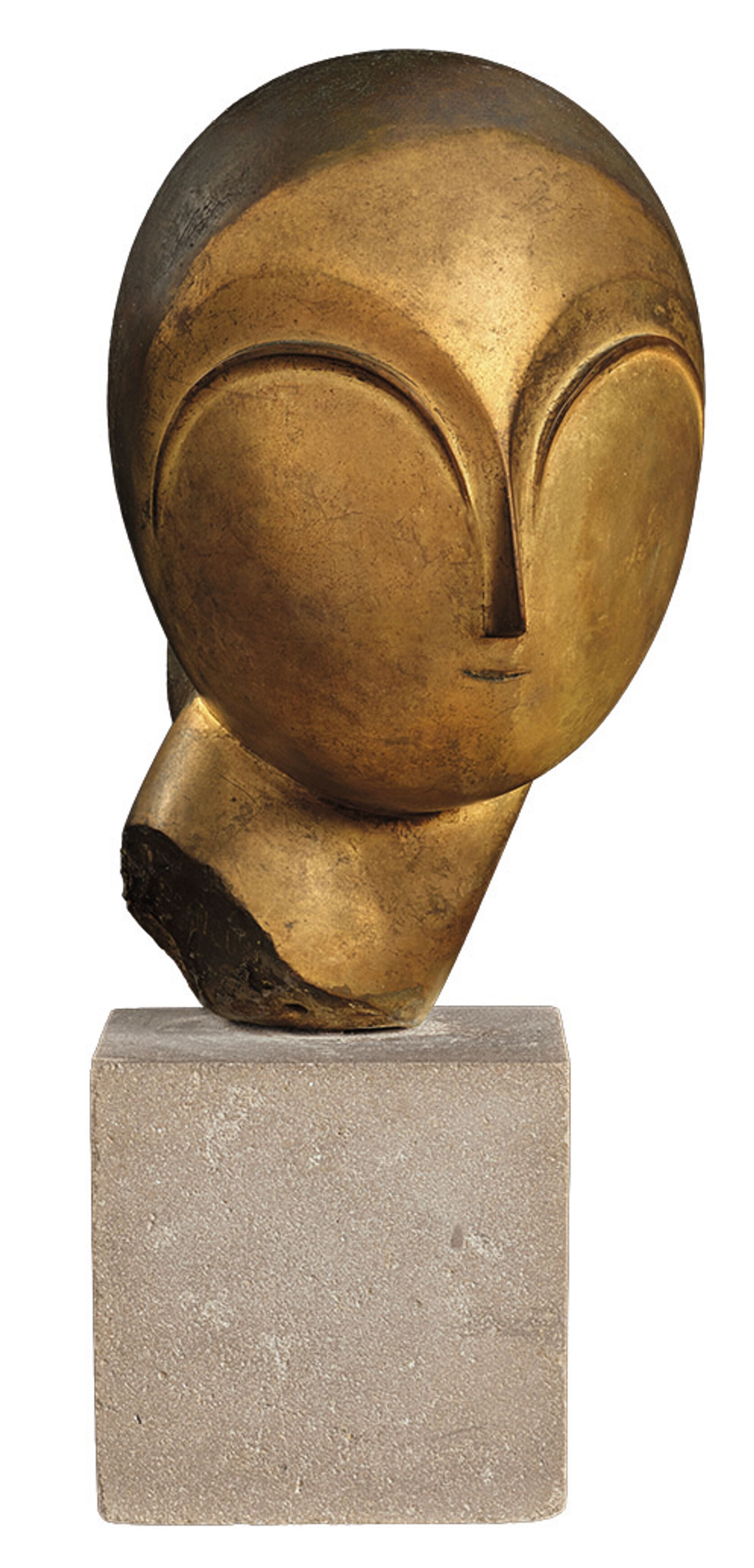
Brâncuși’s Danaïde was one of the key pieces in Christie’s New York auction in May © Succession Brancusi; courtesy of Christie’s Images
Even Phillips’s New York evening sale—which, in recent years, had become a favourite platform for speculators to profitably resell, or “flip”, works by fashionable young artists—had little to offer in terms of red-chips. Dinner, a 2019 painting by the market darling Anna Weyant, which sold for $980,400, was the lone entry from an under-40-year-old among Phillips’s 42 lots.
“Cutting-edge works suffer in a volatile economy,” says Matthew Stephenson, a London-based art adviser specialising in 20th-century and contemporary works. “There isn’t much on the market at the moment. The auction houses know they’re going to struggle with it.” He adds, “The market has gone back to blue-chip Modern and classic contemporary. The challenge is to find truly great examples. There’s such a dividend for the best of the 20th century. But there’s just a handful of buyers, and that generation is ageing.”
The most recent quarterly Contemporary Art Market Confidence Report for the US and Europe conducted by the London-based analysts ArtTactic, published in April, indicated yawning divergences in confidence levels not only between the secondary market for art (60 points out of 100) and general confidence in the economy (15), but also the secondary and primary market (45) for contemporary art. Based on survey responses from a relatively small sample of business insiders, the first divergence reflects the ever-widening gap in wealth between the asset-rich, art-owning (and art-selling) class and “ordinary” wage-earners. The latter reflects a surge in auction resales of contemporary art—mainly classic contemporary works made between 1950 and 2000—contrasting with a drop in demand for new works offered by galleries. Back in February 2022, the primary market confidence indicator was 91 points, slightly above that for the secondary market.
The speculative froth has been taken off the entire market, except for a few pocketsAlain Servais, collector
Eroding confidence
“The speculative froth has been taken off the entire art market, except a few pockets. The gap between primary and secondary is unmistakably visible,” says Alain Servais, a prominent Brussels-based contemporary art collector. “There is definitely a big transfer underlying the auctions. Many of my fellow collectors are looking to liquidate or at least reduce their collections,” adds Servais, who cites soaring storage costs as a key factor. “It ensures a steady flow of good quality material to auctions.”
For Servais and many other collectors, the widening gap between the prices
overhead-burdened galleries are asking for new works and the prices at which similar pieces by the same names can be acquired at auction is eroding confidence in the primary market for contemporary art.
“At Art Basel Hong Kong, I was recently offered a work by an artist with multiple museum solo exhibitions for $85,000. Just days earlier, I had acquired a comparable work by the same artist, with a better, earlier date, at Phillips for $5,000,” Servais says. “How can you build a growing market on such prices?”
Such out-of-kilter pricing, resulting from the onerous expense of running bricks-and-mortar spaces and participating in art fairs, has been blamed for the recent spate of gallery closures, culminating in the shuttering of the London- and New York-based Stephen Friedman Gallery in February.
And yet there still seems to be life in the contemporary primary market, if buyers feel works are not overpriced. In April, for instance, London’s Josh Lilley gallery held a sell-out show of 12 new paintings by the widely exhibited British figurative artist Nick Goss. The works, inspired by the legendarily louche Eel Pie Hotel on the River Thames, which was destroyed by fire in the 1970s, were pitched at £55,000 to £65,000, just slightly above the artist’s current auction high of £50,800, set last June.
“For quality artists who have built up a reputation and who continue to produce interesting work, the market for them feels robust,” says Lilley, commenting on his sixth solo show devoted to Goss. “But there are less people in the room. I’ve had a lot of advisers saying they’re concentrating on blue-chip and scaling back,” says Lilley.
If buyers turn away from today’s art in favour of the tried and trusted 20th-century names, where does this leave growth in the market? Where does that leave contemporary art and artists?
Wealthy collectors could of course pay higher and higher prices for the most desirable works by Picasso, Warhol, Rothko, De Kooning et al. But for how long can that kind of price expansion be sustained as the Boomer-generation buyers die off and their kind of art becomes less and less desirable and relateable to succeeding generations? Why pay $15m for a Warhol Brigitte Bardot silkscreen if you’ve never heard of Brigitte Bardot?
Certainly initiatives like LGD Hammer, the boutique auction platform set up in May by the top-end secondary market dealership Lévy Gorvy Dayan, suggest today’s wealthy are currently in no hurry to spend their millions on blue-chip 20th century art. The gallery hoped that by offering the 1984 De Kooning abstract, Milkmaid, estimated at $10m-$15m, for a limited time to a select group of competing clients, some urgency might be added to a lacklustre private sales trade.
A solo Banksy auction
LGD Hammer’s methodology was similar to Loïc Gouzer’s Fair Warning auctions of high-value single lots. This May, Gouzer sold for $18m Girl and Balloon on Found Landscape from Banksy’s 2012 Crude Oils series in a pop-up, invitation-only sale at Tiffany & Co’s flagship store in Manhattan. Outperformed its massive estimate of $13m, the eye-watering price only enhanced the irony of a modified chocolate-box painting by the world’s most famous outsider artist being auctioned in a gleaming temple to luxury consumerism.
On the other side of the Atlantic, a Banksy sculpture of a besuited marcher blinded by the flag he is waving and about to step into an abyss had suddenly popped up on a plinth in London’s Waterloo Place. Bronze statues of eminent British generals and explorers stand mutely nearby.
Banksy’s witty appropriation of totalitarian sculptural tropes—on 1 May, of all days—eloquently hinted at voters’ imminent lurch to the right in Britain’s local elections on 8 May—and other elections across the world. At the time of writing, around 100 smiling, photo-taking onlookers would be gathered near the statue at any time of day.
Gouzer, in an interview with Artnews, ranked Banksy as “the most consequential artist of our time”, presumably, in part, to justify the extremely consequential $13m estimate he had given his one and only auction lot.
As Gouzer acknowledged, Banksy is still regarded as a bit of a joke by the art establishment, which “has a problem with him”. But at a time when the market is desperate for “serious” people to pay serious amounts of money for serious works of art, Banksy’s flag-blinded marcher seemed one of the few contemporary artworks around that had something serious to say. And it was not for sale.