

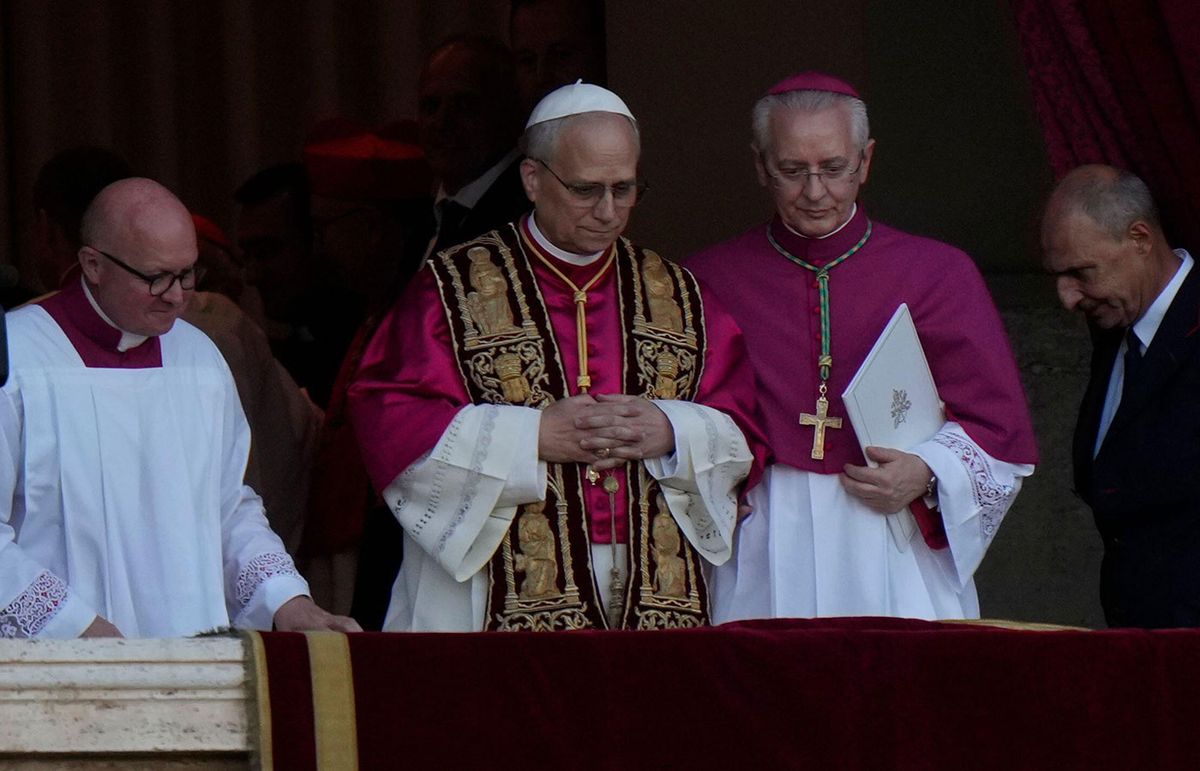
Pope Leo has warned that artificial intelligence is a major threat to humanity today, stressing that unchecked AI development could lead to a modern Tower of Babel, the biblical story invoking societal and moral collapse. In his first encyclical, a pastoral letter addressed to Catholic bishops, he also talks about the power of Picasso’s epic 1937 painting Guernica, which depicts the horrors of the Spanish Civil War.
“Disinformation did not begin with AI, yet today it finds a powerful amplifier in AI. The ability to manipulate content, images and videos exposes people to biased or misleading perspectives,” Pope Leo XIV wrote in the 43,000-word letter, entitled Magnifica Humanitas.
The open document is divided into five chapters and focuses on “safeguarding the human in the time of artificial intelligence”. In a section entitled “two biblical images”, he discusses “two scenes from the Bible: the construction of the Tower of Babel and the rebuilding of the walls of Jerusalem.”
He adds: “We must… avoid the ‘Babel syndrome’, namely the idolatry of profit that sacrifices the weak, a uniformity that neutralises differences, and the pretence that a single language—even a digital one—can translate everything, including the mystery of the person, into data and performance.”
"Artificial Intelligence now demands to be disarmed, freed from logics that turn it into an instrument of domination, exclusion and death," he says. More rigorous ethical codes subsequently need to be in place, argues the Pope. “It is not enough to invoke ethics in the abstract; robust legal frameworks, independent oversight, informed users and a political system that does not abdicate its responsibility are required.”
In a passage apparently aimed at tech giants such as Meta, he adds: “In many cases within the digital context, control over platforms, infrastructure, data and computing power does not rest with states, but with major economic and technological actors. These entities effectively set the conditions for access, determine the rules of visibility and shape the very possibilities for participation… moreover, ownership of data cannot be left solely in private hands but must be appropriately regulated.”
In a passage on finitude—a philosophical term for the limitations of human existence—Pope Leo says: “Authentic culture and art preserve this spark, resisting the normalization of evil. For this reason, certain works have taken on an almost prophetic significance: Beethoven’s Ninth Symphony can be seen as a desire for unity; Guernica as a denunciation of dehumanization; [the novel] Schindler’s List as a call not to consign the past to oblivion.”
The Vatican is meanwhile stepping up its contemporary art programme. Earlier this month, Cristiano Grisogoni, a representative of the Culture and Education dicastery at the Vatican, told The Art Newspaper. “We have so many projects—last year we opened a contemporary art space in front of La Basilica [at the Vatican] called Conciliazone 5 where we’re currently showing works by the British artist George Rouy.”
“Next year we will present works by other artists such as [the Chinese artist] Yan Pei-Ming and [the Swiss painter] Vivian Suter. Pope Leo XIV is following the path started with Pope Francis,” he added. The Vatican’s contemporary art programme is curated by Donatien Grau, head of contemporary art at the Musée du Louvre in Paris. The Holy See’s exhibition in Venice, featuring high-profile artists, poets and musicians such as Brian Eno, FKA Twigs and Precious Okoyomon, has also opened to critical acclaim.