

Two years ago, Poland’s entry for the 2024 Biennale caused a stir domestically after the original selection, a project by the artist Ignacy Czwartos, was cancelled by the incoming centrist government of Donald Tusk. Having viewed Czwartos’s work as being too closely aligned with the previous government’s nationalistic agenda, many working professionally in the art scene were delighted to see the Polish painter replaced with a video-based project by Ukraine’s Open Group collective.
This time around, the country’s entry—an audio-video installation by the Polish artists Bogna Burska and Daniel Kotowski—is less likely to cause such friction, with the more progressive side of the art scene currently coexisting more comfortably with Tusk’s coalition government than was the case under the previous regime.
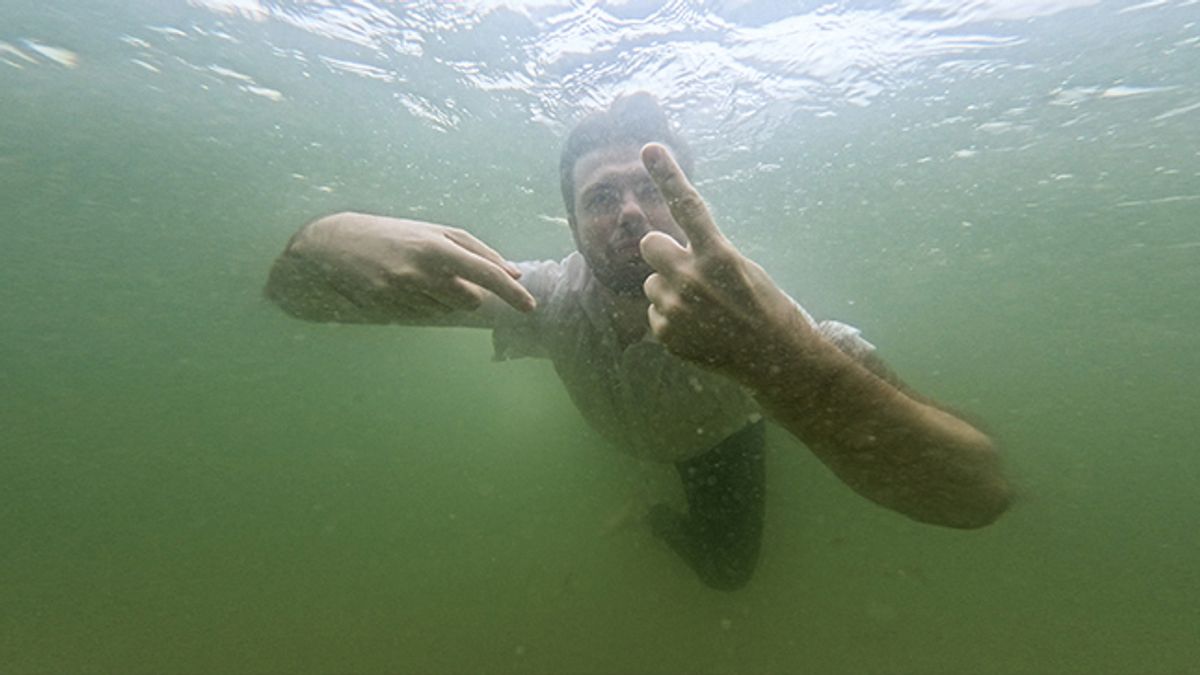
Created in close collaboration with the curators Ewa Chomicka and Jolanta Woszczenko, Liquid Tongues centres on a performance by the Chór w Ruchu (Choir in Motion) that includes both hearing and deaf performers, with much of the content recorded underwater in a Warsaw swimming pool. Presented across two screens, with one of those set to be suspended above the heads of visitors as they enter the Polish pavilion, early previews suggest audiences can expect a visually arresting and sonically charged production that takes inspiration from whale song to explore “alternative modes of communication”.
Liquid Tongues builds on a performance by the Choir in Motion the artists collaborated on at Warsaw’s Zachęta National Gallery of Art last year. Originally founded in 2014, the choir has a shifting membership that adapts to different projects, with Kotowski facilitating the inclusion of deaf performers for both the Zachęta performance and the Venice project. While the former featured a combination of spoken Polish and Polish Sign Language, Liquid Tongues uses spoken English and International Sign.
Burska and Kotowski sketched out some of the ideas developed in Liquid Tongues by filming underwater in the Baltic last summer, but felt the more controlled environment of an indoor swimming pool would be better suited to both the winter schedule and the number of participants involved in the production for Venice. Even so, the artists say that filming underwater still proved to be one of the most challenging parts of the production, with Burska noting that “lots of rehearsals” were required to understand the change in optics and the water’s “disorientating” effect.
Shooting at the pool over three days, Kotowski says that it was only after the performers had practised on land and the team “were fully sure they had everything ready and in place, technically and with the film crew” that they could proceed in the water. The artist, who is deaf himself, adds that the need to fine-tune the signed parts of the performance, as well as factors such as how deaf audiences would perceive the choir’s facial expressions, added an extra layer to control.
Beyond the practical considerations of the shoot, the concept of performing underwater plays an important role in the thinking behind the project, embracing a space where sign language retains its ability to communicate effectively while spoken speech becomes distorted and unreliable. Burska says that was noticeable on set where, even out of the water, the acoustics of the swimming pool left the hearing members of the team finding it harder to communicate than their deaf colleagues.
Liquid Tongues is also notable for the collaborative nature of the project, drawing on the skills of multiple participants and different disciplines. Alongside the choir and film crew, additional creative input comes from choreography by Alicja Czyczel and a choral and musical score by Aleksandra Gryka.
• Giardini