

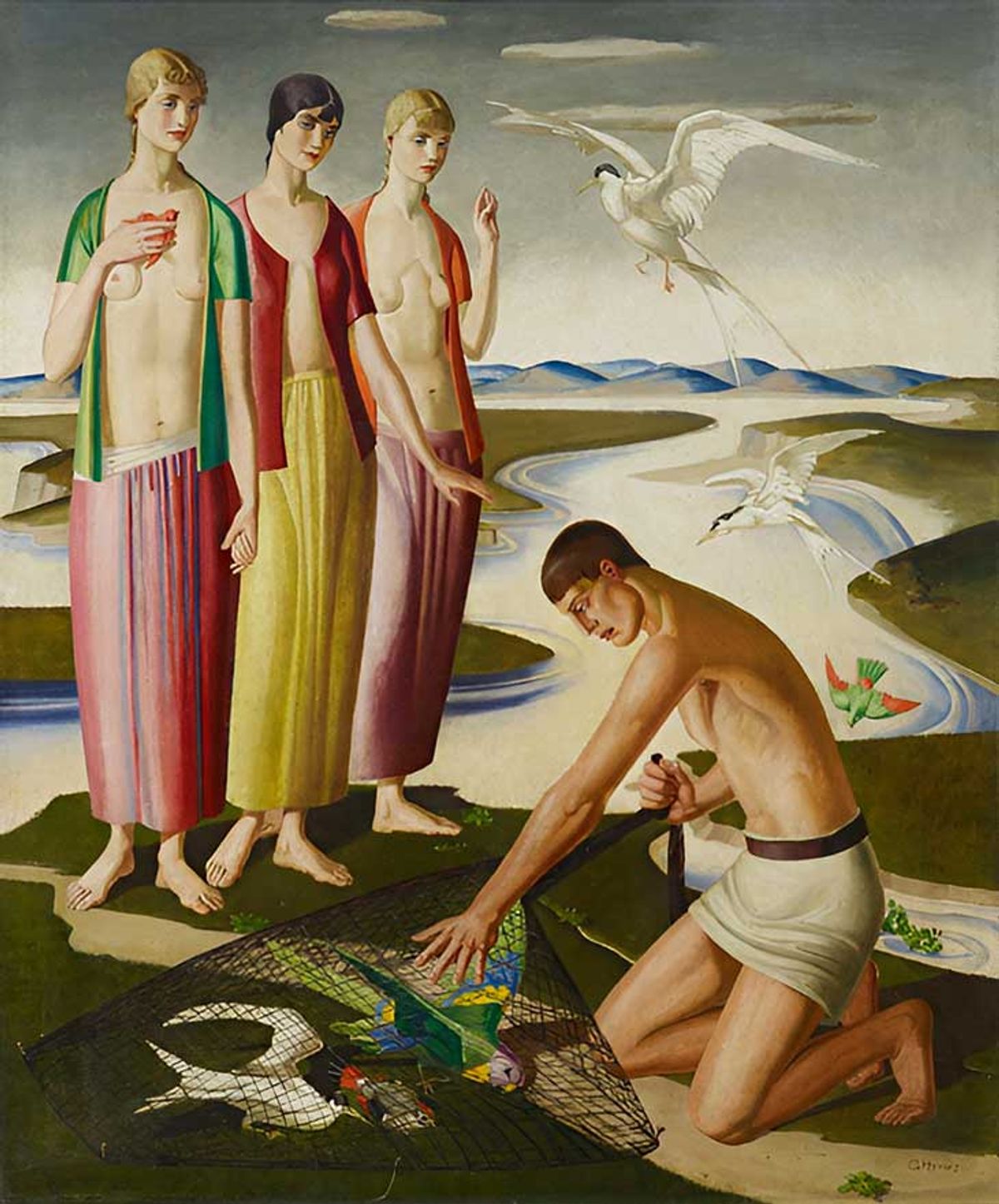
The exhibition Gladys Hynes: Radical Lives, opening this month at Charleston in Lewes, is a rescue mission for a forgotten artist. Commissioned by the Bloomsbury-focused gallery to fill a gap in the history of the group’s Omega Workshops, the show aims to resurrect the five-decade career of Gladys Hynes (1888-1958) a protean rebel slaloming through early 20th-century Britain’s avant-garde circles.
Born into an Anglo Irish family in India in 1888, the heyday of the British Raj, Hynes trained as a landscape and figure painter in Newlyn, Cornwall, with Stanhope Forbes, and in London with Frank Brangwyn and William Nicholson. Roger Fry recruited her to design for Omega. She caroused and argued with Wyndham Lewis and the Vorticists, while Ezra Pound commissioned her to illustrate a collectors’ edition of his Cantos. Hynes was a winner of multiple prizes and was chosen to represent Great Britain at the 1924 Venice Biennale.
A party girl, she mixed with the likes of Harold and Laura Knight, Dod Procter and Nina Hamnett. In Cornish landscapes and London society scenes she painted friends including the androgynous artist Gluck and the lesbian poet and novelist Radclyffe Hall. As an Irish nationalist, Hynes was close to the revolutionary politician and poet Desmond FitzGerald. She was a supporter of the Catholic Women’s Suffrage Society; marched for women’s political rights; painted Surrealist anti-war and anti-capitalist visions during the Second World War; and campaigned to defend Pound during his post-war imprisonment for treason.
Yet Hynes’s name is near enough absent from the published biographies and other histories of the period, and only one of her paintings is in a British public collection. Crucifixion (1939), held by London’s Royal Air Force Museum, is a memorial to her younger brother Patrick, who was killed in the First World War.
Her erasure “is a mystery”, says the show’s curator, Sacha Llewellyn. “She’s never been in any exhibition. I’ve spent my career writing about women artists who merit a rediscovery but Gladys Hynes takes it to a new level. She’s just completely non-existent.”
Antisemitic and racist tropes in some paintings may partly explain her eclipse, Llewellyn says. Still, she adds, “I don’t believe in cancellation culture, and I hope to open up a lot of interesting conversations about not only her politics but also the politics of the people she was involved with.”
“She was important enough to represent Britain at the Biennale and for Pound to commission her to illustrate his Cantos,” Llewellyn says. “Her work merits attention.”
Bringing together 120 paintings, drawings, graphic designs and sculptural pieces, the show will set 40 works by Hynes in a context of paintings by friends and collaborators. “A lot of detective work has gone into this,” Llewellyn says.
Four Hynes paintings, including The Fowler (around 1917-19) and a portrait of Hynes’s sister Sheelah by Dod Procter, have been loaned by the Wolfsonian in Florida, where the show will go on tour next year.
• Gladys Hynes: Radical Lives, Charleston, Lewes, 2 May-11 October