

I had one of the most joyous cultural experiences of my life in March. David Byrne, the former Talking Heads frontman, is touring with a show that features work from 50 years of songwriting while also reflecting his immersion in artforms including contemporary dance, and film and video installation. Byrne and his company’s thrill at presenting the material is so infectious that critics and audiences have greeted it with universal rapture.
And the singer is deeply invested in this emotion. In 2018, he founded a nonprofit, Arbutus, whose goal is “ensuring that our picture of the world contains the joy that it should”, notably via the online magazine Reasons to be Cheerful, a “tonic for tumultuous times”. This is not blinkered, idle positivity but investigative journalism that explores practical thinking and solutions to pressing issues. Indeed, I saw Byrne at a moment when the world’s issues seemed as pressing—and the times as tumultuous—as ever, with the escalation of war in the Middle East. It’s notable, though, that the euphoria which sweeps us along with Byrne in his show is a form of resistance: his performance includes, among much else, images of US immigration agents’ brutality and those who protest it.
Still reeling from Byrne’s concert, I saw two exhibitions that also addressed art’s capacity for joy as activism. David Hockney’s show at London’s Serpentine North, A Year in Normandie and Some Other Thoughts About Painting, is accompanied by a quote from the artist in which he acknowledges “an enormous amount of suffering” and states that he feels his “duty as an artist is to overcome and alleviate the sterility of despair”. Hockney’s conviction is embodied in his work’s exuberance and effervescence.
A queer pioneer
Another current London show counters despair with joy with particular vividness and poignancy. Catherine Opie’s three-decade portrait survey, To Be Seen, running at the National Portrait Gallery, exemplifies her conviction that “without representation there is no visibility”. She made portraits of the leather dyke community around her in Los Angeles in Being and Having (1991), one of her breakthrough series, because, as she has said, she felt that “I didn’t see myself represented in wider culture or society”. And that project transmits joy: against a bright yellow background, Opie presents her lesbian friends and herself—via her male-presenting alter ego Bo—in extreme close-up, severely cropped. They all don obviously fake facial hair. The atmosphere of the images, articulated both in the moustaches and beards and in the tight framing and Pop colour, is one of defiance but also play.
Even in the most arresting and unsettling image in the show, Self-Portrait/Cutting (1993), Opie finds unexpected levity amid despair. We see the artist’s bare back, onto which an image is inscribed with a blade: two stick figures, whose triangle skirts tell us that they are women, with a house and a sun appearing behind a cloud. Blood is swelling into drips that will soon run down her back.
Opie had just been through a breakup. As Shaun Caley Regen, Opie’s Los Angeles gallerist, has said, it is an image of longing, a seemingly unattainable ideal of queer domesticity amid a homophobic world. It was also confronting its audience with the moral panic about gay life and blood in the Aids crisis.
But, as Opie told me on the A brush with… podcast, in the photograph she positioned herself against the patterned wallpaper, a clear nod to the backgrounds in historical paintings, so that a basket of fruit sits above her. “There’s a Carmen Miranda moment,” she said. “There’s humour within that too… I might have had a broken heart and my friends were dying of Aids, but I decided to pick a fabric that had a big fruit basket over my head.” A defiant queerness is, as she said, “embedded within that imagery”.
Opie confronts prejudice
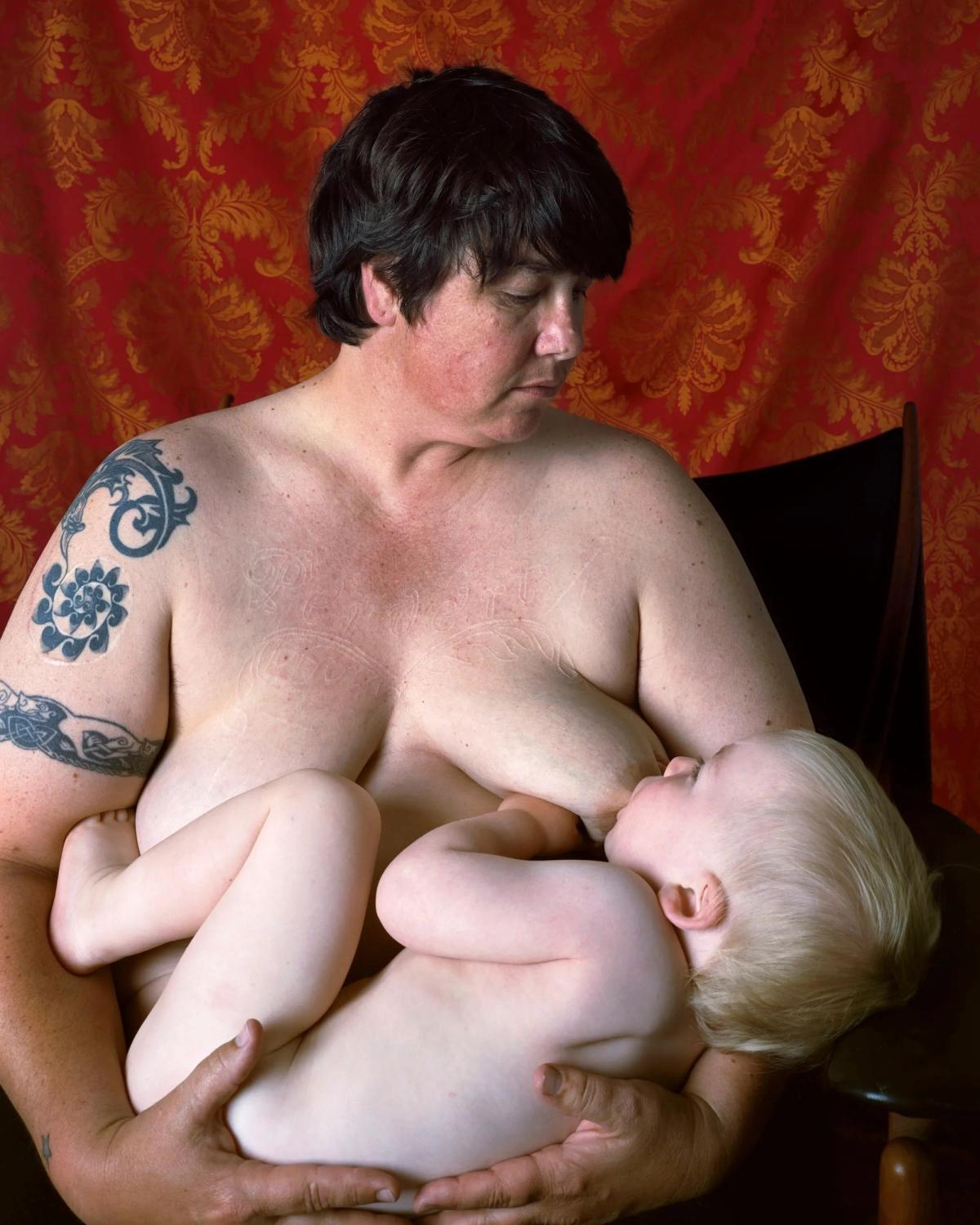
Opie’s exhibition is full of perfectly judged sightlines. Opposite Self-Portrait/Cutting, at the end of a long, narrow space, is another image of herself. In Self-Portrait/Nursing (2004), she breastfeeds her son Oliver, having finally achieved the happiness she has craved. On her chest, above his head, we see the ghostly trace of another painful inscription, where she had had “pervert” written on her chest by a body modifier. This was for another piece, Self-Portrait/Pervert (1994), in which she also wore a leather BDSM hood.
That piece confronted societal marginalisation and prejudice in brutal, still shocking terms. But its presence as a trace in an otherwise celebratory image of Opie’s motherhood is exquisitely touching. She proves that in the unflinching confrontation of conditions that otherwise might prompt despair, an
art of joy can be born.
• Catherine Opie: To Be Seen, National Portrait Gallery, London, until 31 May