

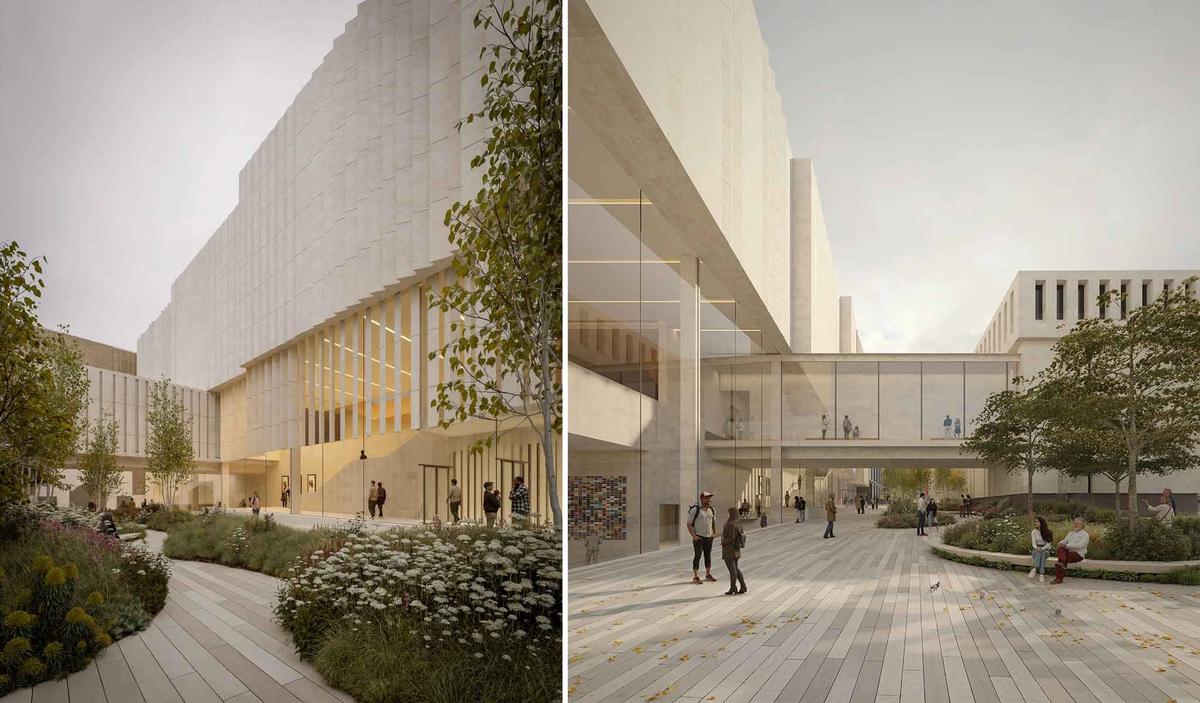
The National Gallery in London’s major new extension will be designed by the Japanese architects Kengo Kuma and Associates. The new building, costing an estimated £350m, is due to open in the early 2030s.
Kuma’s firm was among 65 architects which made a submission to a competition launched last September. Six were then shortlisted in December. They included New York-based Selldorf Architects, the designers behind the refurbishment of the gallery’s Sainsbury Wing.
Gabriele Finaldi, the National Gallery’s director, said in a statement that “Kengo Kuma’s trajectory as an architect demonstrates exceptional design elegance, a keen sensitivity to location and to history, and a supremely beautiful handling of light and of materials”. Two UK-based design companies will work with Kuma on the project: Building Design Partnership (BDP) and MICA.
The new extension, just to the north of the 1991 Sainsbury Wing, will be built on the site of St Vincent House, which is owned by the gallery and is due to be demolished. Light-coloured Portland stone will clad the exterior of the Kuma-designed building.
The new extension’s ground floor will be for public facilities and temporary exhibition galleries. Street-level access means that shows could, if desired, open for longer hours than the permanent collection.
Higher up, the main and the upper floors will provide space for a continuation of the permanent collection, with bridge links to the Sainsbury Wing and the Wilkins building. These two floors are expected to be hung with paintings from the late 19th century up to the present. Until recently, the National Gallery’s collection encompassed works made up until around 1900, but last year Finaldi announced a radical change to the gallery's acquisition strategy, which will see this cut-off extend to the present day. At the top level of the extension there will be a public roof garden, with views towards Leicester Square.
Architecturally, each of the floors will have a different atmosphere. The jury panel for the competition said about the Kuma plan in a statement: “The style of the galleries is very simple and clean, with a contrast between the main floor that incorporates vaults and arches, while the upper floor has a more geometric design. As a result, the main floor of galleries presents a continuum with the Sainsbury Wing and North [Wilkins] Galleries, but the upper floor has its own style, which adds variety and a change of design pace to the overall scheme.”
In terms of hanging space, the permanent collection will gain 1,500 sq m, which compares with 9,500 sq m across the original Wilkins building and the Sainsbury Wing—an increase of just over 15%.
For temporary exhibitions, the new ground floor gallery will have 800 sq m, which is nearly double the space of the Sainsbury Wing basement gallery, which has 450 sq m (there is also 240 sq m of temporary exhibition space in the Wilkins building). The National Gallery will therefore be able to mount much larger exhibitions or divide the space for smaller shows.
The Tokyo-based Kengo Kuma and Associates’ other museum projects include V&A Dundee, the Besançon Art Center in France, part of the Calouste Gulbenkian Foundation in Lisbon and a considerable number of buildings in Japan.
Kengo Kuma, the firm’s founder, said in a statement: “It is a privilege to join the National Gallery in this historic project. The National Gallery‘s collection is a treasure of humanity, and to be entrusted with the expansion that will hold these masterpieces is a responsibility we carry with the greatest care and humility.”
The new extension is the key element in a wider £750m National Gallery project, named Domani (“tomorrow” in Italian). This project will include a planned endowment fund which should enable the gallery to avoid financial deficits. The gallery recently embarked on a cost-cutting scheme, including a “voluntary exit scheme” for staff, to tackle a projected £8.2m deficit by 2026-27.