

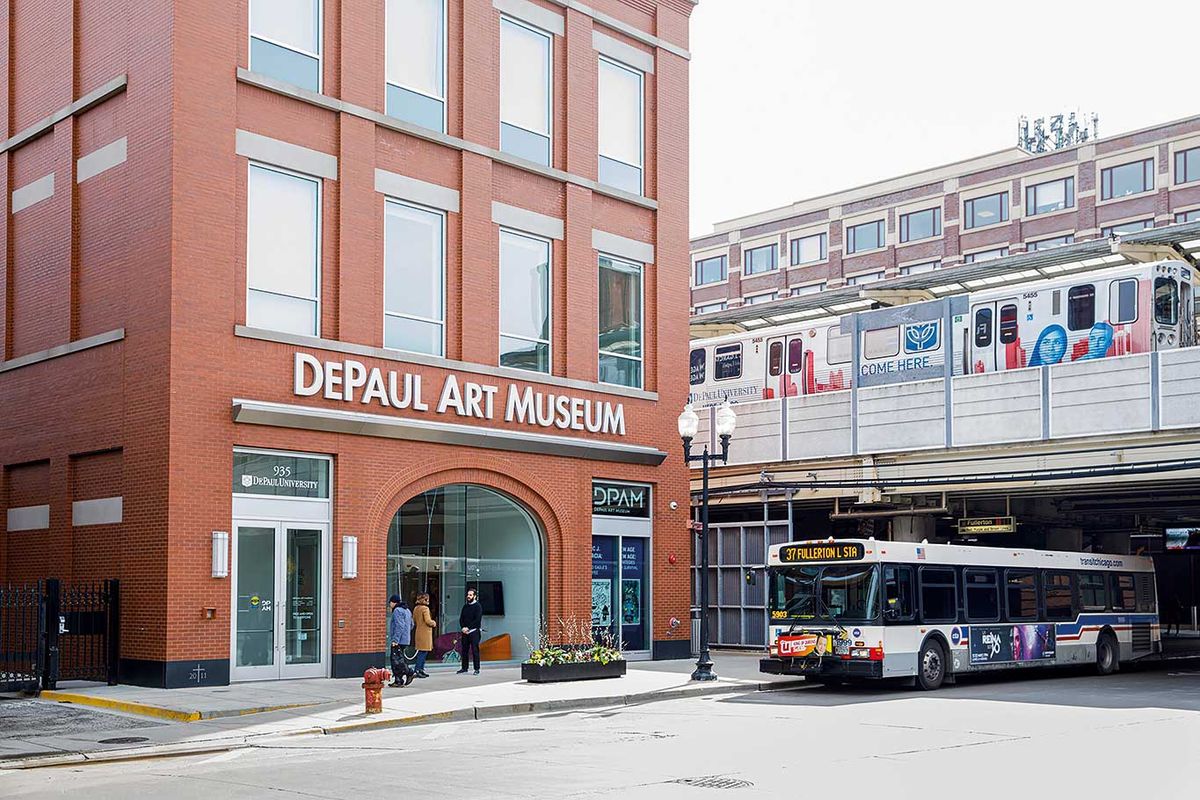
Within days of DePaul University’s announcement on 26 February that it will close its art museum, an open letter opposing the decision—initiated by students and faculty—had gathered more than 3,000 signatures. Regardless, the DePaul Art Museum (DPAM) in Lincoln Park is set to close on 30 June.
The museum was founded in 1985 and initially operated in a space carved out for it in the university’s library. In 2011, it moved into a new $7.8m, 15,350-sq.-ft, three-storey, Leadership in Energy and Environmental Design-certified building. It was an upgrade that signalled the university’s investment in visual art and created a cultural anchor on campus as well as for the community.
The museum’s closure comes after the university, projecting a significant budget deficit in 2026 and seeking to cut spending by $27.4m, laid off 114 staff members last December. Laura-Caroline de Lara, the DPAM’s director, knew that the museum was in peril and raised enough funds to hold on to its small staff and keep the doors open through June. This allowed it to follow through on exhibitions that were already planned and that the museum is contractually obligated to complete.
De Lara was hoping to demonstrate that the museum, which has raised a significant portion of its $745,000 annual budget each year, might find a way to survive on its own. So far, the administration has not wavered in its decision. “It is hard to fundraise if your parent organisation doesn’t have skin in the game,” De Lara says.
The museum’s former director, Julie Rodrigues Widholm, left Chicago in 2020 to direct the Berkeley Art Museum and Pacific Film Archive at the University of California, Berkeley. She says she understands the challenges facing higher education due to low enrolment, among other factors, but “what I find confusing is how closing the museum solves the problem”.
Widholm points out that having a museum on campus is a way to provide professional training as well as presenting important and challenging exhibitions. Students in DePaul’s museum studies programme, for instance, receive invaluable experience through internships and other training at DPAM.
The statement announcing the museum’s closure, by the private university’s president Robert L. Manuel, was titled “Reimagining the arts at DePaul University”. The open letter from students and faculty pointedly responded: “Leaving aside the Orwellian invitation to ‘re-imagine’ the arts by closing the building that houses them, it seems to us that those making the decision must not be fully aware of the multifaceted and widespread value that the DePaul Art Museum has for our academic community.” The open letter outlines the museum’s pedagogical and professional value and appeals to the school’s Vincentian Catholic history, considering the added dimension to campus life “that is a necessity, not a luxury, for an institution committed to its students’ flourishing as thoughtful, curious, imaginative, empathetic persons, in the Vincentian sense”.
The museum’s imminent closure is not the only decision by DePaul’s administration that has provoked pushback. The university also lost favour with preservationists for its plan to tear down four historic rowhouses to build a new athletic facility expected to cost upwards of $42m. Multiple sources interviewed for this article contrasted the decision to close DPAM with the university’s unwavering commitment to sports, suggesting that administrators do not appreciate the value of an academic art museum.
Closing the museum also raises questions about the fate of its collection, which contains around 4,000 works including paintings by artists important to Chicago such as Gertrude Abercrombie, Christina Ramberg, Julia Thecla, Leon Golub and Roger Brown. It also has a rich photography collection that includes works by Andy Warhol, Eugene Von Bruenchenhein, Bruce Davidson and Barbara Crane. There is also a large collection of works on paper that includes etchings by Tony Fitzpatrick, drawings by Martin Puryear and a large stash of vintage movie posters. As part of a multi-year Latinx initiative in 2020, the museum had recently added works by Yvette Mayorga, Edra Soto, Diana Solis and others to the collection.
“It can’t just be shoved in a closet, and it can’t just be scattered across the campus and put in offices,” De Lara says. “There are ethical ways that collections need to be handled.” Beyond logistics like climate control and public access, many of the works in the museum’s collection were donated with the understanding that the art could be seen and studied.
De Lara has been working closely with the president’s office to be sure the administration is informed about the best practices of collection care as well as helping it think through options that include transferring works to other institutions or supporting one staff position to maintain the collection. She adds: “They are getting a major crash course in museum collection management.”