

Historically, a nation could define its territorial sovereignty up to three nautical miles from shore—the shooting range of a cannon ball. Since then, accelerated technological development, advances in warfare and the globalisation of trade have caused this figure to increase to 12. For the artist Shahzia Sikander, these numbers go beyond physical distance and convey dominion, surveillance and access.
“This shifting coastal zone is a site where national authority can be asserted, contested and enforced,” says Sikander, whose latest animated film, 3 to 12 Nautical Miles, is screening on the digital façade of the M+ museum in Hong Kong until 21 June. Dissecting the nature and constitution of authority has long been a driving force in the artist’s practice. She is best known for her contemporary take on South Asian miniatures, fusing Mughal and Islamic motifs with current and historical cultural references.
Alongside drawing and painting, Sikander has been making animations since 2001. Laborious, hand-drawn processes remain integral to her work, which consists of making numerous drawings that are scanned upon each added layer of paint. Her work 3 to 12 Nautical Miles unfolds as a cinematic tableau composed of such drawings in ink and gouache, enlivening Sikander’s intricate imagery.
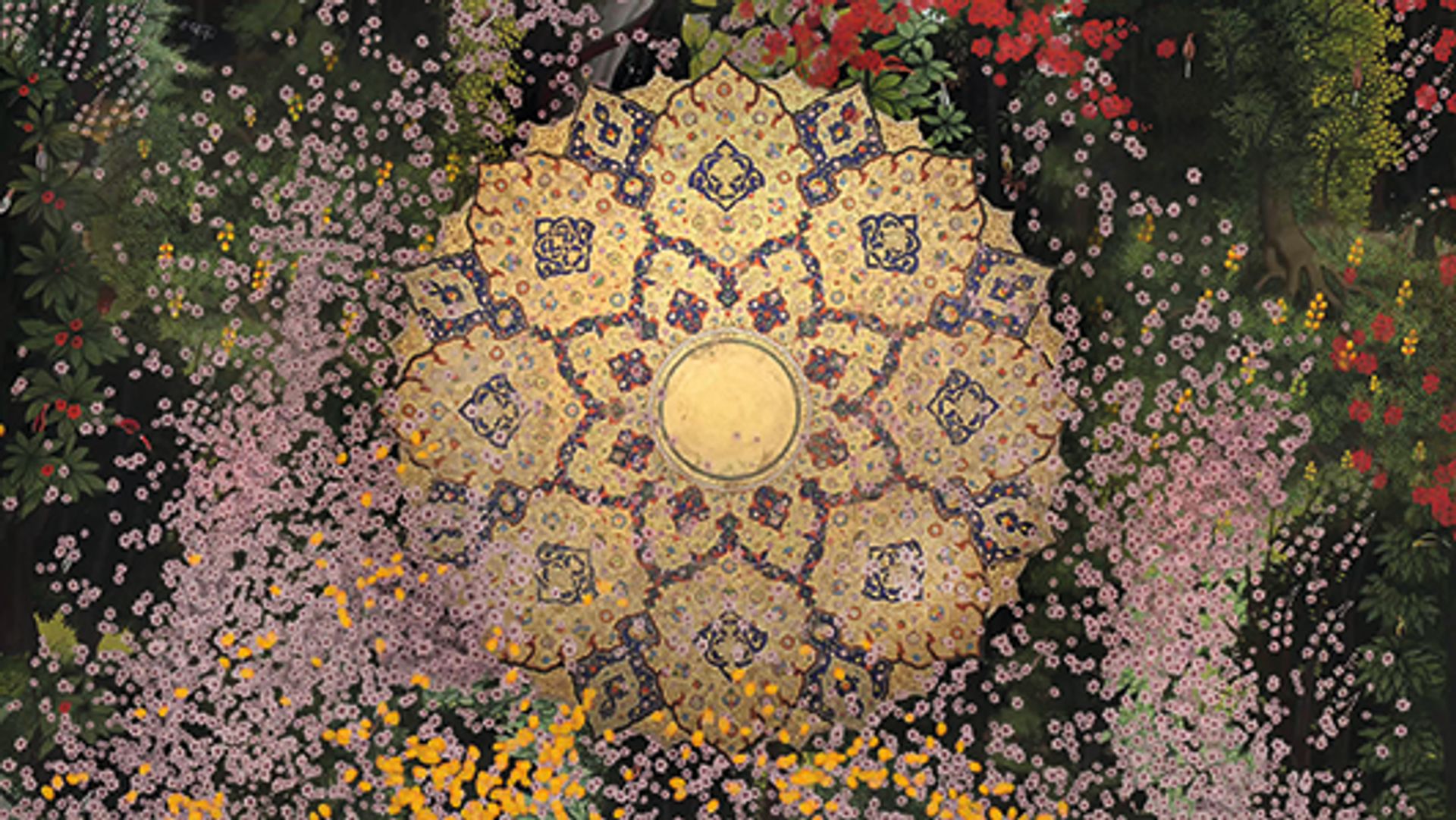
Another still from Sikander’s work, which is being shown on the M+ museum’s façade Courtesy of the artist
In the film, the artist uses the Opium Wars as a point of departure to delve into the interconnected histories of China, South Asia and the British East India Company (EIC). The armed conflicts in the 19th century between Western powers and China kickstarted a chain of events that weakened the latter’s might, forcing the country to legalise opium, open treaty ports to Western merchants and cede Hong Kong to the British Empire.
The film links the weakening of the Mughal Empire under Akbar II’s rule, the decline of the Qing dynasty in China and the rise of the EIC through the overlapping and layering of visual motifs.
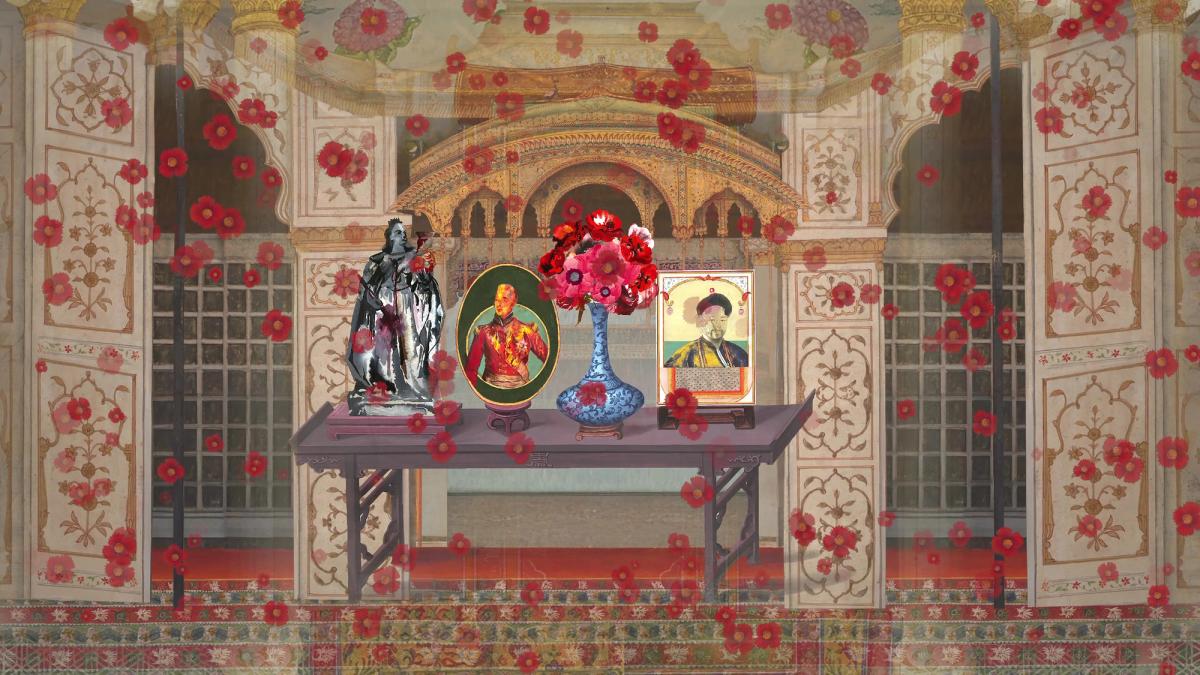
Poppies, for instance, appear in several scenes. As the source of opium, they allude to the dichotomies of pleasure and pain experienced through addiction. One still shows the flowers as a translucent wallpaper print projected over a table of framed portraits, including one of Lin Zexu, a Qing dynasty official and campaigner against the British drug trade whose never-delivered missive appealing directly to Queen Victoria might have prevented the Opium Wars. Meanwhile, a blue-and-white porcelain vase reminiscent of both Chinese and Islamic ceramics, with red poppies bursting from the vessel, while in the background, a Mughal-era throne appears to be fading away.
In another still, Queen Victoria is wearing layered pearl necklaces with maps of India and Hong Kong as pendants. “Vast geographies are rendered portable; extraction becomes adornment, conquest becomes refinement,” says Sikander, who frequently uses cartographic iconography in the film to signify dominion.
British naval prowess is another focus of the film. While Sikander was studying charts and maps at the Hong Kong Maritime Museum, she came across 19th-century Chinese trade paintings depicting small Chinese sampans and junks alongside massive British naval vessels. In her animation, this contrast in size serves as a visual metaphor for how collective acts were integral to the establishment of an extractive system.
The location of the M+ façade on the seafront evokes the themes of maritime sovereignty addressed in the film. “It’s precisely where land meets sea and culture meets commerce. Hong Kong is no longer a backdrop or case study, but a territorial threshold,” Sikander says.
• Shahzia Sikander: 3 to 12 Nautical Miles, M+ Digital Façade, Hong Kong,
until 21 June