

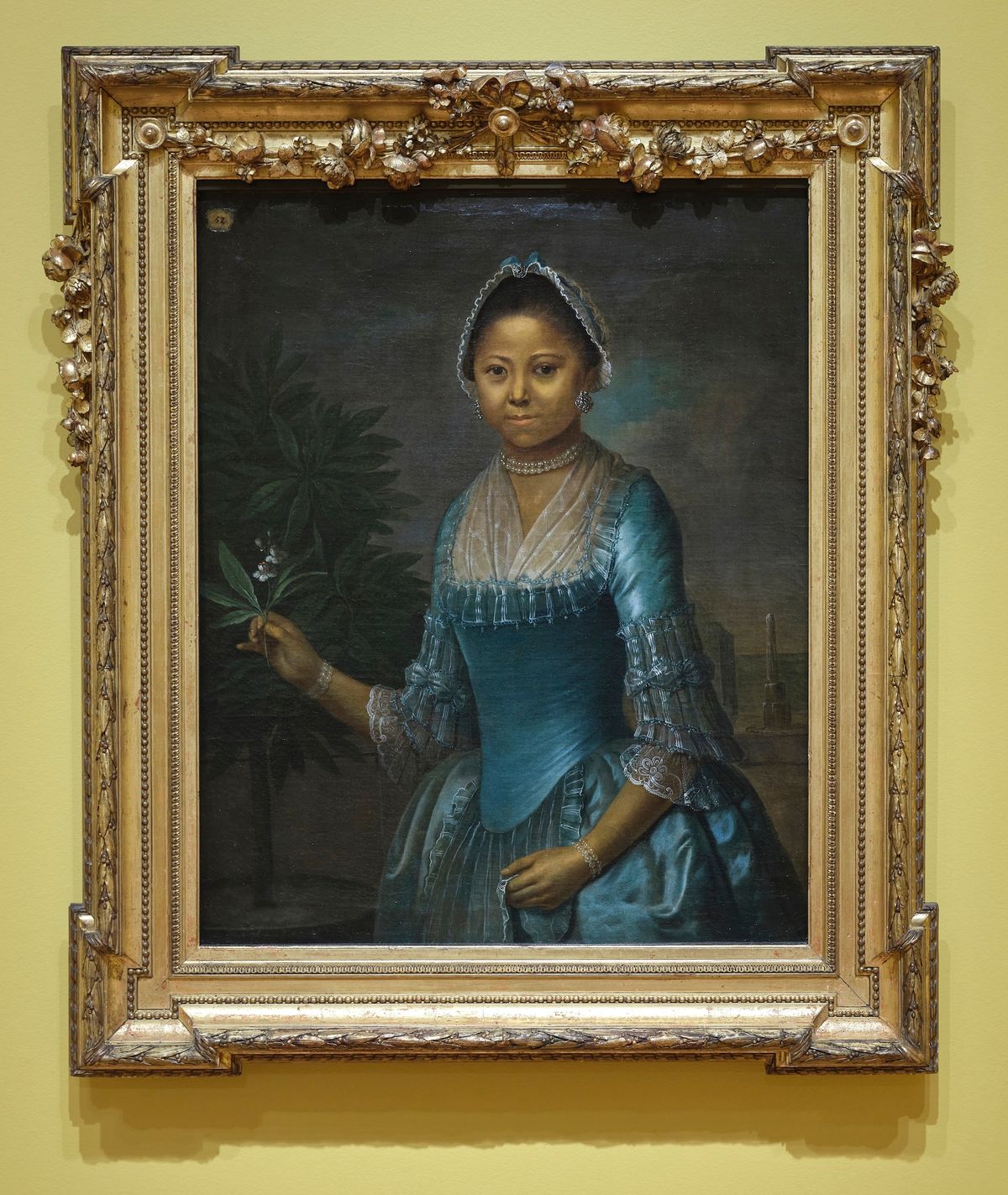
Both the painter and the sitter of a portrait of a young woman of colour purchased at auction by the Art Gallery of Ontario (AGO) in 2020 have finally been identified after lots of digging, a little luck and a reframing. The first name of the painting’s subject is Eleonora Susette (her last name remains unknown); she was born around 1756 in Berbice, a Dutch colony known for sugar and molasses in what is now Guyana. The artist is the Berlin-born artist Jeremias Schultz (1722-1800).
While still a teen, Eleonora Susette was enslaved and made to work alongside her mother for the colony’s governors. In the portrait she is elegantly dressed, sports fine jewellery and has a confident bearing. She holds an orange blossom, hence the painting’s former title, “Portrait of a Lady Holding an Orange Blossom”. Now that she has been identified, the piece has been retitled Portrait of Eleonora Susette (1775).
Trying to identify her and the painter posed a challenge for Adam Harris Levine, the AGO’s associate curator of European art, and Monique Johnson, the gallery’s former interim associate curator of European art. There was not much to go on, though there was a partial signature on the work—“J.Schul...fec”. Another work attributed to Schultz, this one of a young man of colour who is also elegantly outfitted, known as Portrait of a young man wearing a green jacket holding a cane, proved helpful in identifying Eleonora Susette. (That work is held in a private collection.)
After around a year of research, Johnson was able to identify the artist as Schultz, who was mainly active in the Netherlands and typically painted portraits of merchants of the then-thriving Dutch colonial empire. But from there research stalled, as relatively little is known about Schultz’s life and work, and the Dutch colonies were numerous and widely dispersed—numbering nearly 30 at the height of the empire.
“We were looking for two young people of colour who were living in Amsterdam in the 1770s and would have occasion to be painted by Jeremias Schultz,” Levine recently told the AGO’s in-house magazine, Foyer. “That, frankly, felt like a complete dead end to me.”
Even so, he and Johnson kept looking. “We tried many different theories,” he tells The Art Newspaper. “Then this incredible email came.” It was from a mother and her son in the Netherlands, with ties to the artist.
They wrote that a direct ancestor, Beata Louise Schultz, was the artist’s first cousin. Beata and her husband, who had been named governor of the colony, moved to Berbice in 1768. He died a few years later, in 1773, prompting her to return to Amsterdam with two enslaved people, one of them being Eleonora Susette.
Back in Amsterdam, she asked her cousin to paint portraits of her son and daughter, and also of Eleonora Susette and the man in the green jacket, named Michiel. Less than a year later, Eleonora Susette and Michiel were sent back to Berbice. Crisscrossing the Atlantic in those days was risky. “It would have been scary and dangerous,” Levine says.
He adds: “People have a deep affinity for the painting. Toronto is home to a large Caribbean community. It’s gotten a great buzz.”
As for the rest of Eleonora Susette's story, the curators’ research is ongoing. “It’s too bad if all we can share are the details up to her return to Berbice,” Levine says. “It feels like only part of the story. Research is still ongoing. I’ll feel even better when we can share the story in its fullness.”
Schultz’s portrait of Eleonora Susette is now on display, with its updated title and attribution, in gallery 123 on the AGO’s ground level.