

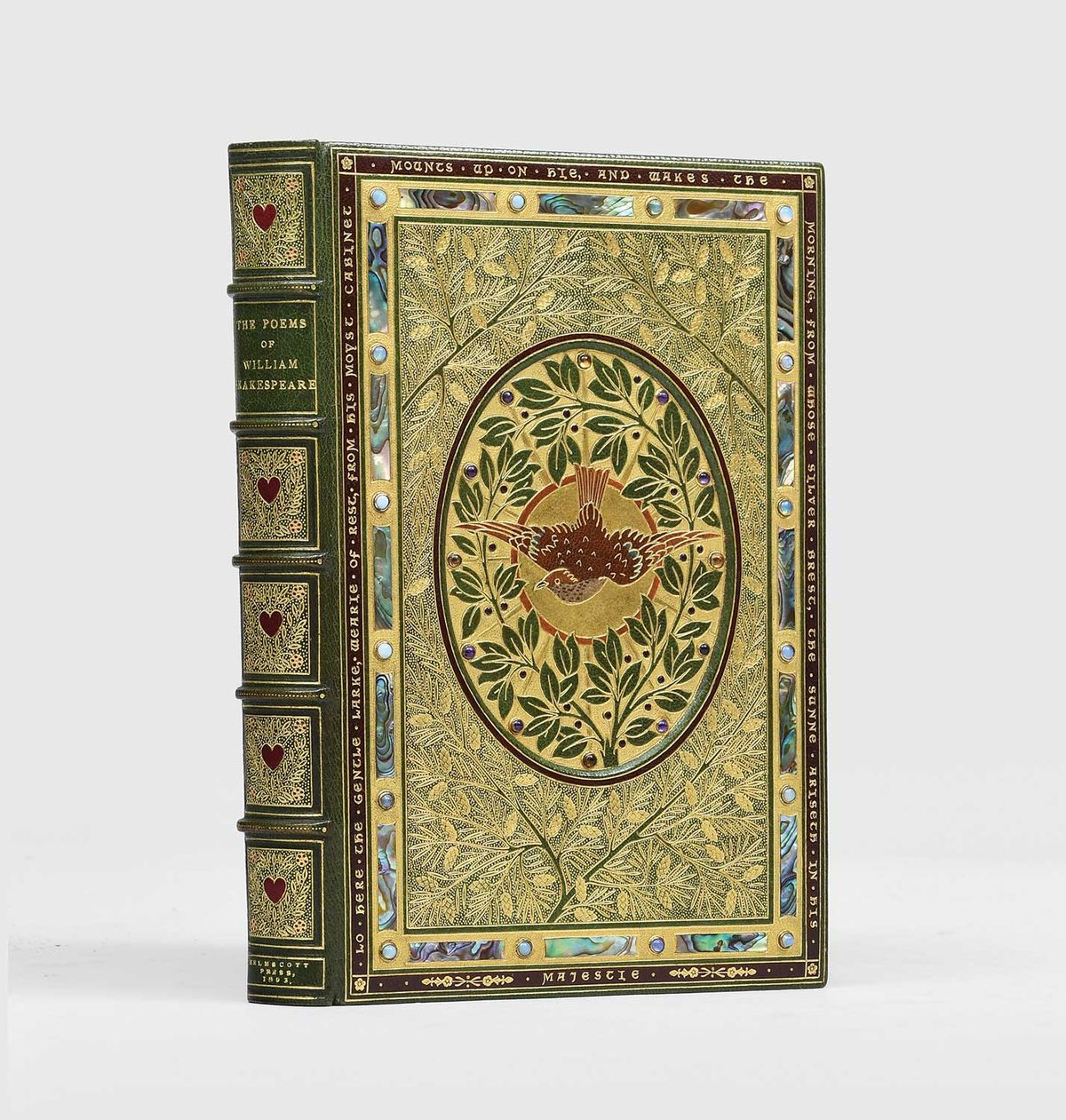
The Kelmscott Press and Sangorski and Sutcliffe, William Shakespeare’s The Poems (1893)
£125,000
Peter Harrington
This first edition book of Shakespearean poems was published by Kelmscott Press, the private press founded by the English designer and author William Morris in 1891. This example is covered in an opulent, bejewelled binding from the renowned London bookbinders Sangorski and Sutcliffe. The decoration, set with mother-of-pearl and more than 100 precious stones, takes inspiration from the sonnets inside. The inside back cover is tooled with gilt flowers—violets, roses, and lilies—mentioned in sonnet 99, while the inside front cover is adorned with hearts and cupid’s arrows for Shakespeare’s love poem, sonnet 116. The book is described as “a landmark of decorative book arts” by Emma Walshe, a rare books specialist at Peter Harrington. “Such bindings have been legendary since the loss of [Sangorski and Sutcliffe’s] ‘Great Omar’ that sank with the Titanic, and this example stands as one of the most ornate and ambitious surviving expressions of the bindery’s craft.”
Courtesy D Lan Galleries
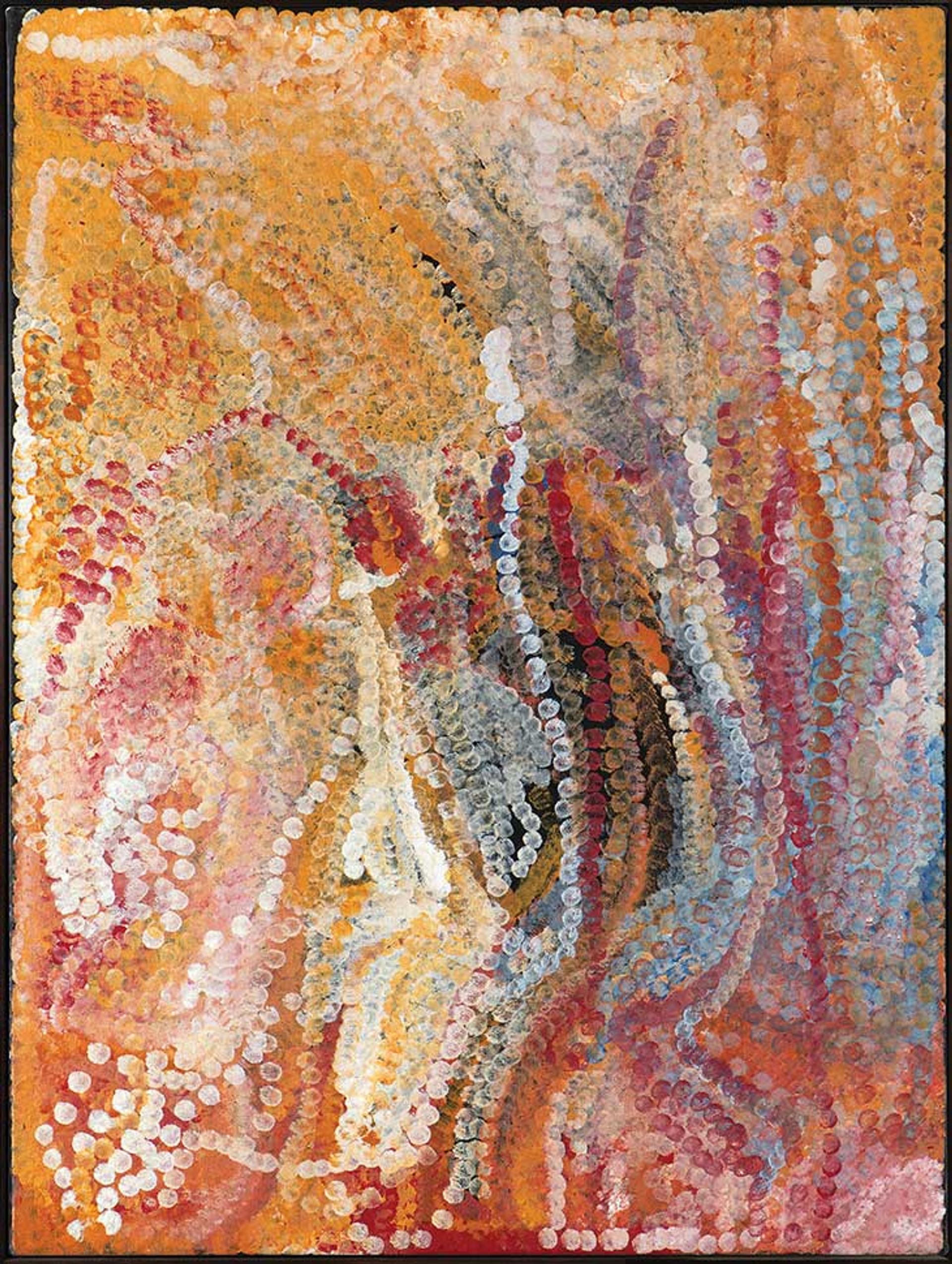
Emily Kam Kngwarray, Untitled—Winter Awelye (1995)
$380,000
D Lan Galleries
Market interest in contemporary Australian Indigenous art has soared recently, helped by acclaimed shows such as the travelling US exhibition The Stars We Do Not See: Australian Indigenous Art, which just closed in Washington, DC, and Tate Modern's recently closed survey on one of the best-known Australian Indigenous artists, Emily Kam Kngwarray (around 1914-96). Kngwarray, a member of the Anmatyerr people, holds the auction record for an Australian female artist and the second highest price for an Indigenous artist, for her work Earth's Creation I (1994), which sold for A$2.1m (around $1.5m) in 2017.
D Lan Galleries is bringing 13 “museum-quality works of art by artists who have shaped the trajectory of this dynamic art movement” from the 1970s to today, according to D’Lan Davidson, the gallery’s founder and director. These include this large-scale abstract work by Kngwarray, which is named after awely, the Anmatyerr term for women's songs and ceremonies. The work features Kngwarray’s signature painted dots but also demonstrates her transition into more linear compositions that captured Anwerlarr (pencil yam)—a native plant that holds great cultural significance. Winter Awelye was painted just a month before one of her most famous works, Anwerlarr anganenty (Big yam Dreaming), a monumental work in the collection of the National Gallery of Victoria, Melbourne.
Courtesy Galerie Van den Bruinhorst
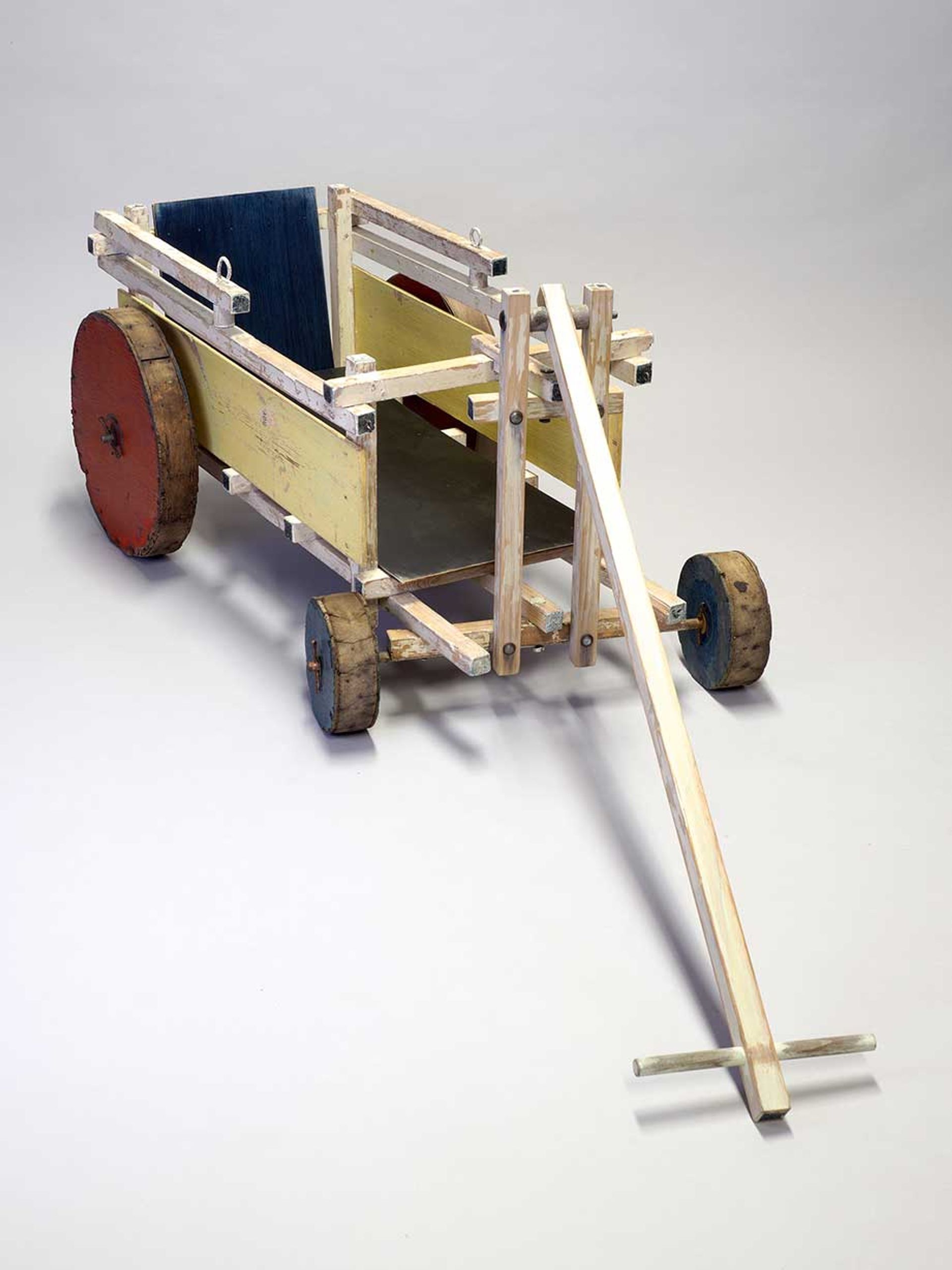
Gerrit Rietveld, Bolderwagen (beach buggy) (1920s)
€250,000-€300,000
Galerie Van den Bruinhorst
Galerie Van den Bruinhorst’s Tefaf stand is dedicated to the Dutch furniture designer and architect Gerrit Rietveld who, along with artists such as Piet Mondrian, was an important proponent of the De Stijl movement. The gallery’s presentation will show design objects from each decade of Rietveld’s career, including this beach buggy in the distinctive primary colours. It is one of only three pre-Second World War examples still in existence, another of which is in the collection of the Centraal Museum Utrecht. Newer versions can be found in Amsterdam’s Stedelijk Museum and London’s Victoria and Albert Museum.
According to the renowned Rietveld restorer Jurjen Creman, the buggy is one of the best documented Rietveld pieces he has come across, having been passed down through generations of the same Dutch family. At Tefaf, the gallery will show old photographs of the buggy being used for its intended purpose: to transport children to and from the beach. Luckily for its future owners, the buggy—made of pine and plywood—has since been carefully restored by Creman.
Courtesy Stair Sainty
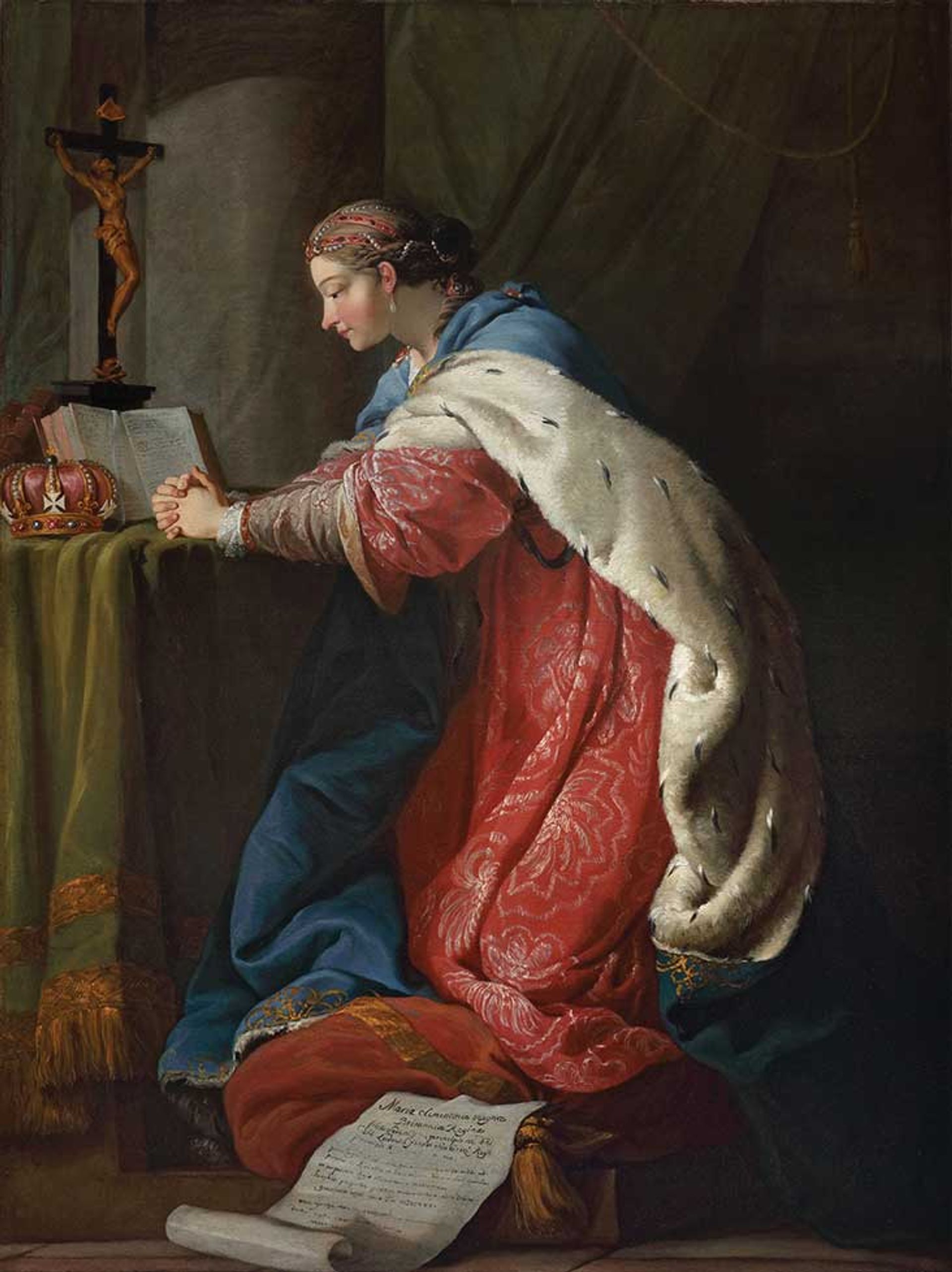
Pierre-Charles Trémolières, Portrait of Maria-Clementina Sobieska (1730)
Around £380,000
Stair Sainty
Stair Sainty is bringing to Tefaf a rediscovered portrait of Maria-Clementina Sobieska (1702-35) by the French artist Pierre Charles Trémolières. She was the granddaughter of Jan Sobieski, the King of Poland; titular Queen of England, Scotland and Ireland through her marriage to the Jacobite pretender James Francis Edward Stuart; and the mother of the ill-fated Bonnie Prince Charlie. “There are many engravings showing [Sobieska’s] image but painted portraits are rare,” says the dealer Guy Stair Sainty. “There are superb portraits of her husband and sons in the [British] Royal Collection but only prints with her image.”
This work, painted towards the end of Sobieska's short life, shows the noblewoman praying with a crown laid on the altar, a symbol of her giving up her royal status to devote herself to her faith. Beside her is a letter in Latin that names her and denotes the painting as a grateful monument to her “royal munificence”, indicating that it was made for a library to which she donated works.
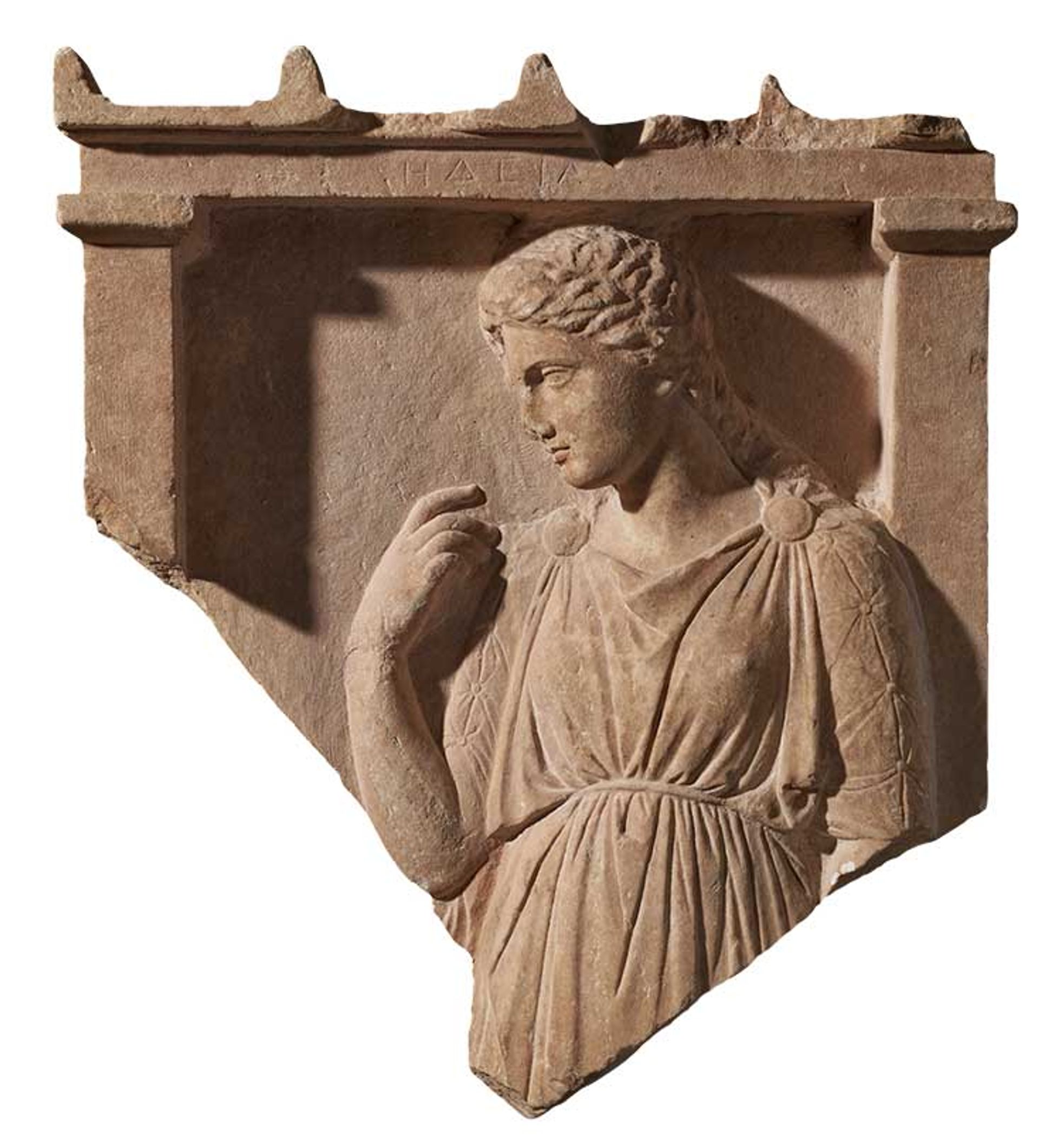
Courtesy David Aaron
Stele of Medeia, Greek, Attic (around 375BC-350BC)
£450,000
David Aaron
This carved marble headstone depicts a parthenos (young unmarried woman), signified by her particular dress, and her name: Medeia. Parthenoi held an important status in ancient Greek society, seen as no longer children but not yet wives and mothers. The art historian Linda Jones Roccos proposed in her research on the subject that the death of a parthenos was mourned as both a personal and societal loss, given that the young woman would not bear children to further the Athenian cause. Once broken into three parts, the stele has been put back together and restored. “The Stele of Medeia is exceptionally rare—a museum-quality monument whose beauty is matched only by its cultural significance,” says Salomon Aaron, the director of David Aaron gallery. “The piece also comes with distinguished provenance having previously been owned by the Athenian art dealer Theodoros A. Zoumboulakis and the renowned Brummer family, who operated art galleries in Paris and New York during the 20th century.”